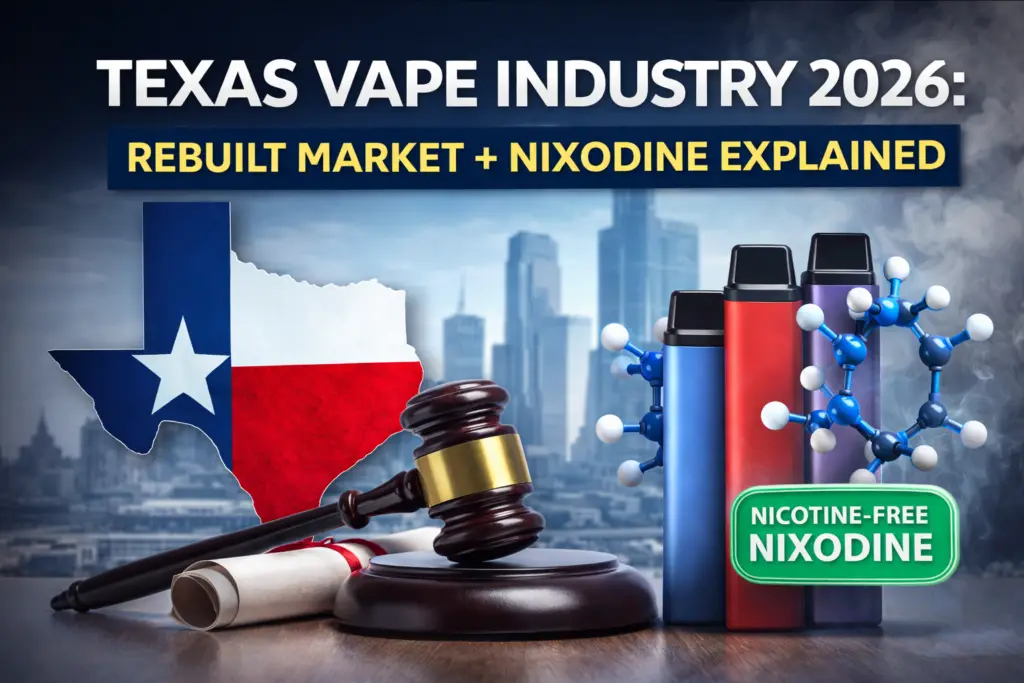
The Texas Vape Industry in 2026: A Market Rebuilt From the Ground Up — Plus What Nixodine Really Is
SB 2024 didn’t just remove products from Texas shelves. It reshuffled an entire supply chain, created new winners and losers, and opened the door to a genuinely novel category: nicotine alternatives. This is the full picture of what happened, what’s happening now, and where Nixodine fits into it all.
Part I: The Texas Vape Industry — A Market Under Pressure Since 2024
How Texas got here: two waves of regulation
The Texas vape market did not change overnight. It changed in two distinct waves, each one tightening the screws further.
The first wave hit January 1, 2024, when a state packaging law took effect under the Protecting Children From Electronic Cigarette Advertising Act. It banned the sale of vape products in packaging depicting cartoon characters, celebrity images, candy or food imagery, and trademarks that mimicked products marketed to minors. On paper, that sounded narrow. In practice, it disqualified dozens of popular brand designs — fruit illustrations, colorful mascots, pop-culture tie-ins — that had been the visual language of the disposable vape category for years. Retailers scrambled to audit shelves. Wholesalers pulled designs. The message from Austin was clear: the era of candy-colored vape marketing was over in Texas.
The second and far more disruptive wave came with Senate Bill 2024, signed by Governor Greg Abbott on June 20, 2025, enforceable from September 1, 2025. This law didn’t just clean up packaging. It fundamentally restructured which products could legally exist in the Texas market at all.
What SB 2024 actually bans — and the critical nuance everyone gets wrong
The law contains four prohibition categories. Three of them are straightforward. The fourth — the foreign manufacturing ban — is the source of tremendous confusion in the market, and getting it wrong has real legal consequences.
The four prohibitions: (1) Products whose e-liquid is manufactured in China or other U.S.-designated foreign adversary nations. (2) Products containing cannabinoids including THC, Delta-8, THCA, CBD, as well as kratom, kava, mushrooms, alcohol, or tianeptine — except for products authorized under the Texas Compassionate Use Program (TCUP). (3) Products in packaging that depicts cartoon characters, celebrity likenesses, candy/food imagery, or trade dress mimicking products marketed to minors. (4) Products designed to resemble non-vape objects — pens, highlighters, USBs, phones, smartwatches, headphones, cosmetics, toys, and clothing.
SB 2024’s foreign manufacturing ban applies specifically to the consumable liquid — not the hardware. The statutory definition of “e-cigarette product” covers the aerosolizable liquid or material. That means a device assembled in Shenzhen with Chinese-manufactured hardware, but filled in the United States with domestic e-liquid, is technically compliant under the current text of the law. A package label that says “Made in China” on the hardware does not automatically constitute a violation. Compliance is determined by the origin of the liquid. Retailers should still request written documentation from distributors confirming liquid origin.
The market shock: who got wiped out, who got a runway
For most of the major Chinese disposable brands, SB 2024 was effectively a market death sentence in Texas. Geek Bar — one of the highest-volume disposable brands in the U.S. — was hit hard. Most Geek Bar models are manufactured and filled in China, which means both the hardware and liquid are Chinese-origin. Under SB 2024, those products cannot legally be sold in Texas. That eliminated one of the best-selling product lines from one of the most populous states in the country.
Similar outcomes awaited other Chinese-manufactured disposable lines that hadn’t pivoted supply chains. The scale of removal was significant: the majority of disposable vapes sold in the U.S. are produced in China, and Texas had just banned their liquids.
The disruption hit hemp shops and smoke shops particularly hard. In the weeks after September 1, retailers across Austin, Dallas, Houston, and San Antonio reported frantic re-ordering as familiar SKUs disappeared. Meanwhile, a small set of brands found themselves positioned to benefit from exactly the chaos their competitors were suffering.
 Shop Geek Bar at VapeOwls
The hemp vape market collapse inside Texas
For the hemp and cannabis vape segment, SB 2024 was arguably even more disruptive than for nicotine disposables, and far more politically charged. Hemp-derived cannabinoid vapes — including Delta-8, THCA, and CBD vapes — are now completely banned from Texas retail sale, with the sole exception of products prescribed under the Texas Compassionate Use Program. The TCUP effectively creates a small authorized oligopoly on cannabinoid vapes, limited to licensed dispensaries for registered patients.
The political backstory matters here. SB 2024 was authored by Senator Charles Perry — the same senator behind the much more sweeping SB 3, which sought a total ban on hemp-derived THC products across Texas. SB 3 was vetoed after significant industry and consumer pushback. SB 2024, which moved more quietly through the legislature, accomplished a partial version of the same goal: removing hemp vapes from every retail surface in the state.
The legal distinction SB 2024 creates is notable: it bans the sale and marketing of cannabinoid vapes by businesses, not possession by consumers. An adult Texan can legally possess a hemp-derived THC vape purchased from an out-of-state online retailer. But no Texas-based store can legally stock or sell it.
For retailers: Selling cannabinoid vapes in Texas after September 1, 2025 is a Class A misdemeanor — up to $4,000 in fines and 1 year in jail per offense.
The next wave: HB 3772 and SB 1182 on the horizon
SB 2024 is not the end of Texas vape regulation. Two additional bills advancing in the Texas legislature in 2025–2026 would extend the regulatory reach further:
HB 3772 would create a state-level registry and certification system for all nicotine-containing e-cigarettes. Manufacturers would be required to certify their products with the state, pay registration fees, and comply with all applicable FDA regulations. This would effectively condition Texas retail legality on FDA PMTA authorization status, removing the large grey market of unauthorized but tolerated products.
SB 1182 proposes a statewide ban on flavored tobacco products including flavored e-cigarettes and menthol, following in the path of California, New York, and New Jersey. If enacted, it would override one of SB 2024’s implicit protections — namely, that U.S.-made flavored e-liquid remains legal even under current law.
What this means for retailers and wholesalers: The Texas regulatory environment is not stable. Businesses investing in compliant inventory should treat SB 2024 compliance as a floor, not a ceiling. Products that are legal today under SB 2024 may face new restrictions under HB 3772 if they lack PMTA status.
The “Made in America” rebranding wave
Texas’s law intersected with two broader national forces: FDA enforcement actions including federal seizures of unauthorized imported vape products (reaching a record $86.5 million in early 2026), and U.S. tariffs on Chinese imports that reached 170–245% in 2025, dramatically increasing the landed cost of Chinese-origin vape hardware.
The result was a perfect storm that made “Made in America” vaping not just a compliance story but an economic one. This created over 150 manufacturing jobs in U.S. facilities — primarily in California, with Fifty Bar’s Thousand Oaks operation as the flagship — and drew global brands like Lost Mary into building American fill-and-assembly operations to stay viable in the Texas market.
Part II: Nixodine — What It Is, How It Works, and Why It Matters for Texas
The origin: a response to flavor bans and nicotine restrictions
Nixodine is a patented, non-nicotine active ingredient developed by Bonguard Naturals, designed to provide adult nicotine consumers (21+) with an experience comparable to nicotine vaping — without containing any nicotine. It is distributed in the United States through Nicotine River.
The strategic logic behind Nixodine is rooted directly in the regulatory landscape that laws like SB 2024 created. As flavor bans, packaging restrictions, and manufacturing origin requirements shrank the pool of legally saleable products, manufacturers faced a question: what active ingredient can we put in a vape device that delivers the experiential satisfaction adult nicotine users seek, without triggering the regulatory frameworks built around nicotine itself?
Bonguard Naturals’ answer was Nixodine. It is not derived from tobacco or nicotine. It does not show nicotine metabolites (including cotinine) in blood or urine tests. It is formulated specifically for use in standard VG/PG e-liquid formats, meaning it requires no hardware retooling by manufacturers — a Nixodine product uses the exact same device architecture as its nicotine equivalent.
What Nixodine actually is: the chemistry
Nixodine has gone through two distinct generations, and understanding the difference matters for anyone evaluating these products.
The first generation, called Nixamide, used nicotinamide (niacinamide) as its primary active ingredient — a water-soluble form of Vitamin B3. However, nicotinamide has no known pharmacological activity at nicotinic acetylcholine receptors (nAChRs). This created criticism that early Nixamide products were essentially providing flavor and vapor without meaningful pharmacological activity at the receptors associated with nicotine’s effects. Some early users reported that the experience felt hollow compared to nicotine.
The current generation, Nixodine-S, uses a fundamentally different active ingredient: (S)-6-Methylnicotine (6-MN), a botanical structural analog of nicotine. Unlike nicotinamide, 6-MN is pharmacologically active at nAChRs — the same receptors targeted by nicotine. Research published in the 1960s (Nature journal) found 6-MN to be approximately 25% more potent than natural nicotine in certain animal models. This is a completely different molecule from the original Nixamide formula and produces a markedly different experience.
Nixodine-S — the current flagship; formulated for use in standard VG/PG vaping e-liquids; available in regular and salt forms.
Nixodine-S Salts — designed for disposable vapes, nic-salt e-liquids, and closed pod systems; calibrated to match typical 50mg nicotine salt strength products.
Nixodine-S Regular — formulated to match traditional freebase vape juice; intended for refillable mods and open systems.
Nixodine 5.0 — lower-concentration variant used in compact pod kits (such as the Mi-Pod NX).
Nixodine-S Polacrilex — powdered form for use in pouches, lozenges, and digestibles.
Nixodine Pure — the raw active ingredient without carrier formulations.
How the vaping experience differs from nicotine
The most consistently reported difference between Nixodine and nicotine is throat hit. Nixodine delivers a milder, smoother throat feel compared to standard nicotine salts. This distinction is more pronounced on dessert and tobacco flavors; it is less noticeable on iced or menthol profiles where the cooling sensation dominates the draw experience anyway.
Flavor performance is generally reported to be equivalent or slightly improved — Nixodine is nearly tasteless and odorless, which may actually allow the e-liquid’s flavor profile to come through more cleanly. Vapor production, puff mechanics, and device performance are identical to nicotine products because the hardware is the same. The active ingredient is a drop-in substitution in the formulation process.
Bonguard Naturals states that Nixodine products have been subjected to independent Harmful and Potentially Harmful Constituents (HPHC) testing, stability testing for potency retention, LD/50 studies, and a brain receptor study. Their stated position is that “there is evidence to suggest Nixodine contains fewer hazardous chemicals than traditional nicotine vaping or combustible cigarettes.”
Important caveats: Nixodine is a new product category. While Bonguard Naturals has conducted testing, there is limited independent peer-reviewed research on 6-MN in humans at vaping concentrations. Addiction potential of 6-MN is not fully established — Bonguard Naturals itself notes that Nixodine “may be habit forming.” Nixodine is not a cessation product, not intended for non-nicotine users, and is not medically evaluated for harm reduction.
Why Nixodine is specifically relevant to Texas
Nixodine occupies a strategically interesting regulatory position in states like Texas. SB 2024’s prohibited substance list includes cannabinoids, kratom, kava, mushrooms, and alcohol — but 6-methylnicotine, the active ingredient in current Nixodine-S, is not on that list. Bonguard Naturals explicitly states that Nixodine products are not broadly written into most nicotine-specific analog regulations “unless they are broadly written to include any vapable products or any analogs.”
This creates a window. A Nixodine product filled in the United States, using compliant packaging, not disguised as a non-vape object, and not containing any of SB 2024’s banned substances, appears to be legal under the current law. Brands are explicitly marketing this compliance advantage.
Current Nixodine products in the market
| Product | Brand | Format | Puffs | Nixodine type |
|---|---|---|---|---|
| Fifty Bar 20K Nixodine | Fifty Bar / Beard Vape Co. | USA-assembled disposable | ~20,000 | Nixodine-S Salts 50 |
| Lost Mary MT35K Nixodine | Lost Mary | USA-filled disposable | ~35,000 | Nixodine-S |
| Hot Box Elite 50K | Hot Box | Disposable, 3 modes | ~50,000 | Nixodine 50 (PurMesh 3.0) |
| Katchmi 20000 | Katchmi | Disposable, integrated USB-C | ~20,000 | Nixodine-S, strength 50 |
| Mi-Pod NX | Mi-One Brands | Compact pod kit | Pod-based | Nixodine 5.0 |
| Nix e-Liquids | Various | Bottled e-liquid for mods | Open system | Nixodine-S Regular |
| Rinnbar 50000 | Rinnbar | USA-filled disposable | ~50,000 | Nixodine (unspecified variant) |
Nixodine vs. zero-nicotine vapes: an important distinction
Zero-nicotine vapes (0% nic) contain no active ingredient at all — just VG/PG and flavoring. They produce vapor and flavor but no pharmacological activity. They are designed for vapers who enjoy the behavioral habit and flavor of vaping but have already reduced to zero nicotine, or who never used nicotine to begin with.
Nixodine products, by contrast, contain an active ingredient (6-MN) that is pharmacologically active at nicotinic receptors. They are explicitly intended for adult nicotine consumers (21+) who already vape nicotine and are looking for an alternative. They are not intended for non-nicotine users, not intended for initiation, and may be habit-forming. The 21+ age restriction and the “already use nicotine” framing appear in virtually every Nixodine product’s marketing language.
Market positioning: Bonguard Naturals positions Nixodine as less expensive than synthetic nicotine (TFN), compatible with existing hardware and formulation processes, and supported by more rigorous testing than most competitors in the nicotine-alternatives space. Their competition includes NoNic6 and Metatine, though Nixodine has captured the most commercial traction in 2025–2026 based on the number of major brand partnerships and industry publication coverage.
Part III: Putting It Together — What This Means for Retailers in 2026
The Texas vape industry in 2026 is not a market in decline — it’s a market in restructuring. The total number of legal SKUs is smaller, the compliance documentation requirements are higher, and the consequences of stocking the wrong product are more severe. But the adult consumer demand for nicotine alternatives to combustible cigarettes has not disappeared. It has redirected into a narrower, better-regulated channel.
For retailers and distributors operating in or supplying the Texas market, the practical priorities are: first, document the liquid origin of every disposable SKU on your shelves. Second, prioritize brands with U.S. assembly and fill, not just “assembled in the USA” claims — verify that the e-liquid itself is domestically produced. Third, watch HB 3772 closely. If it passes, PMTA status will become a Texas retail prerequisite, and any unauthorized product — regardless of where the liquid is made — will face new legal exposure.
Nixodine products add a fourth consideration: whether to stock the non-nicotine alternative category at all. For Texas specifically, they represent a product that appears to sit outside the SB 2024 prohibition structure — but retailers should confirm that interpretation with legal counsel before stocking.
Texas vaping is not banned — adult nicotine vaping is fully legal. The market restrictions target specific product types, manufacturing origins, and content categories.
SB 2024 targets liquid origin, not hardware. A Chinese-built device with U.S.-made e-liquid is technically compliant; a U.S.-built device with Chinese-made e-liquid is not.
The cannabinoid vape market is fully eliminated from Texas retail except via TCUP.
More regulation is coming. HB 3772 and SB 1182 are advancing. Operators should treat SB 2024 compliance as the minimum, not the endpoint.
Nixodine is a real product with real pharmacological activity (6-MN), not just a zero-nicotine vape. It is intended exclusively for existing adult nicotine consumers (21+), may be habit-forming, and carries limited independent long-term safety research as of 2026.
For educational and informational purposes only. Adult audience (21+). Not medical advice, not legal advice. Regulatory status of specific products changes frequently — verify with official Texas statutes and legal counsel before making retail or purchasing decisions. All external links verified April 2026. VapeTrends360 carries no affiliate relationships with any brand mentioned in this article.