🎯 The 60-Second Summary
Since October 2025, at least eight new vape brands have appeared on U.S. shelves wearing stars, stripes, and “Built in the USA” stamps. A Reuters investigation published April 7, 2026, examined trademark documents and business filings and found that none of the eight brands hold FDA marketing authorization — and at least two are controlled by Chinese or Hong Kong entities.
The rebrand is a response to two simultaneous pressures: the Trump administration’s China tariff regime and an intensifying FDA enforcement posture against unauthorized disposable vapes. The calculation, according to Barclays analyst Pallav Mittal, is that American-looking packaging will be less likely to “catch the eyes” of customs officials at the border.
The FDA’s response has been unambiguous: country of origin is irrelevant to PMTA compliance. An unauthorized vape is unauthorized whether it was assembled in Shenzhen or Shreveport.
🔥 Why “Made in USA” Branding Is Surging Right Now
Three forces converged in late 2025 to make domestic positioning suddenly attractive to unauthorized vape brands:
Trump-era tariffs on Chinese imports raised landed costs across the vape supply chain. Brands pivoting to U.S.-filled e-liquid (even while importing hardware from China) can reduce tariff exposure on the consumable portion of their product.
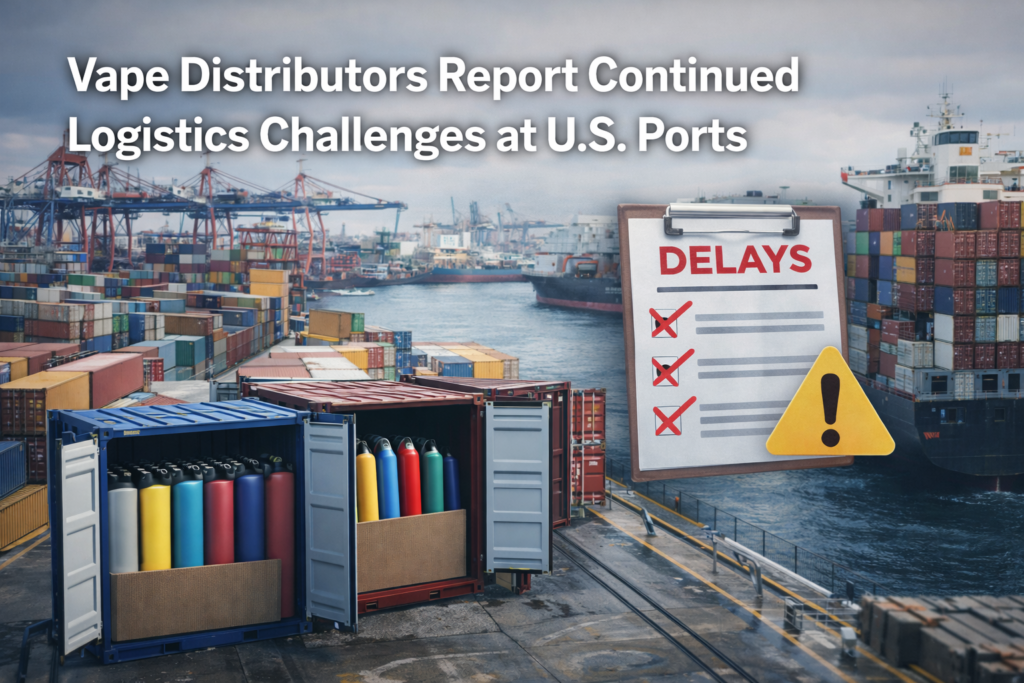
In September 2025, the FDA and U.S. Customs and Border Protection conducted the largest joint operation in U.S. vape enforcement history, seizing 4.7 million unauthorized e-cigarette units valued at roughly $86.5 million. Customs officers have been trained to flag Chinese-labeled shipments.
Retailers report growing consumer interest in “Made in America” labeling across product categories. Some brands are genuinely responding to that demand signal; others are exploiting it as cover.
The net effect: a rebrand wave that looks like compliance theater. Packaging changes. Legal status does not.
🔍 The 8 Brands: What Reuters Found
Reuters analyzed trademark documents and state business filings for the eight brands that emerged with American credentials since October 2025. The full list of eight was not published in the original report, but the two most-documented cases establish the pattern:
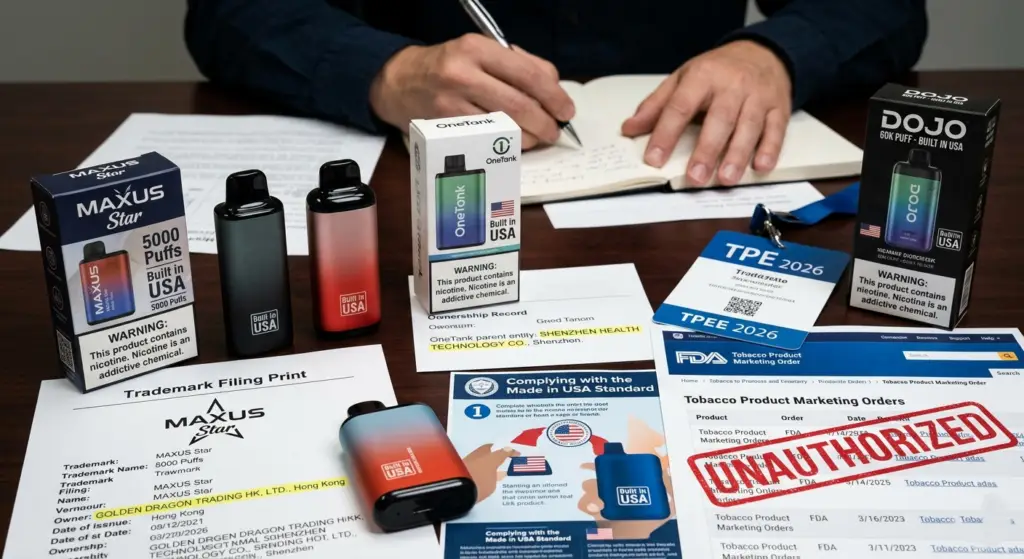
🇺🇸 MAXUS Star
Packaging prominently features “Vape American” along with stars, stripes, and a “Built in the USA” stamp.
Trademark reality: The MAXUS brand is owned in the United States by Rivermountain (H.K.) Tech — a Hong Kong-based entity that also holds trademarks in China for sub-brands of Chinese vape manufacturer Freemax.
MAXUS Star, Freemax, and Rivermountain did not respond to Reuters’ requests for comment. Reuters could not verify where the device is physically manufactured.
🇺🇸 OneTank
Packaging displays an American flag stamp and the phrase “made in USA.”
Trademark reality: Local business filings and U.S. trademark records show the brand is controlled by a representative of Shenzhen Onevape Technology.
OneTank did not respond to Reuters’ requests for comment, and reporters could not establish whether OneTank operates any U.S. manufacturing site.
🇺🇸 DOJO PUREX 60K TPE 2026 Debut
Not part of the original Reuters list of eight, but a clear example of the trend at Total Product Expo (TPE) 2026.
DOJO introduced the PUREX 60K disposable — a 1,000 mAh device with a 16 mL reservoir and claimed 60,000-puff output — marketed as “BUILT IN THE USA.”
The device is not on the FDA’s list of 41 authorized ENDS products.
✅ Charlie’s Holdings Legitimate Edge Case
Not every American-branded vape is cynical marketing. Charlie’s Holdings Inc. opened its first U.S. factory in December 2025 specifically to fill one of its disposable vape brands with e-liquid domestically.
The important caveat: the company’s annual report states that its disposable vape devices are still produced by a Chinese manufacturing partner. U.S. operations cover e-liquid filling — not hardware assembly.
This is the most honest version of what’s happening across the category: partial domestication of one supply-chain stage, not full onshoring.
⚖️ What the FDA Actually Cares About (Hint: Not Where It’s Built)
📋 The PMTA Is the Only Gate
Under the Family Smoking Prevention and Tobacco Control Act, every electronic nicotine delivery system (ENDS) product introduced after February 15, 2007, requires a Premarket Tobacco Product Application (PMTA) and an FDA marketing authorization order before it can be legally sold in U.S. commerce.
As of February 18, 2026, the FDA had authorized exactly 41 e-cigarette products — a list dominated by tobacco- and menthol-flavored pods and disposables from:
- 🟦 NJOY (Daily Extra Rich Tobacco, Daily Menthol, etc.)
- 🟦 Vuse (Alto, Vibe, Ciro, Solo lines)
- 🟦 Logic (Pro, Power, Disposable series)
- 🟦 JUUL (tobacco and menthol pods, 3% and 5% only)
🚨 The Enforcement Reality
The FDA’s April 2026 enforcement posture has multiple layers that all apply equally to domestic-branded and import-branded unauthorized vapes:
- Import Alerts authorizing CBP to detain unauthorized ENDS products without physical examination
- Warning Letters to retailers and distributors offering unauthorized products
- Joint FDA/CBP seizure operations, including the record $86.5 million September 2025 action
- Civil monetary penalties and injunctive relief against repeat violators
For a deeper breakdown, see our FDA Vape Enforcement Plan 2026 analysis and the state-by-state vapor product directory tracker.
🔒 The FTC Rule Nobody’s Talking About
Under the FTC’s rule, a product cannot be marketed as “Made in USA” unless it is “all or virtually all” made in the United States. That standard requires:
- ✅ Final assembly or processing in the United States
- ✅ All significant processing occurring in the U.S.
- ✅ All or virtually all ingredients or components made and sourced in the U.S.
💵 The Financial Exposure
The FTC has authority to impose civil penalties of up to $53,088 per violation. Recent enforcement actions — including cases against Oak Street Manufacturing, Americana Liberty, Touchtunes, Cycra, and Lithionics Battery — demonstrate the Commission is actively policing this space.
📚 Full text: FTC Made in USA Labeling Rule
🎯 What This Means for Each Segment of the Industry
🏪 For Retailers
Domestic-looking packaging is not a safe harbor. Before stocking any SKU positioned as “Made in USA” or “Built in the USA,” verify:
- Is the product on the FDA’s current list of 41 authorized ENDS products?
- If your state operates a vapor product directory, is the SKU listed?
- Does the brand’s parent entity have a verifiable U.S. manufacturing footprint, or only a U.S. trademark filing?
A “no” on question one is disqualifying in every state with a registry law. Retailers looking for compliant inventory should verify sourcing through authorized channels — trusted U.S.-based retail platforms like VapeOwls.com provide product-level traceability, and wholesale buyers can reference established distributors such as B&J Wholesale for licensed-supply sourcing.

📦 For Distributors
The gray-market risk profile is changing. Distributors who previously rejected overtly Chinese-branded unauthorized product may now be accepting American-branded unauthorized product under the assumption that origin branding confers legitimacy. It does not.
The DOJ’s 88 enforcement actions between 2022 and 2025 — documented in the April 2026 Government Accountability Office report — targeted distributors and online sellers at a disproportionate rate relative to retailers.

🏭 For Manufacturers
The Charlie’s Holdings model is instructive: public transparency about which supply-chain stages are actually domestic, clear acknowledgment of Chinese partners, and ongoing PMTA submissions. Brands most exposed to FTC enforcement are those making categorical “Made in USA” claims on products with Chinese hardware.
🤝 For Advocacy and Trade Associations
The “Built in USA” trend complicates the industry narrative by introducing unauthorized products that visually code as domestic. Trade association education efforts may need to expand to include FTC origin-claim compliance alongside FDA PMTA guidance.
👀 What to Watch Over the Next 90 Days
- 📋 The full Reuters list of eight brands. Only MAXUS Star and OneTank were publicly identified. The other six will likely surface through state registry enforcement or follow-up journalism.
- 📨 FDA warning letters specifically citing origin claims. An action that cites “Built in USA” labeling as an aggravating factor would be a significant signal.
- 🤝 FTC coordination. A joint FDA/FTC action on “Made in USA” vape claims is the single most likely next-phase enforcement development.
- ⚖️ Fourth Circuit ruling on state registry preemption. Oral argument in the VTA’s challenge to North Carolina’s registry law was heard January 29, 2026. The ruling will directly affect how aggressively states police unauthorized products.
❓ Frequently Asked Questions
Does a “Built in the USA” label mean a vape is FDA-authorized?
No. Country of manufacture and FDA marketing authorization are entirely separate regulatory questions. As of early 2026, only 41 ENDS products hold FDA marketing authorization, and none of the eight “Made in USA” brands identified in the April 2026 Reuters investigation are on that list. Origin branding has no bearing on PMTA status.
What is a PMTA and why does it matter?
A Premarket Tobacco Product Application (PMTA) is the application pathway every new tobacco product, including ENDS devices, must clear before being legally marketed in the United States. FDA review evaluates whether the product is “appropriate for the protection of public health.” Without a marketing authorization order, a vape cannot be legally sold — regardless of where it was made, what flavor it carries, or what the packaging claims.
Which vape brands are actually FDA-authorized in 2026?
As of February 2026, the 41 authorized products come primarily from NJOY, Vuse (Alto, Vibe, Ciro, Solo lines), Logic, and JUUL (tobacco and menthol pods, 3% and 5% strengths only). All authorized products are limited to tobacco or menthol flavors. The FDA maintains a current list that retailers should consult directly before stocking any product.
Can a vape brand legitimately claim “Made in USA”?
Only if the product meets the FTC’s “all or virtually all” standard — meaning final assembly occurs in the United States, all significant processing is domestic, and all or virtually all components are U.S.-sourced. A disposable vape with a Chinese battery, coil, and housing does not meet this standard even if the e-liquid is filled domestically. Claims that fall short expose the brand to FTC civil penalties of up to $53,088 per violation.
Are “Made in USA” vapes safer than imports?
Not inherently. Safety is a function of product testing, manufacturing quality control, ingredient sourcing, and PMTA review — none of which are guaranteed by a U.S.-origin claim. Unauthorized domestic-branded products have the same untested-ingredient and unverified-manufacturing concerns as unauthorized imported products. FDA authorization remains the single most reliable signal of product safety review.
What happens if I sell “Made in USA” vapes that aren’t FDA-authorized?
Retailers face federal PMTA enforcement exposure, potential state registry penalties ranging from $2,000 to $50,000 per violation in registry states, and — if the “Made in USA” claim is substantively false under the FTC standard — additional federal deceptive-advertising liability. The three exposure categories stack; an American-branded unauthorized vape can trigger all three simultaneously.
How do I verify whether a vape product is legal to sell in my state?
Check the FDA’s current list of authorized ENDS products first. If your state operates a vapor product directory (Alabama, Florida, Kentucky, Louisiana, Oklahoma, North Carolina, Virginia, Wisconsin, Tennessee, and others), verify the SKU appears on that state’s registry. Additional local ordinances may apply in municipalities like Denver and San Francisco. See our state-by-state regulatory tracker for current compliance details.
Will the FDA start specifically targeting “Made in USA” vape claims?
The FDA has not publicly announced a specialized enforcement initiative targeting origin claims, but has reaffirmed that unauthorized products are illegal regardless of manufacturing location. A joint FDA/FTC enforcement action combining PMTA non-compliance and origin-claim deception is plausible over the next 6–12 months given the FTC’s general Made in USA enforcement activity and the FDA’s focus on unauthorized disposables.
🎯 The Bottom Line
The “Built in USA” wave is a marketing response to a regulatory problem — not a regulatory solution. For the eight brands Reuters identified and the growing number following their playbook, domestic packaging is at best a customs-detection hedge and at worst a second layer of deceptive-advertising exposure layered on top of existing PMTA violations.
For the industry, the development is a useful clarifying moment:
- ❌ Country of origin is not a compliance substitute
- ❌ Trademark filings are not PMTA submissions
- ❌ An American flag on the box is not a marketing authorization order
The brands that will survive the next phase of enforcement are the ones that get PMTA-compliant — not the ones that get patriotic.
📚 Sources and Further Reading
📰 Primary Reporting
- Reuters — “Vape makers turn to ‘Made in America’ credentials amid Trump’s tariffs, crackdown” (April 7, 2026)
- Nicotine Insider — “‘Made in USA’ Vape Products Gain Traction” (April 9, 2026)
- 2Firsts — “TPE 2026 Cools as Caution Deepens in the U.S. Vape Market” (April 12, 2026)
⚖️ Regulatory Sources
- FDA Center for Tobacco Products
- FTC Made in USA Labeling Rule
- Government Accountability Office — “E-Cigarette Enforcement” report (April 2026)
🏪 Industry Retail and Distribution References
- VapeOwls.com — U.S.-based retail platform for adult consumers and wholesale buyers
- ICEMAX 12K vs. IceBomb Bundle vs. Flum Float X 10K — Full Comparison & Review 2026 (VapeOwls.com editorial)
- B&J Wholesale — Licensed U.S. distributor serving smoke shops, vape stores, and c-stores
🔗 Related VapeTrends360 Coverage