Made in USA Disposable Vapes: Are They Actually Compliant?
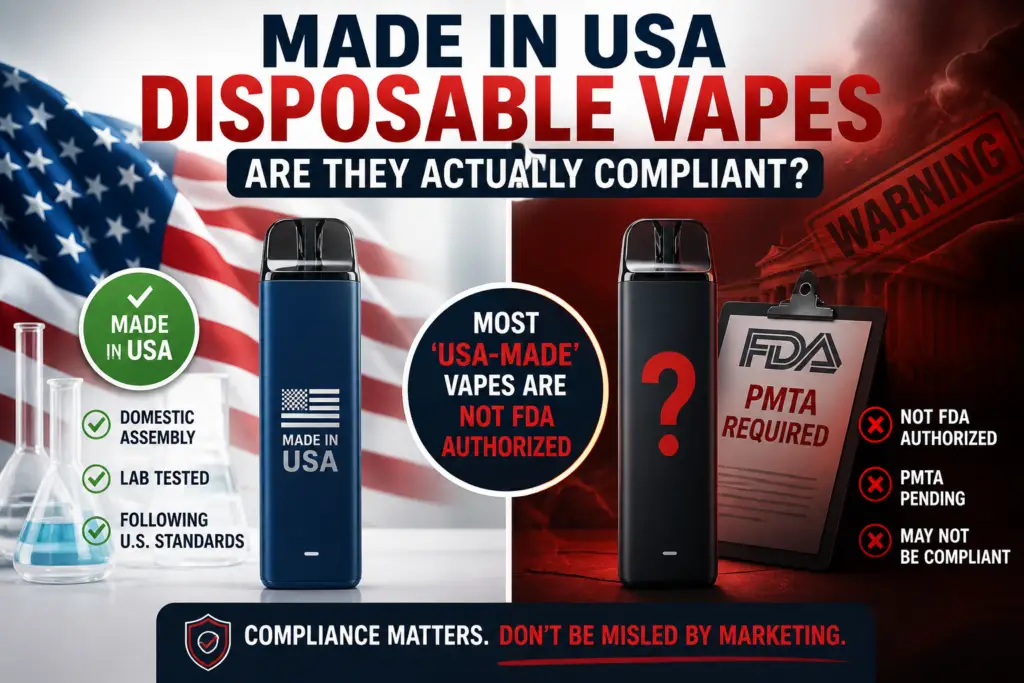
“Built in America” has become the disposable vape industry’s favorite shield against the 2026 enforcement wave. The FDA’s position is colder: origin doesn’t matter — authorization does. Here’s what the marketing actually buys you, and what it doesn’t.
Walk into any U.S. vape distributor’s catalog this spring and you’ll see the same flag waving from product after product. Fifty Bar. One Tank 40K. Juice Head Bars. Pink Spot. Dozens of “USA-built,” “American-assembled,” “domestically filled” disposables, all positioned as the responsible alternative to the Chinese imports being seized at ports of entry. The pitch is direct: buy American, sleep easy.
The problem is that the FDA isn’t grading on origin.
In its April 2026 statements on illicit-market enforcement, the agency made the point as plainly as it ever has: any vape product lacking proper authorization is illegal — domestically manufactured or otherwise. “Made in America” may carry reputational weight. It does not, on its own, confer legal status.
For retailers, distributors, and policy watchers trying to make stocking decisions in directory states, that distinction is the entire ballgame. This breakdown separates what the USA label actually does for compliance from what the marketing implies — and where the real legal protection lives.
- 41 e-cigarette products hold FDA Marketing Granted Orders nationwide.
- 1 disposable on that list — NJOY Daily, in tobacco and menthol only.
- Zero “Made in USA” disposables currently hold full PMTA authorization.
- $21,000+ per violation civil penalty for retailers selling unauthorized SKUs.
- Six directory states (CA, FL, NC, TN, VA, WI) bar any unlisted product regardless of where it was assembled.
What “Made in USA” Actually Means in This Industry
The phrase has stretched considerably over the past two years. In disposable-vape marketing, it currently covers at least four distinct claims, and they are not interchangeable.
Domestic e-liquid, imported hardware
The most common configuration. Devices, batteries, coils, and shells are sourced from Chinese OEMs; e-liquid is blended in U.S. facilities and filled stateside. Most of the “USA” disposables in U.S. distribution operate this way. The flag on the box reflects the juice and the final fill — not the device.
Domestic assembly, imported components
Hardware components arrive from overseas; final assembly, filling, and packaging happen in U.S. facilities. Fifty Bar’s public positioning falls here — the brand markets itself as “Built in the USA,” collaborates with Beard Vape Co. on e-liquid, and assembles in Thousand Oaks, California. The brand also publicly cites support for 150+ U.S. jobs. These are company claims, not third-party certifications.
Fully domestic production
Vanishingly rare in the disposable category. The economics of single-use lithium-battery hardware still favor Asian manufacturing at scale, and most “fully USA” claims, when scrutinized, fall into one of the two categories above.
Co-branded with a U.S. juice line
A device built overseas, packaged with a recognizable American e-liquid brand on the label (Pod Juice, Beard, Juice Head). The “USA” association rides on the juice partner’s reputation, not the manufacturing chain.
None of these configurations changes the product’s PMTA status one inch. They are positioning, not paperwork.
The Federal Bar: PMTA Is the Only Currency That Counts
The Family Smoking Prevention and Tobacco Control Act requires every new tobacco or nicotine product sold in the U.S. to receive a Premarket Tobacco Product Authorization. The FDA has issued Marketing Granted Orders to 41 products as of early 2026. The vast majority of those are tobacco- or menthol-flavored pod systems and cartridge products from Vuse, NJOY, Logic, and a handful of other large applicants.
NJOY Daily — in tobacco and menthol — remains the only authorized disposable. Every other disposable on the U.S. market, regardless of where it was filled or assembled, is operating without federal authorization.
That includes the Made-in-USA category in its entirety.
Industry watchers should expect this to evolve, but slowly. The FDA’s March 9, 2026 draft guidance on flavored e-cigarette PMTA review introduced the possibility that some non-fruit, non-candy adult flavors — coffee, mint, spice, tobacco-adjacent profiles — could clear in coming review cycles if applicants demonstrate clear public-health benefit for adult smokers. Sweet and dessert profiles, which dominate the USA-made disposable lineup, remain at the highest evidentiary bar.
| Brand | USA Claim | PMTA Status | Federal Legality |
|---|---|---|---|
| NJOY Daily | Domestic distribution; corporate U.S. | MGO granted (tobacco, menthol) | Authorized |
| Fifty Bar 20K | Built / assembled in USA, U.S. e-liquid | No MGO; “in alignment” claims only | Unauthorized |
| One Tank 40K | U.S. assembly / filling | No MGO | Unauthorized |
| Juice Head Bars | U.S.-blended juice, FDA-registered facility | No MGO on disposables | Unauthorized |
| Pink Spot, Pod Juice variants | U.S.-made e-liquid | No MGO on disposable formats | Unauthorized |
“FDA-registered facility” is a regulatory housekeeping requirement for tobacco product manufacturers. It is not the same as a Marketing Granted Order and does not make a product legal to sell.
The State Layer: Directory Laws Don’t Care Either
Federal status is only half the equation. As of May 2026, six states — California, Florida, North Carolina, Tennessee, Virginia, and Wisconsin — operate vape product directories that condition retail legality on the state’s approved list. Arizona, Georgia, North Dakota, South Carolina, and Tennessee have similar bills in active legislative pipelines.
The criteria for directory listing track federal authorization. Most directories require either an FDA Marketing Granted Order or, in some structures, a timely-filed PMTA on a product that was on the market by the FDA’s September 9, 2020 cutoff. A “Made in USA” claim does not satisfy either test.
This is the part of the regulatory picture that catches retailers off guard. A USA-assembled disposable that ships freely into Texas or Nevada may be flatly illegal in California or Wisconsin not because of the device’s origin, but because it isn’t on the state list. Stocking it can mean fines, license suspension, and inventory destruction.
So What Does the USA Label Actually Buy You?
The honest answer: real things, none of which are federal compliance.
Supply-chain insulation from “seize and destroy”
The FY 2026 Agriculture Appropriations bill granted federal authorities the power to immediately seize and destroy unauthorized vape shipments at the U.S. border, rather than holding them pending legal review. This authority targets imported, non-PMTA hardware — primarily Chinese-manufactured disposables. A domestically assembled product simply doesn’t pass through that interdiction layer in the same way. That’s a meaningful logistical advantage for distributors, but it’s a supply-chain benefit, not a legality benefit.
Reputational and political positioning
USA-made framing aligns with current federal political messaging on Chinese-manufactured disposables. Some state-level enforcement bills, including Indiana’s recent legislation, explicitly target “foreign” or “Chinese-produced” vape products. A domestic brand is less likely to be the headline target of that kind of legislation, even if its PMTA status is identical to an import.
Marketing differentiation in a saturated category
For consumers fatigued by counterfeit risk, opaque supply chains, and a flood of indistinguishable imported devices, “made in America” is a real purchase trigger. It correlates — though does not guarantee — better quality control, traceability, and ingredient transparency.
Future PMTA optionality
Domestic manufacturers are structurally better positioned to pursue PMTA submissions. They control more of the supply chain, can demonstrate manufacturing controls more directly to the FDA, and have a clearer regulatory dialogue. Fifty Bar’s public statements about “PMTA compliance alignment” hint at this trajectory — though no submission, let alone authorization, has been confirmed.
The Bottom Line for Each Reader
For retailers and distributors
Origin matters for supply continuity in 2026, especially if your sourcing was disrupted by border-interdiction actions. It does not matter for whether you can legally sell the product in directory states. Audit every SKU against (1) the FDA’s published authorized-products list and (2) your state’s directory if applicable. A USA-built unauthorized product carries the same retail risk as a Shenzhen-built unauthorized product.
For consumers
If federal compliance is your priority, the only currently authorized disposable is NJOY Daily in tobacco or menthol. If you’re buying a USA-assembled flavored disposable, you’re buying an unauthorized product — one that may carry better quality controls than its imported counterparts, but that operates in the same gray legal zone.
For policy watchers
The “Made in USA” framing is a window into how the industry is repositioning under enforcement pressure, not a measure of regulatory progress. Watch instead for the first non-tobacco, non-menthol PMTA authorization. That’s the inflection point. Until then, every flavored disposable on every U.S. shelf — regardless of flag — is operating outside federal authorization.
“Made in USA” is a meaningful logistics and marketing position. It is not a compliance designation. The FDA evaluates products by authorization, not by passport — and in 2026, that distinction is the one that decides which inventory survives.
Frequently Asked Questions
Are USA-made disposable vapes FDA approved?
Almost none are. As of May 2026, the only FDA-authorized disposable e-cigarette is NJOY Daily, available in tobacco and menthol flavors. No “Made in USA” flavored disposable currently holds a Marketing Granted Order from the FDA. Domestic assembly does not equal federal authorization.
Is Fifty Bar legal to sell in the United States?
Fifty Bar is assembled in the United States and uses American-made e-liquid, but as of this publication it does not hold an FDA Marketing Granted Order. That makes it federally unauthorized. In directory states (California, Florida, North Carolina, Tennessee, Virginia, Wisconsin), it cannot legally be sold at retail. In states without directory laws, enforcement is inconsistent but the federal status is unchanged.
Why does “Made in USA” matter at all if it’s not a legal protection?
It matters for supply-chain stability. The FY 2026 federal “seize and destroy” authority targets unauthorized imports at the U.S. border. Domestically assembled products bypass that interdiction layer, which protects distribution continuity. It also positions brands more favorably under state-level legislation that explicitly targets Chinese-manufactured devices. But neither benefit makes an unauthorized product legal.
Will any USA-made disposables get PMTA authorization in 2026?
Possibly, but slowly. The FDA’s March 2026 draft guidance opens a door for adult-oriented flavors like coffee, mint, and spice, provided manufacturers can show public-health benefit for adult smokers. Domestic manufacturers have structural advantages in pursuing PMTA submissions. No USA-made disposable has confirmed an active submission cleared for authorization at this time.
What’s the safest stocking strategy for retailers right now?
Audit every SKU against two lists: the FDA’s published authorized-products database, and your state’s vape product directory if you operate in a directory state. Treat any unauthorized product — domestic or imported — as enforcement risk. Pivot category share toward authorized pod systems, FDA-authorized nicotine pouches (ZYN, On! Plus), and tobacco/menthol disposables that hold MGOs. Origin is a tiebreaker, not a qualifier.
- FDA, Authorized Tobacco Products database (current as of April 2026)
- Tobacco Insider, “USA: Illegal Vapes” — April 2026 update on FDA enforcement posture and “Made in America” positioning analysis
- FDA Draft Guidance, “Premarket Tobacco Product Applications for Flavored E-Cigarettes — Considerations Related to Youth Risk” (March 9, 2026)
- FY 2026 Agriculture Appropriations Bill — federal “seize and destroy” authority for unauthorized vape shipments
- Vape Shop Wholesale, Vape Laws by State 2026 (updated April 2026)
- Fifty Bar corporate statements (thefiftybar.com) and distribution claims, accessed May 2026
- VapeTM, USA-Made Vape Sourcing Analysis — manufacturer claims vs. third-party certification distinctions
- U.S. GAO Report on illicit e-cigarette market enforcement (April 2026)
VapeTrends360 reports on regulatory developments and market dynamics in the vapor and nicotine products industry. This article is editorial analysis, not legal advice. Retailers and distributors should consult counsel for compliance decisions specific to their jurisdiction and inventory.
VapeTrends360 Weekly Brief
Stay Ahead of the Industry
Get the news before it becomes a problem.
- FDA enforcement updates
- New product launches
- Market trends
- Retailer insights
Join industry professionals who want the news before it becomes a problem. Free. Unsubscribe anytime.