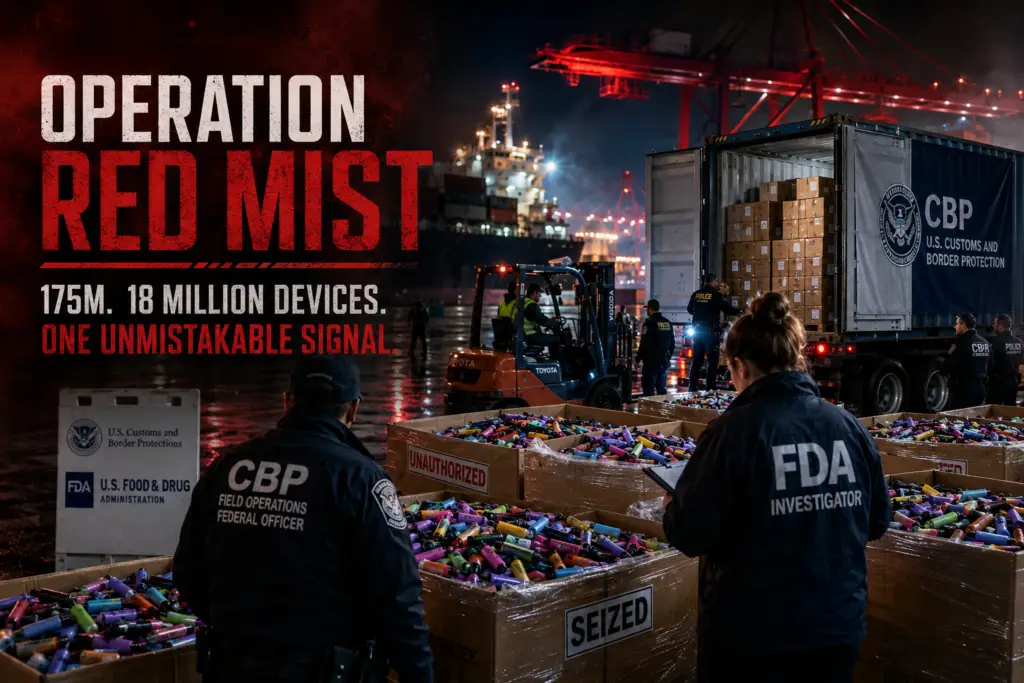
Operation Red Mist:
$175M. 18 Million Devices.
One Unmistakable Signal.
CBP, the U.S. Coast Guard, and the FDA have completed the largest maritime seizure of illegal vaping products in American history — and the enforcement clock isn't stopping here.
Federal enforcement against unauthorized vaping products just reached a new watermark. U.S. Customs and Border Protection, working in coordination with the U.S. Coast Guard and the Food and Drug Administration, announced this week the results of Operation Red Mist — a sustained maritime interdiction campaign that has yielded more than 18 million units of illegal electronic nicotine delivery systems valued at over $175 million. Every single product intercepted lacked the FDA premarket authorization required to legally sell in the United States.
The operation, which began in September 2025 and focuses primarily on maritime cargo originating from the People's Republic of China, represents a significant escalation in both the coordination and reach of federal vape enforcement. Unlike prior single-port seizure events, Operation Red Mist is explicitly designed to disrupt the supply chain end-to-end — from pre-shipment intelligence in China, through inspections at ports of entry, all the way to post-seizure investigations of importers, distributors, and middlemen inside the U.S.
What Investigators Found at Sea
CBP inspection teams documented a consistent pattern of evasion across the seized shipments. Hazardous materials — primarily lithium-ion batteries — were misclassified and improperly labeled, a tactic used simultaneously to avoid detection, escape import duties, and sidestep federal safety standards for the transport of electronics. Many shipments carried vague product descriptions with underreported values, a method CBP officials say has become standard operating procedure for illicit vape importers seeking to slip past targeting systems.
Beyond the labeling fraud, every intercepted product violated importation requirements for tobacco products and consumer electronics, and failed to meet environmental protection and transport safety standards. In other words, the violations were not technical oversights — they were systematic and deliberate.
The spread of illegal e-cigarettes is alarming for communities everywhere. Our frontline personnel are working tirelessly to keep these dangerous products out of our communities, especially out of the hands of young people who are frequently targeted by manufacturers.
— Diane J. Sabatino, Executive Assistant Commissioner, CBP Office of Field Operations
How We Got Here: An Escalating Enforcement Arc
Operation Red Mist didn't emerge from nowhere. It is the latest — and by far the largest — action in a multi-year federal campaign that has progressively expanded in scale, interagency coordination, and legal authority. Reviewing the seizure timeline illustrates just how rapidly enforcement capacity has grown:
The fiscal trajectory is equally telling. According to federal reporting, the FDA refused roughly 100 tobacco shipments at ports of entry in fiscal 2023. That figure climbed to approximately 1,600 in fiscal 2024. In fiscal 2025, the number surpassed 9,000 — a nearly 90-fold increase in two years. Operation Red Mist reflects not just more resources, but a fundamentally different targeting posture: the agencies now intervene before products even board a ship.
The Legislative Backbone Supporting It All
The operational escalation has been matched by new legal tools. In late 2025, the END (Ensuring the Necessary Destruction) of Illicit Chinese Tobacco Act was signed into law as part of the fiscal 2026 agriculture appropriations bill. The law grants the FDA explicit authority to destroy adulterated, misbranded, or counterfeit tobacco products — including unauthorized e-cigarettes imported from China — rather than simply detaining or returning them. Congress also directed the FDA to allocate no less than $200 million in fiscal year 2026 specifically toward illicit vape enforcement, formalizing the funding pipeline for operations like Red Mist.
The FDA's New Enforcement Prioritization Framework (May 2026)
Just days before the Operation Red Mist announcement, the FDA published a significant new guidance document: "Enforcement Priorities for Certain New Tobacco Products Marketed Without Premarket Authorization" (Federal Register docket FDA-2026-D-5083, published May 12, 2026). The guidance is important to read alongside the Operation Red Mist news because it defines the dividing line between products the government is actively coming after and those it will temporarily deprioritize while review is pending.
The core policy: the FDA does not intend to prioritize enforcement against ENDS or nicotine pouch products that have a pending, accepted-and-filed PMTA application — provided those products are not marketed with youth-appealing elements such as cartoon characters, toy or phone disguises, or unusually high nicotine levels. For non-tobacco flavored products, the application must also include the public health data the agency needs to complete its review. Critically, the agency will publish a public-facing list of manufacturers and products that qualify for this deprioritization — giving both retailers and distributors a reference point for sourcing decisions. Read our full breakdown of FDA-authorized vape products in 2026.
What the guidance does not do is provide cover for the products seized under Operation Red Mist. Those shipments contained items with zero PMTA applications on file — not deferred, not pending, not under review. They represent the "worst actors" the FDA's own language targets: products that have made no attempt to comply with the basic premarket authorization framework and are imported under false pretenses.
- Only 41 e-cigarette products are currently FDA-authorized for U.S. marketing and distribution, from brands including Glas, Logic, Juul, NJOY, and R.J. Reynolds Vapor.
- An estimated 6,000+ e-cigarette products were being sold in the U.S. as of mid-2024, meaning the vast majority remain unauthorized.
- The GAO noted a single 2024 seizure worth $76M — roughly 3 million devices — equated to just 4% of China's monthly e-cigarette exports to the U.S. at the time.
- Chinese vape exports to the U.S. rebounded sharply in late 2025, reaching 14.8 million kilograms in October after an initial enforcement-driven dip in mid-2025.
- The FDA's new May 8, 2026 guidance creates a protected lane for products with accepted PMTAs — but zero tolerance for no-PMTA products like those seized under Red Mist.
- A Truth Initiative report found illicit products accounted for over 86% of vape sales in early 2024 — illustrating the scale of the market the government is attempting to restructure.

What It Means for Legal Trade Operators
For retailers, distributors, and wholesalers operating inside the legal framework, Operation Red Mist sends a constructive signal alongside its headline numbers. The federal government is actively working to eliminate the gray-market products that have undercut compliant supply chains for years. Every container that doesn't reach store shelves is a marginal improvement in market conditions for authorized product sellers. For a current breakdown of state-level compliance obligations, see our Spring 2026 state registry and retailer guide.
But the data also reveals a sober reality: even at this scale of enforcement, federal agencies are intercepting a fraction of total illegal imports. The GAO's April 2026 report underscored this gap plainly. The $175 million seized under Operation Red Mist is enormous in absolute terms, but Chinese e-cigarette exports to the U.S. topped $10.6 billion in 2025. A $175 million seizure, however historic, represents less than 2% of a single year's export volume. The structural challenge has not been solved — it has been confronted more forcefully than before.
For compliance officers and in-house counsel at distributors, the takeaway from Mayer Brown and other legal advisors is consistent: audit product lines now. Confirm that every ENDS product in your catalog carries a valid FDA marketing authorization order. Ensure employees can identify unauthorized products, and review internal escalation procedures for when enforcement agents make contact. The presence of high-profile Cabinet officials at prior raids — and the $200 million congressional appropriation for FY2026 — indicate that enforcement pressure will not subside.
The PMTA Pathway: Narrowing but Open
The regulatory environment for legitimate manufacturers has also evolved meaningfully this month. On May 5, 2026 — one week before the Operation Red Mist announcement — the FDA authorized its first-ever non-tobacco and non-menthol ENDS products, marking a historically significant expansion of what the PMTA pathway can yield. Earlier this year, on March 9, the agency released draft guidance that could eventually open the door for mint, coffee, tea, and spice-flavored products to pursue authorization, though fruit, candy, and dessert flavors continue to face the highest evidentiary burden. See our full guide to flavored vape regulations in 2026.
This regulatory thaw matters because it reframes the commercial logic of the illicit trade. The argument that no flavored product could ever be authorized — which had been used to rationalize gray-market sourcing — is no longer legally accurate. A legitimate pathway for differentiated products is being built, however slowly. The question for manufacturers who want long-term U.S. market access is whether they invest in that pathway or bet against it.
For four years, manufacturers have been patiently waiting for authorization decisions. This guidance finally gives them the ability to stop operating in a grey area of regulation.
— Laura Leigh Oyler, VP of Regulatory Affairs, Nicokick.com
The Bottom Line
Operation Red Mist is not merely a law enforcement milestone — it is a market restructuring event. The federal government has demonstrated, at a scale previously unseen, its capacity to intercept illegal Chinese vape imports through coordinated maritime interdiction, pre-shipment intelligence, and post-seizure prosecution. Combined with the new FDA enforcement prioritization framework, the $200 million FY2026 enforcement budget, and the first non-tobacco ENDS authorizations in history, this week's news sketches the contours of what the regulated U.S. vape market is being shaped to become: smaller in product count, higher in compliance cost, but materially less distorted by unauthorized competition.
For the legal trade, the path forward is clear — but it requires operating as though enforcement is permanent, not episodic. The signal from Washington in May 2026 is unambiguous: the gray market has an expiration date.
Frequently Asked Questions
Operation Red Mist is a multi-agency federal enforcement initiative launched in September 2025, led by U.S. Customs and Border Protection in coordination with the U.S. Coast Guard and the FDA. It specifically targets maritime cargo shipments of unauthorized e-cigarettes from China. As of its May 14, 2026 announcement, the operation had seized over 18 million devices valued at more than $175 million — the largest vape enforcement action in U.S. history. For broader regulatory context, see our Spring 2026 Policy Update.
As of May 2026, only 41 e-cigarette products carry full FDA marketing authorization — from brands including Glas, Logic, Juul, NJOY, and R.J. Reynolds Vapor Company. In May 2026, the FDA also authorized its first-ever non-tobacco, non-menthol ENDS products (Glas G2 blueberry and mango pods). All other e-cigarettes — including virtually all flavored disposables — remain unauthorized. An estimated 6,000+ products are sold in the U.S. market today. See our full FDA authorization guide for the current list.
The FDA has issued over 800 warning letters to retailers for selling unauthorized tobacco products and filed civil money penalty complaints against over 175 retailers. Penalties stack per transaction, making enforcement financially devastating for noncompliant operators. Repeat violators can face No-Tobacco-Sale Orders (NTSOs) — preventing the sale of any regulated nicotine product for months or years, often forcing store closures. For state-level compliance specifics, review our state-by-state regulatory guide.
On May 8, 2026, the FDA published "Enforcement Priorities for Certain New Tobacco Products Marketed Without Premarket Authorization" (docket FDA-2026-D-5083). The guidance states the agency will deprioritize enforcement against products that have a pending, accepted-and-filed PMTA application — as long as the product lacks youth-appealing design elements (cartoon characters, toy or phone disguises, unusually high nicotine). The FDA will also maintain a public list of qualifying products. Critically, products with no PMTA on file — like those seized under Operation Red Mist — remain active enforcement targets.
CBP documented three consistent evasion methods: (1) Misclassification — lithium-ion batteries and device components labeled as generic electronics to bypass safety and regulatory inspection; (2) False undervaluation — cargo values deliberately underreported to reduce import duties and avoid customs thresholds; and (3) Vague product descriptions — intentionally nonspecific labels preventing automatic categorization as tobacco products requiring FDA review. All three tactics were used simultaneously on most seized shipments.
Operation Red Mist focused specifically on ENDS (electronic nicotine delivery systems / vapes), not nicotine pouches. However, the FDA's May 8, 2026 enforcement guidance covers both product categories under the same PMTA framework. The nicotine pouch category is significantly ahead on the authorization pathway — the FDA authorized 20 ZYN products in January 2025 and additional pouch SKUs since under an expedited pilot. Compliant pouch brands with accepted PMTAs qualify for the FDA's enforcement deprioritization and face lower seizure risk. Licensed wholesale distributors like B&J Wholesale carry FDA-track nicotine pouches for volume B2B orders.
The Ensuring the Necessary Destruction (END) of Illicit Chinese Tobacco Act was signed into law in late 2025 as part of the fiscal 2026 agriculture appropriations bill. It gives the FDA explicit statutory authority to destroy adulterated, misbranded, or counterfeit tobacco products imported from China — rather than merely detaining or returning them. Paired with the $200 million FY2026 enforcement appropriation, it ensures operations like Red Mist are structurally funded and legally unambiguous going forward.
All structural indicators point to continued escalation. FDA port refusals grew from ~100 in FY2023 to 9,000+ in FY2025. Congress has allocated $200 million for FY2026 enforcement. The Supreme Court's April 2025 ruling removed a major legal obstacle for enforcement attorneys. The END Act gives the FDA new destruction authority. And the May 2026 enforcement prioritization guidance explicitly signals the agency will focus finite resources on "worst actors" — those with no PMTA on file. Read our FDA Enforcement Plan 2026 analysis for the full forward-looking picture.
This article is intended for industry professionals and is provided for informational purposes only. Nothing herein constitutes legal or regulatory advice. All regulatory information should be independently verified against official FDA and CBP publications. Sponsor content is clearly labeled; editorial content is editorially independent. About VapeTrends360.