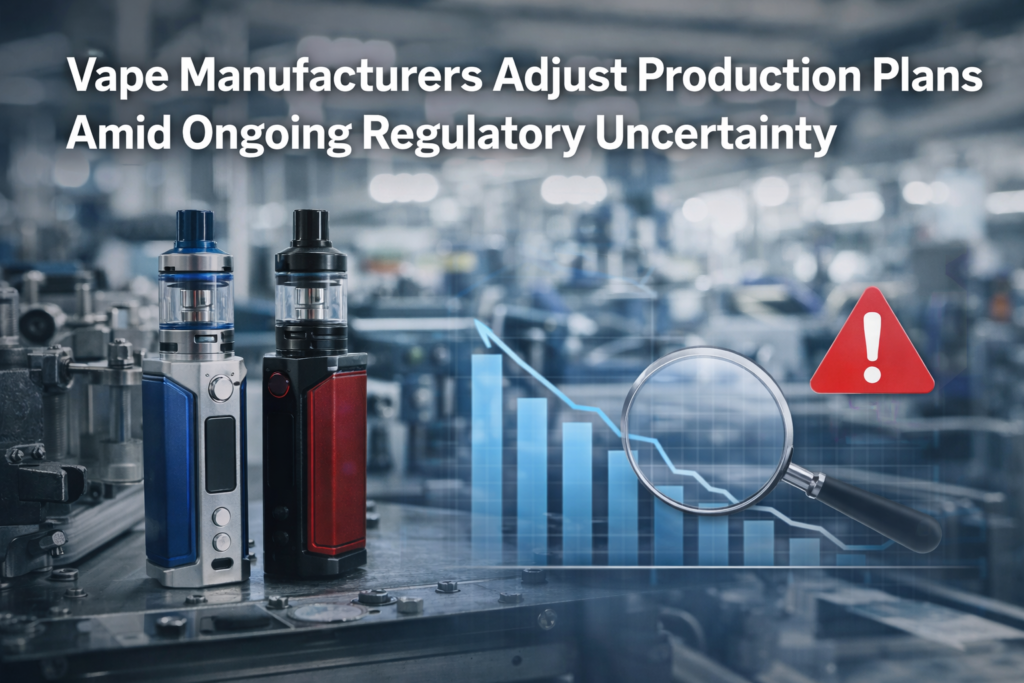
Vape manufacturers across multiple regions are continuing to adjust production schedules and operational planning as regulatory uncertainty reshapes access to key markets, according to industry sources, supplier communications, and logistics providers.
Rather than responding to a single policy change, many companies describe the current environment as a period of ongoing recalibration. Enforcement priorities, shifting market access, and evolving compliance expectations have created conditions where long-term production forecasting has become more difficult, particularly for manufacturers serving multiple international destinations.
Production Volumes and Portfolio Decisions
Manufacturers operating in Asia and North America report that output levels are increasingly tied to short- and medium-term visibility rather than long-range projections. In some cases, production runs have been scaled back or staggered to avoid excess inventory exposure, while other firms have paused new product introductions pending greater clarity on regulatory pathways.
Several industry participants note that product portfolios are also being reviewed. Rather than expanding offerings, some manufacturers are consolidating SKUs, focusing on fewer device formats, or prioritizing products with established distribution histories. This approach is intended to reduce operational complexity during a period when market conditions remain fluid.
While these adjustments vary by company size and market focus, the underlying goal is consistent: maintain flexibility while limiting risk tied to uncertain demand or access.
Supply Chain Impacts Beyond Finished Products
Industry observers emphasize that the effects are not limited to finished devices. Component sourcing, packaging schedules, and third-party logistics arrangements have also been affected, particularly for disposable-format products that depend on high-volume, tightly coordinated manufacturing cycles.
Suppliers of batteries, heating elements, packaging materials, and other components report more frequent order revisions and shorter lead times. In response, some manufacturers are renegotiating supplier agreements or seeking alternative sourcing options to avoid bottlenecks.
Logistics providers add that shipping schedules and warehouse planning are being adjusted more frequently than in previous years, reflecting a broader shift toward just-in-time inventory strategies where feasible.
Operational Flexibility Becomes a Priority
Across the industry, flexibility has emerged as a central operational theme. Manufacturers are increasingly prioritizing shorter production runs, diversified sourcing, and modular planning models that allow for faster response to changes in enforcement or market access.
For some firms, this has meant investing in internal compliance teams or external advisory support to better assess production decisions before committing capital. Others are placing greater emphasis on scenario planning, preparing for multiple regulatory outcomes rather than betting on a single path forward.
Smaller manufacturers, in particular, are taking a cautious approach, balancing the need to remain active in the market with the risks associated with overproduction or misaligned inventory.
No Single Strategy, Ongoing Adjustment
Despite these shared trends, industry participants caution that there is no single strategy that applies across the board. Differences in target markets, distribution models, and regulatory exposure continue to shape how individual companies respond.
What is consistent, however, is the expectation that operational adjustments will continue. Manufacturers are treating the current period not as a temporary disruption, but as part of a longer-term shift in how production and planning decisions are made within the industry.
As regulatory frameworks and enforcement practices continue to evolve, manufacturers are likely to remain in a state of ongoing recalibration—seeking balance between compliance, operational efficiency, and market demand in an increasingly complex global environment.