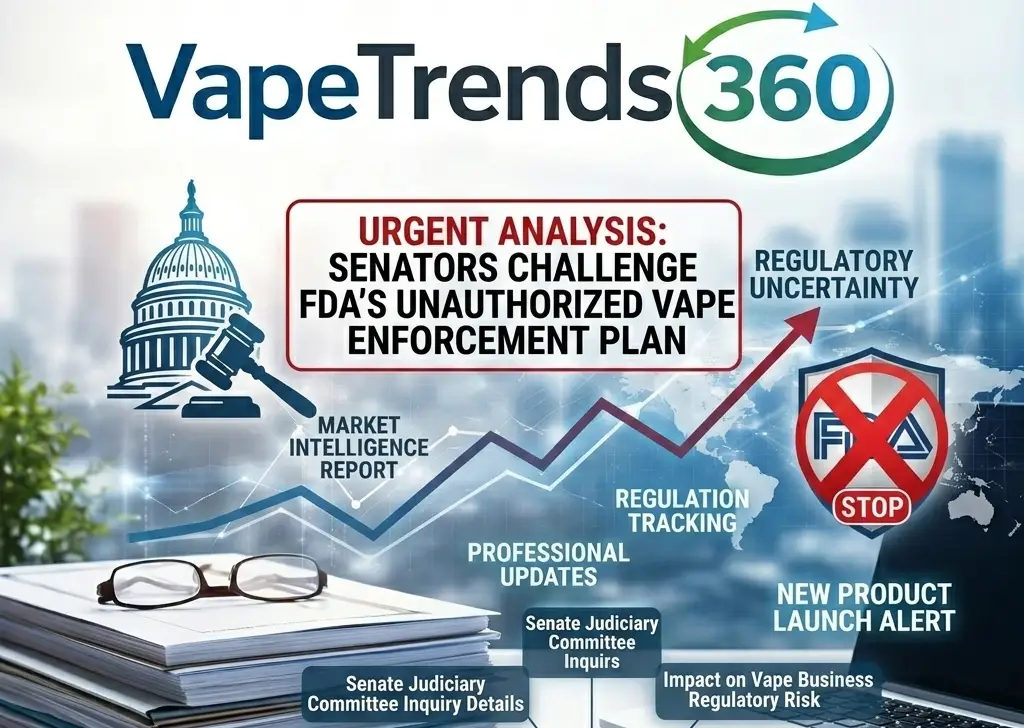
Senators Challenge FDA Enforcement Strategy on Unauthorized Vape Products
Congressional criticism of the FDA’s PMTA enforcement timeline intensifies — and what it signals for manufacturers, distributors, and retailers navigating the evolving U.S. disposable vape market.
 Sponsored
Senators question the FDA’s enforcement timeline
Several U.S. Senators have publicly criticized the Food and Drug Administration’s updated enforcement strategy targeting unauthorized vaping products, raising pointed questions about the agency’s pace and regulatory priorities in a rapidly expanding disposable vape market.
The pushback reflects growing congressional frustration over the enforcement timeline tied to the Premarket Tobacco Product Application (PMTA) framework. With millions of product applications still unresolved, enforcement signals are increasingly shaping how manufacturers, distributors, and retailers plan product strategies across the United States.
Full breakdown of the FDA’s 2026 enforcement roadmap and what manufacturers, distributors, and retailers must prepare for now.
What the updated FDA enforcement plan targets
The agency continues prioritizing action against vaping products that fall into the following categories:
- Products lacking completed or authorized PMTA status
- Devices presenting potential youth-appeal concerns
- Products entering the market via unauthorized distribution channels
- Submissions that do not meet evolving scientific documentation standards
Senators responding to the announcement questioned why stronger enforcement steps were not implemented earlier — amplifying long-standing concerns about regulatory consistency and market clarity.
 Sponsored
Why this matters for the disposable vape sector
The enforcement discussion arrives as disposable vaping products remain one of the most rapidly evolving device categories in the nicotine delivery market. Enforcement signals, even preliminary ones, directly influence commercial behavior across the entire supply chain.
In practice, regulatory enforcement posture shapes product availability timelines, flavor portfolio decisions, importer sourcing strategies, retailer inventory risk management, and investment in age-verification technologies. Because PMTA authorization remains the central gateway for continued market access, enforcement priorities effectively redraw competitive positioning in real time.
PMTA pressure continues to reshape market structure
The FDA’s enforcement posture remains tightly bound to the broader PMTA review process introduced under the agency’s Deeming Rule authority. Products without marketing authorization face increasing uncertainty as the FDA works through submissions and raises the bar on scientific evidence, youth-access mitigation, and manufacturing transparency.
At the same time, congressional criticism highlights a live debate in Washington: whether enforcement actions are keeping pace with market expansion in disposable nicotine devices — or consistently lagging behind it.
 Sponsored
Enforcement timeline: 2023 to 2026
How 35-state flavor ban legislation and Big Tobacco litigation are reshaping the competitive landscape for independent retailers and distributors.
 Sponsored
Technology compliance expectations are rising
The enforcement discussion reinforces a clear directional shift: compliance-support technologies are becoming required infrastructure, not optional safeguards. Age-verification systems, product authentication tools, and traceability improvements now reflect a broader regulatory trend toward technology-enabled compliance across nicotine product distribution channels.
Retail environments that adopt structured verification workflows are increasingly better positioned to absorb enforcement changes without major operational disruption. This hardware evolution is also visible at the product level — newer device categories like smart-display disposables are building usage-monitoring features directly into the device, reflecting a broader industry move toward transparent, verifiable consumption data.
A broader pattern of congressional oversight
Congressional criticism of the FDA’s vaping enforcement timeline fits a wider pattern of oversight activity surrounding nicotine regulation. Lawmakers from both parties have pressed for clearer enforcement timelines, stronger action against unauthorized products, improved transparency in PMTA review progress, and tighter coordination between federal and state regulatory frameworks.
These pressures collectively signal that enforcement policy will remain a defining theme in the U.S. vape market well beyond 2026. Flavor policy in particular sits at the center of this tension — with ice and menthol flavor profiles among the most closely watched categories as regulators assess youth-appeal risk across the disposable segment.
How smart-display hardware is reshaping the disposable category — and which devices are leading the segment heading into enforcement tightening.
What industry stakeholders should monitor next
Monitoring these indicators will remain essential for manufacturers, distributors, and retailers managing the next phase of regulatory adjustment in the U.S. disposable vape category. For a device-level perspective on how leading brands are responding to compliance pressure, see our RELX Infinity 2 review — a compact USB-C pod system that reflects how hardware design is increasingly shaped by regulatory positioning.
 Sponsored
A deep-dive into the ice and menthol flavor segment — demand trends, device compatibility, and regulatory risk factors for 2026.
How closed-pod system design is evolving in response to PMTA compliance expectations and adult user preferences in 2026.