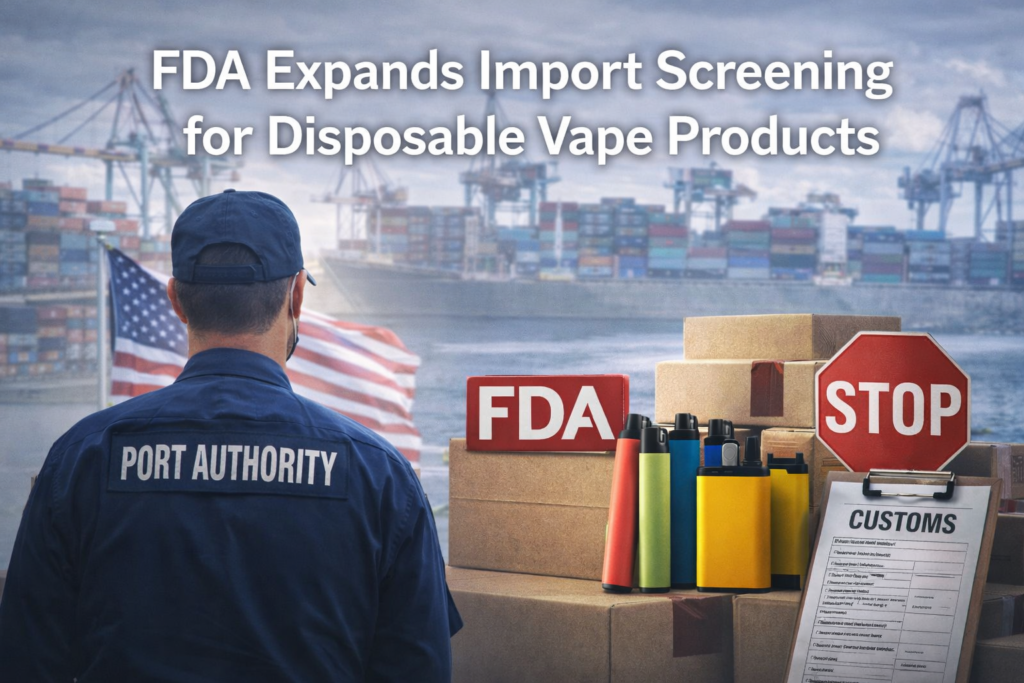
The U.S. Food and Drug Administration (FDA) has announced an expansion of import screening measures targeting unauthorized disposable vaping products entering the United States. The move reflects ongoing federal efforts to strengthen compliance oversight and improve enforcement coordination at U.S. ports of entry.
Increased Oversight at U.S. Ports
Federal officials say the enhanced screening initiative will increase collaboration between the FDA, U.S. Customs and Border Protection (CBP), and other enforcement agencies. The updated process is designed to identify imported vaping products that may lack required authorization or fail to meet federal regulatory standards before they enter domestic distribution channels.
Disposable vaping products have become a focal point for regulators due to their rapid growth and complex international supply chains. Many devices are manufactured overseas and shipped in high volumes, making port-level screening a critical enforcement tool.
Regulatory Background
Under current federal law, manufacturers and importers of electronic nicotine delivery systems (ENDS) must comply with established authorization pathways, labeling requirements, and import declaration rules. Products that fail to meet these standards may be detained, refused entry, or seized at the border.
According to the FDA, expanded import screening aims to address several recurring compliance concerns, including:
Misdeclared or inaccurately labeled shipments
Products without appropriate authorization status
Repeated import attempts linked to previously flagged entities
Supply-chain practices that obscure product origin or regulatory standing
While enforcement actions often occur downstream at the retail or manufacturing level, import screening functions as an early checkpoint designed to prevent non-compliant products from entering the U.S. market.
Industry Implications
The expanded screening measures may result in:
Longer processing times for certain shipments
Increased documentation and verification requirements for importers
Heightened compliance expectations across the supply chain
Continued uncertainty around the availability of some disposable vape products
Industry observers note that these steps align with a broader enforcement strategy that has developed over several years, as regulators seek to adapt oversight mechanisms to evolving market conditions.
Ongoing Developments
The FDA has indicated that import screening protocols may continue to evolve based on enforcement data, compliance trends, and interagency coordination outcomes. Stakeholders across manufacturing, logistics, and distribution sectors are encouraged to stay informed about regulatory updates and ensure alignment with current federal requirements.
As enforcement priorities shift, access to clear, accurate regulatory information remains essential for businesses, policymakers, and adult consumers navigating a changing compliance landscape
How FDA Import Screening Works for Disposable Vapes
The FDA’s import screening program for disposable vape products operates through a combination of advance electronic data submitted by importers (via Automated Commercial Environment), physical examination at ports of entry, and laboratory testing of sampled products. The expansion announced in 2026 adds additional flag triggers for products from manufacturers not listed in the FDA’s tobacco product registration database — which encompasses the vast majority of Chinese-origin disposable vapes entering the U.S. market.
Import alerts can result in products being detained without physical examination, meaning customs will hold any shipment from a flagged manufacturer until the importer provides documentation that the product meets FDA requirements — documentation that virtually no unauthorized disposable vape maker can provide. In practice, this functions as a de facto ban on detained manufacturers.
Which Products Are Most Affected?
The screening expansion disproportionately affects high-puff-count disposable vapes — products offering 10,000 puffs or more — that are imported in bulk by U.S. distributors. These products overwhelmingly lack FDA authorization via Premarket Tobacco Application (PMTA) approval, making them ineligible for legal sale in the United States under existing tobacco product regulations.
Products that are most likely to trigger scrutiny include those with: brand names not previously seen in FDA enforcement actions, packaging that has been changed to obscure origin, shipments consigned to new or recently formed U.S. importers, and products that have already appeared on FDA import alert lists under different brand names.
What Distributors and Retailers Need to Know
- Check FDA import alert lists before placing orders — products from detained manufacturers cannot legally enter commerce even if they clear customs.
- Require manufacturer documentation — at minimum, ask suppliers for their FDA tobacco product registration number and any submitted PMTA reference numbers.
- Diversify sourcing — reliance on a single Chinese supplier creates significant supply chain risk given the unpredictability of import alert decisions.
- Monitor customs broker communications — port detentions happen quickly; a distributor without a responsive customs broker relationship can face costly delays.
The FDA’s expanded import screening reflects a long-term enforcement posture, not a temporary initiative. Distributors and retailers whose business depends on importing unauthorized disposable vapes face escalating legal and commercial risk that will not diminish in 2026 or beyond.
VapeTrends360 Weekly Brief
Stay Ahead of the Industry
Get the news before it becomes a problem.
- FDA enforcement updates
- New product launches
- Market trends
- Retailer insights
Join industry professionals who want the news before it becomes a problem. Free. Unsubscribe anytime.