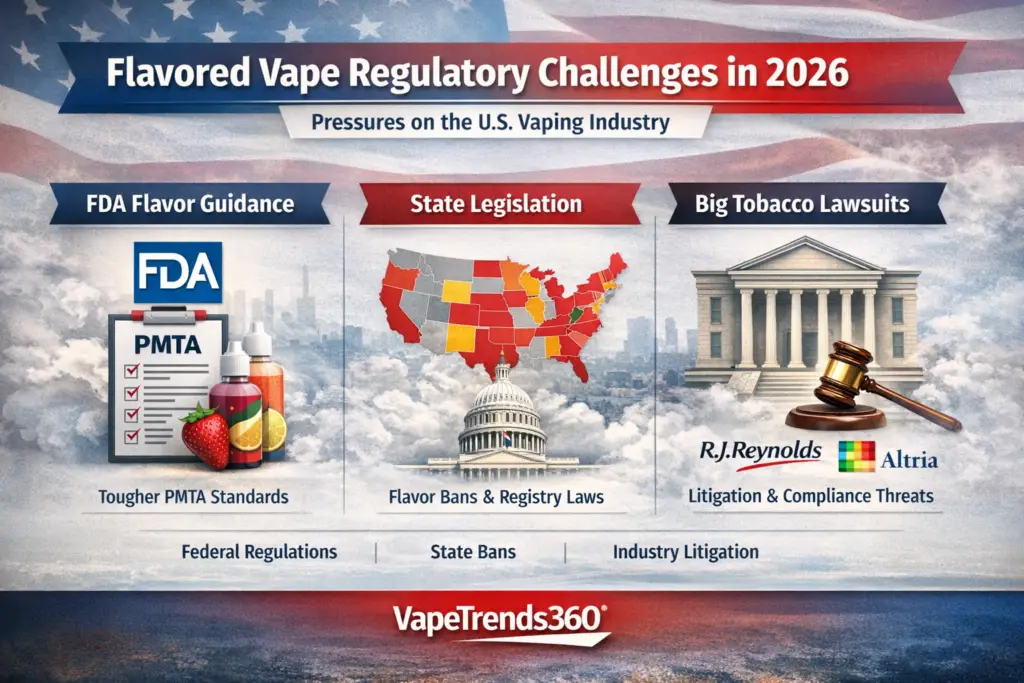
Flavored vape regulations in 2026 are reshaping the U.S. nicotine market across three simultaneous fronts — proposed FDA flavor guidance, accelerated state-level legislation, and expanding manufacturer litigation signals. Here’s what retailers, distributors, and manufacturers need to understand right now to protect inventory strategy and compliance positioning.
April 9, 2026 · VapeTrends360 Editorial Desk · Updated April 9, 2026 · 8 min read
In This Article
- FDA flavored vape draft guidance 2026 — what the new ENDS framework means
- State flavor ban update — wins, watch states, and 300+ active bills
- Virginia vape registry enforcement — the April 2026 rollout explained
- RJ Reynolds warning letters and litigation positioning
- What retailers and distributors should do now
- FAQ: flavored vape regulation questions answered
The 2026 Flavored Vape Enforcement Environment Has Shifted
If 2025 marked a turning point for flavored vape regulation, early 2026 has confirmed the transition to a multi-layer enforcement landscape.
Within weeks, three distinct forces converged across the U.S. vaping sector:
- proposed FDA flavor-related ENDS guidance
- accelerated state legislative activity across dozens of jurisdictions
- manufacturer-level litigation positioning affecting supply-chain risk exposure
For independent vape retailers and wholesalers, decisions being made today will shape product availability well into 2027.
Flum Mello Review 2026 – Design, Vapor Production & Flavor Lineup
FDA Flavored Vape Draft Guidance 2026: What the New ENDS Framework Means
The most consequential federal development of early 2026 is the FDA’s draft guidance on flavored Electronic Nicotine Delivery Systems (ENDS), published in the Federal Register on March 9, 2026.
The guidance outlines how the agency intends to evaluate flavor-related PMTA applications going forward and reinforces the higher evidentiary burden historically applied to fruit, candy, and dessert-flavored products.
Manufacturers must demonstrate that benefits for adult smokers outweigh youth initiation risks — a standard reinforced by the Supreme Court decision in FDA v. Wages and White Lion Investments.
Industry groups including the Vapor Technology Association (VTA) report that FDA officials are actively reviewing stakeholder feedback and remain open to discussion regarding PMTA process improvements.
“It’s clear that our industry and opinion matter to our allies at the FDA and that the agency is genuinely interested in solving the problem.”
— VTA Executive Director, April 2026
Action item for stakeholders
The public comment window on FDA-2026-D-1817-0002 remains open at FederalRegister.gov. Participation by retailers, distributors, and manufacturers can influence how the guidance is interpreted and implemented.
State Flavor Ban Activity 2026: 35 States, 300+ Bills Under Consideration
Federal enforcement represents only one dimension of the 2026 regulatory environment.
Across the country, VTA’s advocacy network — covering 35 states with more than 200 lobbyists — is currently tracking over 300 pieces of legislation affecting flavored nicotine products.
Several states have already concluded legislative sessions without adopting sweeping flavor restrictions:
Florida
Indiana
New Mexico
Oregon
South Dakota
Utah
Washington
West Virginia
Wisconsin
Wyoming
These outcomes reflect the growing role of coordinated policy engagement across state capitals.
However, three states remain particularly important to monitor:
New York
Governor Hochul’s proposed vapor floor tax has been removed from both House and Senate budget proposals — a meaningful interim policy outcome. Final negotiations could still revive the measure.
Arizona
HB 4001 continues advancing through the Senate after House passage. The bill includes licensing and enforcement improvements without registry-style PMTA mandates or new tax increases.
Oklahoma
HB 3881 introduces manufacturer attestation requirements and adopts marketing and labeling standards aligned with PMTA compliance expectations. It also includes a January 1, 2028 domestic-processing requirement that may influence long-term disposable vape supply chains.
RELX Infinity 2 & Pod Pro 2 Review – The 6th‑Generation Vaping Experience
Virginia Vape Registry Enforcement: A Preview of Registry-Based Regulation
Virginia’s Vape Registry enforcement began April 1, 2026, offering the clearest example of how registry-style authorization systems affect flavored product availability.
According to the VTA, the current registry framework could eliminate access to approximately 99% of flavored vaping products previously available through retail channels in the state.
The organization is currently engaging the Virginia Attorney General regarding enforcement implementation concerns while emphasizing the importance of maintaining youth-access prevention safeguards alongside adult product availability.

The national lesson
Registry enforcement is no longer theoretical.
Retailers should:
- verify product eligibility in registry states
- document sourcing transparency
- confirm distributor compliance readiness
before enforcement begins in their jurisdiction.
RJ Reynolds Warning Letters: Litigation as a Market-Shaping Tool
Alongside regulatory developments, manufacturer-level legal positioning has emerged as another enforcement factor affecting flavored disposable vape availability.
Beginning in 2023, RJ Reynolds issued warning letters to selected retailers and wholesalers indicating potential litigation tied to intellectual property positioning and regulatory alignment concerns.
Although the full legal basis has not been publicly disclosed, the strategy demonstrates how corporate enforcement tools may increasingly operate alongside federal and state regulatory frameworks.
For independent retailers and distributors, this creates exposure across two parallel channels:
- regulatory enforcement expectations
- manufacturer litigation positioning
Supply-chain transparency is becoming as important as pricing when evaluating inventory risk.
What Vape Retailers and Distributors Should Do Now
The 2026 regulatory environment requires a more structured compliance strategy than earlier enforcement cycles.
Three priorities stand out.
1. Audit PMTA documentation across inventory
Retailers should confirm whether products have:
- marketing authorization
- a valid Submission Tracking Number (STN)
- an active appeal status
Products lacking documentation present both regulatory and legal exposure.
2. Participate in the FDA guidance comment process
The open comment period on FDA-2026-D-1817-0002 represents one of the few opportunities stakeholders have to influence federal interpretation of flavored ENDS standards.
3. Track state-level legislative calendars closely
Regulatory exposure varies dramatically by jurisdiction.
Retailers in Arizona currently face a different operating environment than those in Virginia or New York.
Staying informed is now a competitive advantage.
Frequently Asked Questions: Flavored Vape Regulations 2026
What is the FDA’s flavored vape guidance for 2026?
The March 9, 2026 draft guidance outlines how the FDA evaluates flavored ENDS PMTA submissions and reinforces higher evidentiary standards for fruit, candy, and dessert-flavored products.
Which states banned flavored vapes in 2026?
As of April 2026, no additional states enacted full statewide flavor bans during the current legislative session. However, registry-style enforcement systems such as Virginia’s significantly restrict flavored product availability.
Can RJ Reynolds sue vape retailers?
RJ Reynolds issued warning letters beginning in 2023 indicating potential litigation tied to intellectual-property positioning and regulatory alignment concerns. The scope of enforcement remains evolving.
Why does PMTA compliance matter for retailers?
Retailers selling products without authorization, pending applications, or appeal status risk enforcement exposure including seizures, fines, and inventory instability.
What is the Virginia Vape Registry?
Virginia’s registry requires products to be authorized before retail sale. Enforcement began April 1, 2026 and significantly reduced flavored product availability statewide.
The Bottom Line
The U.S. flavored vape market is not collapsing — but it is entering a more complex enforcement phase shaped by overlapping federal guidance, state-level policy activity, and manufacturer litigation positioning.
Retailers, distributors, and manufacturers that treat compliance as a strategic capability rather than a regulatory burden will be best positioned to navigate the evolving enforcement environment through 2026 and beyond.
Sources
FDA Tobacco Products Guidance Center
https://www.fda.gov/tobacco-products
CDC Office on Smoking and Health
https://www.cdc.gov/tobacco
CORESTA Regulatory Science Resources
https://www.coresta.org
Read more
Which States Allow Flavored Vapes in 2026? Full Legal Guide
FDA‑Authorized Vape Products in 2026: What Retailers and Consumers Need to Know
FDA Expands Import Screening on Disposable Vape Products