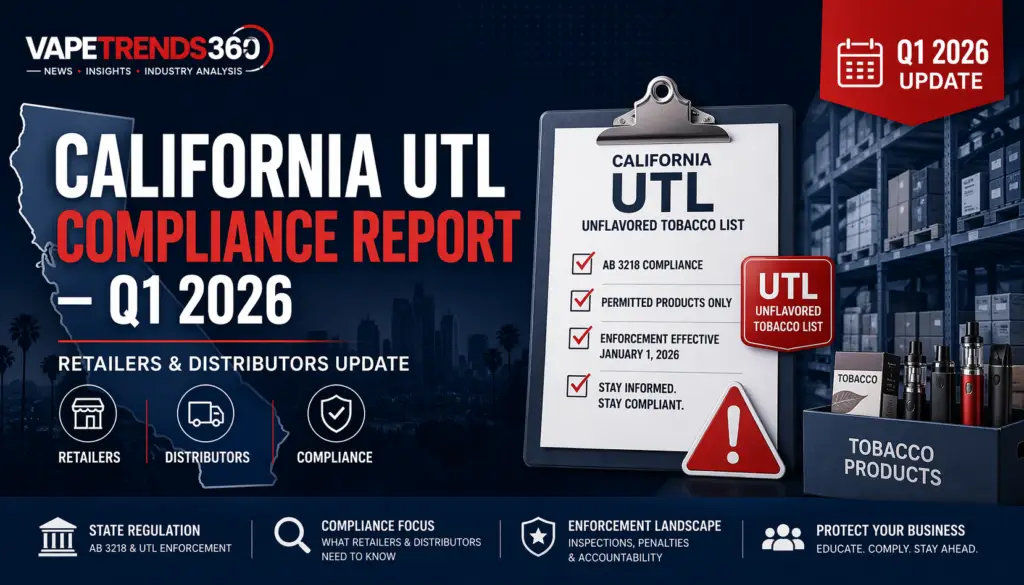
California UTL: Q1 2026 Compliance Report for Retailers and Distributors
When California Attorney General Rob Bonta published the first-ever Unflavored Tobacco List on December 31, 2025, most industry operators already knew the outline of what was coming. What few anticipated was how narrow the list would actually be, how fast the DOJ would transition from “education” to “enforcement,” and how thoroughly it would reshape the wholesale channel serving the nation’s largest vape market.
This Q1 2026 compliance report walks distributors, wholesalers, retailers, and delivery sellers through what’s changed, what penalties now apply, and the operational steps required to stay on the right side of AB 3218 and SB 1230 going into Q2.What the UTL Is — and Why It Matters
The Unflavored Tobacco List is a state-maintained registry of tobacco products the California Attorney General has certified as lacking a “characterizing flavor” under Health & Safety Code §104559.5. It was created by Assembly Bill 3218, which took effect January 1, 2025, and built on the existing flavored-tobacco ban established by Senate Bill 793 (upheld by voters via Proposition 31 in November 2022).The mechanism is a hard whitelist. If a covered tobacco or vapor product is not on the UTL, it cannot legally be sold, possessed for sale, stored, or delivered to any California address by any retailer, wholesaler, distributor, or delivery seller. There is no grace period for unlisted inventory after January 1, 2026.📅 Key Compliance Dates
- October 9, 2025 Initial UTL application deadline for manufacturers and importers
- December 31, 2025 First UTL published by the California DOJ
- January 1, 2026 Active enforcement begins; unlisted products subject to seizure
- February 19, 2026 AG issued Notice of Proposed Adoption of Regulations (formal rulemaking)
- March 9, 2026 Close of 15-day public comment period on proposed regulations
- March 31, 2026 Late manufacturer applications first reviewed
- July 1, 2026 Next scheduled UTL update window
What’s Actually on the List (and What Isn’t)
The first UTL is dominated by products from large tobacco manufacturers with existing FDA marketing orders — the Vuse Solo and Alto platforms, NJOY Daily and ACE systems, and Logic Pro and Power devices, all in tobacco-only flavor profiles. Menthol is explicitly excluded because SB 793 classifies menthol as a characterizing flavor.Legal to Sell
- Vuse Solo & Alto (tobacco only)
- NJOY Daily & ACE (tobacco)
- Logic Pro & Power (tobacco)
- FDA-authorized tobacco-flavor pods
- Unflavored tobacco e-liquids on UTL
Illegal to Sell
- All flavored disposables (fruit, dessert, candy)
- All menthol products, including FDA-authorized
- Products with “coolant additives”
- Elf Bar, Lost Mary, Geek Bar, RAZ, Flum
- Fume, Breeze, Kado Bar, Hyde, Tyson 2.0
Enforcement Posture: “Obviously Flavored” Is the Priority
In a Department of Justice information bulletin issued ahead of the January 1 launch, California officials signaled a tiered enforcement approach. The top priority is what the DOJ calls “obviously flavored” products — items whose trade names or marketing make the violation self-evident (any SKU with “Strawberry,” “Blue Razz,” “Mango Ice,” or similar in the product name). These are subject to immediate seizure and civil penalties.Products in gray areas — certain hand-rolled leaf cigars, pipe tobaccos, and unflavored items still pending UTL determination — will initially receive educational notices and compliance outreach before escalation to fines. But the DOJ has been explicit that unregistered products remain subject to seizure at any time under Business & Professions Code §§22974.2 and 22978.3.Local Overlay Risk
Local jurisdictions retain power to enforce stricter ordinances. San Francisco bans all vapor product sales regardless of UTL status. Los Angeles County and dozens of cities have additional retailer licensing overlays. UTL compliance is the floor, not the ceiling.The Penalty Structure Retailers Need to Memorize
AB 3218’s tiered civil penalty schedule applies per violation — which can mean per product, per transaction, or per inspection finding, depending on the enforcing agency:| Violation | Civil Penalty | Additional Consequences |
|---|---|---|
| 1st violation | $400 – $600 | Product seizure; compliance notice on record |
| 2nd violation (within 5 years) | $900 – $1,000 | Product seizure; retailer license review |
| 3rd violation (within 5 years) | $1,200 – $1,800 | Product seizure; potential license suspension |
| 4th+ violation (within 5 years) | $3,000 – $4,000 | Product seizure; license revocation |
What Q1 Inspections Have Actually Looked Like
Reports from retailers across Los Angeles, San Diego, the Inland Empire, and the Bay Area describe a sharply accelerated inspection cadence in January and February 2026. CDPH and local health department inspectors have been pairing with CDTFA tax compliance officers to do walk-throughs that cover both UTL compliance and excise tax receipts simultaneously.Distributor and Wholesaler Obligations
The supply-chain implications extend well beyond the point of sale. Under the current framework:- California-licensed distributors and wholesalers may not sell unlisted covered products to any California retailer.
- Out-of-state wholesalers are permitted to possess inventory that isn’t UTL-listed, but may not ship it to California addresses.
- Any delivery to a California licensee creates exposure for the sender under both state law and the federal PACT Act.

How to Verify UTL Status Before You Buy or Sell
The UTL is maintained by the California DOJ and published as a downloadable list with brand, product, and variant-level detail. Compliance verification should happen at three points in the workflow:- Pre-Purchase (Distributor / Wholesaler) Every PO for California-bound inventory should include a UTL check against the current published list. Manufacturer attestations are not sufficient — the only authoritative source is the DOJ publication.
- Pre-Shelf (Retailer) When inventory lands, cross-check each SKU against the UTL before it goes to the sales floor. Barcode and SKU-level logging creates the paper trail that works in your favor during inspections.
- Pre-Sale (Point of Sale) Larger operations are adding UTL-status flags into their POS systems that block ring-up of non-listed items. For smaller retailers, a printed UTL summary at the counter is the baseline.
Q1-to-Q2 Transition Compliance Checklist
- Download the current UTL from the California DOJ and date-stamp the version you’re working from
- Pull a full SKU-level inventory report and flag every item not on the UTL
- Remove all unlisted covered products from sales floor, back stock, warehouse, and delivery inventory
- Document disposal or out-of-state return of unlisted inventory with photos and shipping records
- Update POS system with UTL-status flags or block codes on non-listed SKUs
- Update e-commerce platforms to block shipping of non-UTL products to California ZIPs
- Verify your retailer or distributor license is current with CDTFA and your local jurisdiction
- Confirm PACT Act registration and monthly reporting is up to date for any remote sales
- Train counter staff on UTL basics and the difference between “flavored” and “unflavored tobacco”
- Subscribe to DOJ update notifications — the UTL will be amended on rolling application cycles
- Schedule quarterly UTL reconciliation tied to each new DOJ publication
What Q2 2026 Likely Holds
Three forces will shape Q2 enforcement:First, the AG’s February 19, 2026 proposed regulations — once finalized after the March 9 comment window — will lock in the formal penalty assessment and appeal procedures for distributors and wholesalers. Expect the first wave of distributor-level civil penalty actions in Q2 or early Q3.Second, the March 31, 2026 late-application review window means a second wave of UTL additions is coming. Manufacturers whose unflavored tobacco SKUs weren’t ready for the October 2025 deadline now have a path onto the list, but with longer review timelines.Third, interaction with the FDA’s March 9, 2026 draft guidance on adult-flavor pathways (mint, coffee, tea, spice) creates a question the California framework hasn’t yet answered: if the FDA eventually authorizes a mint-flavored product under a new adult-flavor pathway, does it qualify for UTL registration? Under the current statutory text of SB 793 and AB 3218, the answer is no — menthol and mint are characterizing flavors regardless of federal status. Any change would require legislative action in Sacramento.Frequently Asked Questions
Are menthol vapes legal in California in 2026 if they’re FDA-authorized?
No. California’s SB 793 classifies menthol as a characterizing flavor, and AB 3218 did not carve out an exception for federally authorized menthol products. Even the FDA-authorized Vuse Alto menthol variants are not legal to sell in California. Only tobacco-flavored products on the UTL qualify.
Can a California retailer hold unlisted inventory in back stock if it’s not being sold?
No. AB 3218 explicitly prohibits retailers from possessing, storing, or owning flavored tobacco products or products not on the UTL. Removing items from the sales floor but keeping them in the back room is not compliant and has already triggered Q1 citations.
What happens to unlisted inventory purchased before January 1, 2026?
There is no sell-through period. Pre-existing inventory of unlisted covered products had to be removed by January 1, 2026. Best practice is to ship it out of state to a licensed buyer in a jurisdiction where it can be lawfully sold, or to document destruction.
How do out-of-state online retailers comply when shipping to California?
Out-of-state sellers must: (1) block non-UTL SKUs from shipping to California ZIPs, (2) maintain PACT Act registration and file monthly reports with California tax authorities, (3) verify age at both point-of-purchase and delivery (adult signature required), and (4) hold the appropriate California remote retailer licensing. Shipping an unlisted flavored disposable into California — even from another state — violates AB 3218.
How often is the UTL updated, and how does my product get added?
The DOJ accepts rolling applications after the initial October 9, 2025 deadline. Late applications are first reviewed starting March 31, 2026, with the next formal update window targeted for July 1, 2026. Manufacturers and importers apply through the DOJ’s online portal and pay an initial placement fee ($300 per product, reduced to $150 for annual renewals based on current draft rules).
Do hemp-derived or cannabis vape products fall under UTL rules?
No. SB 793 and AB 3218 regulate tobacco products (including nicotine vapor). Hemp-derived CBD and delta-THC vape products are governed by California’s separate cannabis and hemp regulatory frameworks. However, dual-purpose retailers selling both nicotine and hemp products must comply with both regimes.
Can consumers still possess or buy flavored vapes for personal use?
California’s flavor laws target the supply side. Consumers are not criminalized or fined for personal possession or use of flavored products. However, any attempt to purchase from a California retailer or receive a shipment to a California address is blocked by the retailer-facing restrictions.
Does the UTL preempt stricter local rules?
No. Local jurisdictions retain authority to pass stricter ordinances than state law. San Francisco bans all vapor product sales entirely. Los Angeles County, Contra Costa County, and several dozen cities have their own tobacco retailer licensing overlays. UTL compliance is the floor, not the ceiling.
Further Reading & Official Sources
- California DOJ — Unflavored Tobacco List Regulations (official rulemaking page)
- California Department of Public Health — California Flavored Tobacco Sales Law
- California AG Office — UTL Publication Announcement (Dec. 31, 2025)
- BJWholesale — Licensed U.S. wholesale distribution
- VapeOwls — Southern California consumer vape retailer