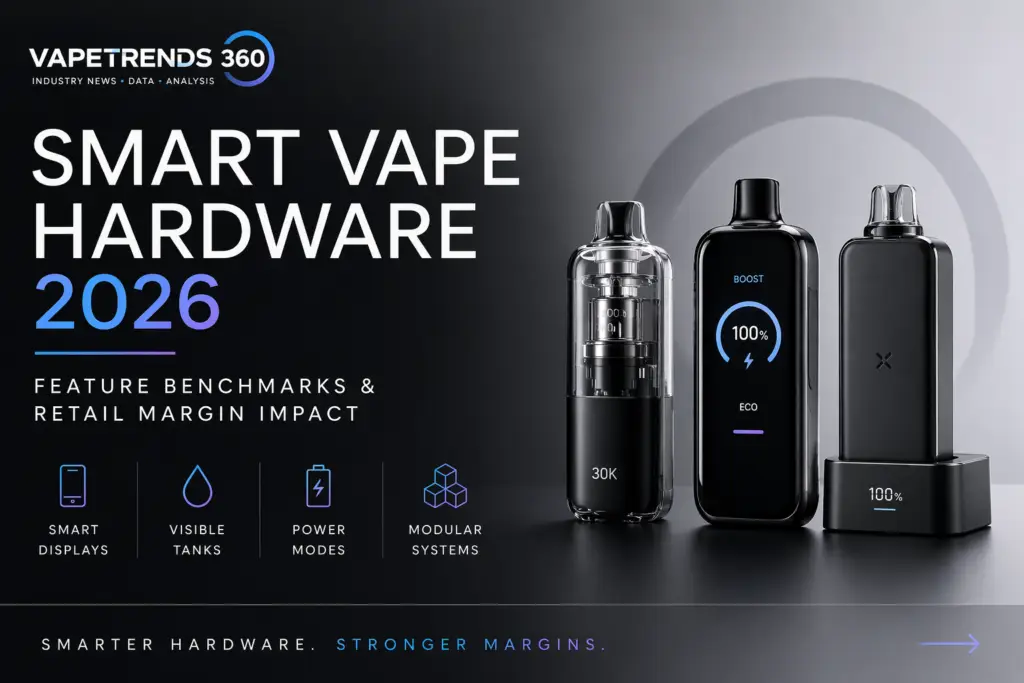
Smart Vape Hardware: 2026 Feature Benchmarks & Retail Margin Impact
The vape industry exited the puff war in 2025 and entered the Smart Era. Today’s flagship disposables are miniature computers with HD screens, dual-core VPU chipsets, AI-tuned airflow, and interactive flavor controls. For retailers and distributors, that shift is reshaping margin structure, shelf strategy, and counter-staff training requirements. Here’s the 2026 hardware benchmark and the bottom-line impact on your P&L.
For a decade, the disposable vape category competed on a single number: puffs. Ten thousand became fifteen, fifteen became twenty-five, twenty-five became fifty, and by late 2025 the ceiling had stretched to the Waspe Crystal 180K. Then the market did something unexpected. It stopped caring.
Vapesourcing’s 2026 backend data — drawn from millions of SKU-level transactions — shows that consumers are now prioritizing longevity, reliability, and brand-name trust over gadgetry. But that’s only half the story. The other half is that the flagship products driving the highest ASPs and the strongest sell-through in Q1 2026 aren’t just bigger. They’re smarter. HD screens, dual-core processors, AI-tuned airflow, and ultrasonic atomization are the features pulling premium shelf space — and premium margins.
This VapeTrends360 hardware report benchmarks the three flagship “smart disposables” that have defined the 2026 feature ceiling, analyzes what those features mean for retail margin and sell-through velocity, and lays out the Q2-Q3 inventory strategy questions distributors and retailers should be asking right now.
Defining the “Smart Era” — What Actually Changed
The distinction between a legacy disposable and a smart disposable isn’t about a screen bolted to the front. It’s about a full-stack shift in how the device manages three variables: power delivery, flavor extraction, and user feedback. Three hardware layers define the category:
1. The chipset. Legacy disposables used a simple draw-activation circuit and a fixed-voltage battery dump to the coil. Smart disposables now run a dedicated Vaping Processing Unit (VPU) — Geek Bar’s internal term — or a dual-core processor that manages power curves across the life of the device. The chipset adjusts wattage based on coil temperature, e-liquid viscosity, puff duration, and remaining battery charge. This is what stretches a 25,000-puff claim from an aspirational marketing number into a reproducible performance spec.
2. The display. The screen isn’t cosmetic. It’s a telemetry surface. Smart disposables now report real-time battery percentage, e-liquid level, current wattage or power mode, puff counter, and mode-switching confirmation. For retailers, this matters because screen-equipped products have demonstrably lower return rates — customers know what they have left and don’t return “dead” devices that were actually full.
3. The interaction model. This is where 2026 separated itself from 2024. Lost Mary’s Spin-to-Enhance dial, Geek Bar’s AI airflow tuning, and RAZ’s Normal/Boost switching transformed the disposable from a passive delivery device into something closer to a configurable pod system. The practical effect at retail is that counter staff now need to explain features, not just sell flavors.

The 2026 Flagship Benchmark: Three Reference Devices
Across thousands of SKUs, three devices define the 2026 smart-era feature ceiling. These are the products distributors should be benchmarking competitive lineups against:
| Feature | Geek Bar Pulse X 25K | Lost Mary Ultrasonic 35K | RAZ LTX 25000 |
|---|---|---|---|
| Display | 3D curved LED screen (Starlight UI) | Dual LED indicators (battery + e-liquid) | 1.77″ HD screen (light/dark modes) |
| Chipset | VPU dual-core | Ultrasonic + dual mesh | VPU Inside |
| Signature Feature | AI airflow tuning | Spin-to-Enhance dial | Animated vaping UI |
| E-Liquid Capacity | 18 mL | 20 mL | 16 mL |
| Battery | 820 mAh | 800 mAh | 800 mAh |
| Power Modes | Regular (25K) / Pulse (15K) | Normal (35K) / Boost (20K) | Normal (25K) / Boost (15K) |
| Wattage Range | 11W / 20W | Ultrasonic + mesh hybrid | 12W / 24W |
| Charging | USB-C | USB-C (1A fast) | USB-C |
| Typical MSRP | $17.99 – $19.99 | $15.99 – $17.99 | $14.99 – $16.99 |
Each device represents a distinct engineering philosophy. Geek Bar went deep on chipset sophistication — the Pulse X is the first disposable to publicly brand its silicon (the VPU). Lost Mary bet on replacing the heating paradigm entirely, swapping traditional coil-only atomization for ultrasonic technology that vibrates e-liquid at high frequency. RAZ took the most retailer-friendly path: a sharp HD screen, intuitive mode switching, and broad flavor availability at a mid-tier price.
Benchmark update: Geek Bar Pulse X2 50K
Worth adding to the flagship benchmark set: the Geek Bar Pulse X2 50K (Pulse X 2). It pairs a 0.6ohm dual mesh coil with adjustable airflow and a 3D curved display at 50,000 rated puffs and 850mAh. At a $22.99 shelf price that is roughly 46¢ per 1,000 puffs, against about 80¢ for the Pulse X 25K it replaces — the clearest example this cycle of puff-count inflation actually translating into lower cost per puff rather than just a bigger number on the box. The trade-off for retailers is SKU depth: 18 flavours against 40+ on the outgoing model.
Retail Margin Analysis: Where the Money Actually Is
The headline story from Q1 2026 inventory data is that smart disposables aren’t just selling at higher retail prices — they’re producing meaningfully better unit economics than the legacy 5K-10K category they’re displacing. Three dynamics are driving this:
Tier 1
Legacy Disposables (5K–10K)
Gross margin, price-compressed by commodity competition
Tier 2 — Growth Zone
Smart Mid-Tier (15K–25K)
The sweet spot — premium features without premium sticker shock
Tier 3
Flagship Smart (35K+)
Best unit margin, slower velocity, requires counter-staff selling
The mid-tier smart disposable is the highest-ROI SKU a retailer can stock right now. The sticker price is high enough to protect margin from aggressive online competition, the feature set is meaningful enough to justify the price to customers, and the velocity is fast enough that inventory turns don’t suffer the way they do at the flagship tier.
Mid-sized multi-category wholesalers such as BJWholesale have restructured their 2026 smart-disposable programs around this exact thesis: deep inventory on Tier 2 SKUs, curated selection on Tier 3 flagships, and reduced stock depth on legacy Tier 1 products. That shift has been validated by sell-through data from independent retailers across the Southwest.
Compliance Overlay
In flavor-ban states — California (UTL), Massachusetts, New York — smart disposables are almost entirely excluded from legal sale because their flavor profiles are fruit, candy, or menthol-derived. Retailers in these states must read the smart-era trend through the lens of tobacco-flavored UTL-listed products only.
The Counter-Staff Training Gap
The single most underestimated operational cost of the Smart Era is staff training. In the 5K-disposable era, counter conversations were five seconds long: “What flavor do you want?” In the smart-disposable era, customers routinely ask:
- What’s the difference between Regular Mode and Pulse Mode?
- Does the AI airflow feature actually work, or is it marketing?
- Is the Spin-to-Enhance dial better for tart flavors or sweet ones?
- How long does 25,000 puffs actually last for a real person?
- Why does this one cost $18 when the old ones cost $8?
Retailers who have invested 10-15 minutes of staff training per new SKU launch are reporting materially higher attach rates on premium flavors and accessories. Those who haven’t are watching premium inventory sit on the shelf while customers default to the cheapest option available.
The retailer’s job in 2026 isn’t to stock every SKU. It’s to curate the right 20 SKUs and teach staff to sell the top 5.
Q2-Q3 Inventory Strategy Questions
Heading into Q2 and Q3, every distributor and retailer allocating open-to-buy dollars should be answering three specific questions about their smart-vape program:
1. What’s my cap on SKU count per shelf linear foot? The temptation in the Smart Era is to carry every flagship the market throws at you. That’s a losing strategy because it dilutes staff expertise and creates inventory-aging problems. Benchmark: 3-5 flagship SKUs, 8-12 mid-tier smart SKUs, 2-3 legacy holdover SKUs for price-sensitive customers.
2. Am I priced correctly relative to online competition? Smart disposables have narrower price bands than legacy products, but online discounting pressure is intensifying. Retailers who try to hold MSRP on flagship smart SKUs against aggressive online competitors are losing unit velocity. Retailers who match online pricing to within 10-15% are capturing the convenience premium and protecting margin.
3. Do I have a counterfeit authentication process? High-value smart disposables are the #1 target for counterfeiters in 2026. Every intake of a new flagship SKU should include a scratch-code verification against the manufacturer’s authenticity portal. Retailers without an authentication workflow are carrying reputational risk they can’t quantify until a customer brings back a counterfeit device.
Q2 Smart-Vape Inventory Playbook
- Audit current SKU mix against the Tier 1 / Tier 2 / Tier 3 framework
- Reallocate shelf space toward Tier 2 (mid-tier smart) at the expense of Tier 1 (legacy)
- Establish a 3-5 SKU flagship cap; avoid carrying every 35K+ device on the market
- Build a one-page smart-vape feature cheat sheet for counter staff
- Run 10-minute weekly training blocks on new SKU launches
- Implement scratch-code authentication on all flagship intake
- Track sell-through velocity weekly by tier — not monthly by category
- Benchmark MSRP against top 3 online competitors and close the gap to 10-15%
- Cross-sell batteries, chargers, and adjacent pods to smart-disposable buyers
- Segment California inventory (UTL-listed SKUs only) and flag non-compliant smart devices
What’s Coming in H2 2026
Three developments on the hardware roadmap will define H2 2026 and deserve watching now:
Bluetooth-connected disposables. Lost Vape’s Centaurus BT200 proved that Bluetooth-to-smartphone integration works in open-system box mods. The question is how quickly the disposable category follows. Early signals suggest at least two major Chinese manufacturers are prototyping Bluetooth-enabled disposables for a Q3 2026 launch. If that ships, the “smart” definition expands again — from onboard intelligence to networked intelligence.
Ultrasonic atomization going mainstream. Lost Mary’s Ultrasonic 35K proved the concept commercially. Expect three to five additional manufacturers to launch ultrasonic-heated disposables by year-end, which will both validate the technology and compress the premium Lost Mary has enjoyed on the feature.
AI moving from marketing claim to functional spec. “AI-tuned” is currently a loose descriptor covering everything from basic adaptive firing curves to actual machine-learning-trained coil management. By H2 2026, expect industry pressure (including from FDA marketing-claim review) to force manufacturers to specify what their AI actually does. Distributors and retailers should be prepared to explain real AI features to customers who are becoming increasingly skeptical of the term.

The Smart Era isn’t a marketing cycle. It’s a structural shift in how the disposable category is designed, priced, and sold — and it’s producing the best unit economics the vape channel has seen in three years.
Retailers and distributors who optimize shelf mix, staff training, and pricing for this reality are capturing 40%+ gross margins on fast-turning mid-tier SKUs. Those still treating 2026 like a puff-count race are leaving that margin on the table.
Frequently Asked Questions
Is “AI-tuned airflow” a real feature or marketing language?
Both. The underlying functionality — a chipset that adjusts power delivery based on coil temperature, puff duration, and battery state — is real and measurable. The term “AI” is loose; most current implementations are adaptive firing curves rather than machine learning. Retailers should position the feature as “smart firing” or “adaptive airflow” in customer conversations to avoid over-promising.
What’s the actual difference between a VPU chipset and a standard disposable circuit?
A standard disposable uses a simple draw-activation switch that dumps battery voltage directly to the coil. A VPU (Vaping Processing Unit) actively monitors coil resistance, battery state, and power delivery, then modulates wattage dynamically — enabling features like mode switching, consistent flavor across the device’s lifespan, and more accurate puff-count reporting. The practical effect is a more consistent experience from first puff to last, which is why VPU-equipped devices produce lower return rates.
Do smart disposables have higher counterfeit risk?
Yes. Flagship smart devices are the #1 counterfeit target because they carry the highest retail markup and consumer demand. Counterfeiters can replicate packaging and shells but struggle to clone the chipset, screen responsiveness, and coil behavior. Any retailer carrying $15+ disposables needs a scratch-code authentication process at intake — not at point of sale.
Are smart disposables FDA-authorized?
No. As of April 2026, all 41 FDA-authorized e-cigarette products are tobacco or menthol flavored pod or cartridge systems from large tobacco manufacturers (Vuse, NJOY, Logic). No flavored smart disposable from Geek Bar, Lost Mary, RAZ, or similar manufacturers has received PMTA marketing authorization. These products operate in a federal enforcement gray zone that has tightened significantly in 2026.
What’s the realistic inventory turn on a flagship smart disposable?
Tier 3 flagship smart SKUs (35K+ puff, $20+ retail) typically turn 8-12× annually in independent specialty retail, versus 18-24× for Tier 2 mid-tier smart SKUs. That slower turn is why flagship inventory requires disciplined SKU management — carrying 15 flagships guarantees that 10 will age out before they sell through.
How much should I train staff on new smart-vape features?
Benchmark: 10-15 minutes per new SKU launch, delivered in weekly team huddles rather than one-off training sessions. The key is consistency. Retailers who train staff to confidently explain the Spin-to-Enhance dial or Pulse Mode capture the premium-SKU conversion; retailers who don’t watch customers default to whatever’s cheapest.
Will ultrasonic atomization replace coil-based heating?
Not in 2026, likely not in 2027. Ultrasonic is a premium feature that adds cost and complexity; it will remain a differentiator in flagship SKUs while the bulk of the market continues to use mesh-coil heating. Expect 3-5 additional ultrasonic disposables by end of 2026, but coil heating will remain the category standard for the foreseeable future.
What’s the wholesale case pack strategy on smart disposables?
For flagship smart SKUs, order in smaller case packs (5-10 units per flavor) across a wider flavor range rather than bulk-buying single flavors. Consumer purchase behavior in smart disposables is “try before you commit” — customers will test 2-3 flavors before settling, so depth in one flavor creates aging inventory.
Further Reading & References
- VapeTrends360 — Geek Bar Pulse X Review: One of the Best Disposable Vapes in 2026?
- VapeTrends360 — Geek Bar CLR 50K — Independent Review (Neutral, Fact-Based)
- VapeTrends360 — Flavored Vape Regulations 2026: FDA Guidance, State Bans & Legal Pressure
- BJWholesale — Licensed U.S. wholesale distribution
- VapeOwls — Southern California consumer vape retailer