Made in USA vs. Made in China: How Origin Became the New Compliance Line
For fifteen years, “country of origin” was a marketing footnote on disposable vape packaging. In 2026, it has become a compliance determinant — and in at least one major state, a criminal one. Here is what retailers, distributors, and manufacturer reps need to know before the next order lands on the dock.

The shift: from branding claim to buying criterion
Walk the aisles at a 2024 tobacco trade show and “Made in USA” was the kind of sticker you might see on a bottle of artisan salt nic — nice to have, rarely decisive. By April 2026, it is the question that determines whether a shipment clears customs, whether a retailer’s inventory is legal to sell in Texas, and whether a distributor’s invoice will be honored by their carrier.Three enforcement pressures converged to make this happen, and they did so faster than most operators in the channel expected. These compound with the broader shift in U.S. federal vape policy, which since March 2026 has formally raised the evidentiary bar for non-tobacco-flavor PMTAs.Pressure one: Texas SB 2024
Governor Greg Abbott signed Senate Bill 2024 into law on June 20, 2025, with an effective date of September 1, 2025. The final version of the bill prohibits the sale of any e-cigarette product manufactured in, or marketed as being from, China or any other country designated a “foreign adversary” by the U.S. Secretary of Commerce.The compromise language is narrower than the earliest drafts — the bill ultimately targets products where the e-liquid itself is manufactured and filled in China, rather than every component. A device with a Chinese-made shell but U.S.-filled juice can still qualify. But the practical effect on Texas smoke shop inventory has been dramatic: reporting from Austin-based retailers suggests disposable vapes represented roughly 25 to 33 percent of revenue at many independent shops before the law took effect, and the vast majority of that SKU count was filled overseas.Pressure two: FDA “seize and destroy” at the border
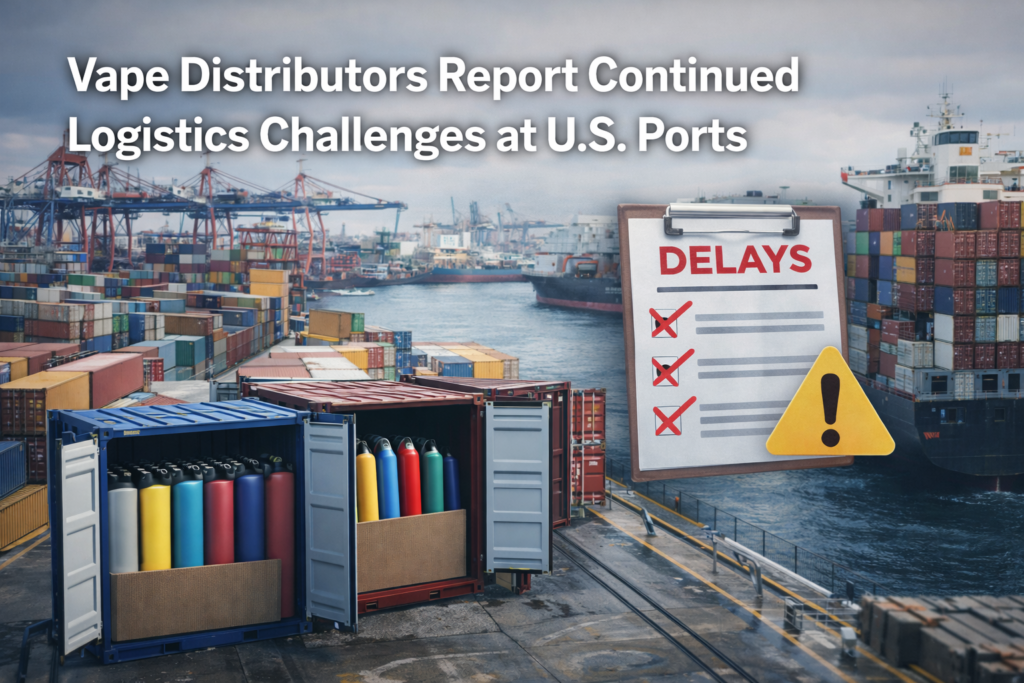
The FY 2026 Agriculture Appropriations bill included a quiet but consequential provision. Previously, when Customs and Border Protection flagged an unauthorized vape shipment, the agency would detain the product and begin a legal review process that could take months. Importers often waited it out or rerouted.Under the new provision, CBP may seize and destroy unauthorized vape shipments immediately at the port of entry. Combined with the FDA raising civil money penalties to over $21,000 per violation for retailers caught selling unauthorized brands, the cost-of-noncompliance calculus has changed materially.Congress reinforced this posture by directing the FDA to allocate $200 million for enforcement in FY2026, with a multi-agency task force — FDA, DOJ, and DHS — coordinating on port-of-entry interdiction. Chinese e-cigarette exports to the U.S. exceeded $10.6 billion in 2025, according to a recent GAO report, so the supply being choked at the border is enormous. We track confirmed seizure actions and agency letters in our ongoing Enforcement Actions & Warning Letters coverage.Pressure three: state product directories
Separate from origin-based rules, a growing list of states now operate a “directory” or “whitelist” system. If a brand is not on the state’s approved list, it cannot be sold in that state — regardless of whether it is FDA-compliant or American-made. California, Wisconsin, North Carolina, Florida, Tennessee, Mississippi, and Pennsylvania all operate some version of this model as of April 2026.Directory laws and origin laws do not perfectly overlap. A product can be:- FDA-authorized (one of the ~41 ENDS products with a Marketing Granted Order) and on every state directory — fully compliant.
- U.S.-assembled but not FDA-authorized — legal to ship to Texas, potentially illegal to sell in California.
- Chinese-manufactured and FDA-authorized (rare, but it exists for some SKUs) — legal federally and in most states, illegal in Texas under SB 2024.
The FDA’s counterpoint: compliance, not origin
This is the part of the conversation that industry messaging often glosses over, and it matters. The FDA itself has been explicit that “Made in America” positioning does not, on its own, confer legal status. The agency’s position is that any vape product lacking proper authorization is illegal, regardless of whether it was manufactured in Thousand Oaks or Shenzhen.Who is actually building vapes in the United States?
The domestic manufacturing tier is small but growing. Fifty Bar, headquartered in Thousand Oaks, California, is generally cited as the first disposable vape brand to assemble and fill devices domestically, in partnership with Beard Vape Co. The current flagship is the Fifty Bar 20K V2, with an 18 ml tank, USB-C rechargeable battery, and mesh coil. One Tank 40K and a handful of hybrid-pod brands (which assemble domestically even when hardware sub-components are imported) round out the short list.The economic logic for moving assembly to the U.S. is not purely regulatory. Tariffs on Chinese electronics, freight volatility, and the port-seizure risk have all raised the effective landed cost of imported disposables. For brands operating at scale, the math on domestic assembly has tightened considerably since 2024.That said, “domestic” is a spectrum, not a binary:| Tier | What It Means | Regulatory Treatment |
|---|---|---|
| Fully domestic | Hardware, e-liquid, assembly, and packaging all U.S.-based | Clearest path; generally passes origin rules |
| U.S.-filled, imported hardware | Chinese shell, U.S.-made e-liquid, U.S. fill/assembly | Legal under Texas SB 2024 (liquid origin is the trigger) |
| Imported and U.S.-filled | Pre-assembled Chinese device, topped with U.S. liquid before retail | Gray area — depends on state law interpretation |
| Fully imported, U.S. distributor | Made and filled in China, imported by U.S. entity | Subject to SB 2024 ban in Texas; CBP seizure risk at port |
What “Built in USA” actually solves — and what it doesn’t
What it solves
- Texas SB 2024 exposure. A U.S.-filled disposable is not captured by the statute’s core prohibition.
- Port-seizure risk. Domestic assembly eliminates CBP as a point of failure.
- Supply-chain transparency. U.S. facilities are more easily audited, inspected, and verified than overseas OEM partners.
- Consumer trust. Counterfeit rates on imported disposables remain high; domestic lines are materially harder to clone.
What it does not solve
- PMTA status. The FDA still requires marketing authorization regardless of origin. For a list of brands claiming domestic production and what the FDA actually reviews, see our “Built in USA” vape playbook.
- State flavor bans. California, Massachusetts, New York, New Jersey, and Rhode Island prohibit flavored ENDS regardless of where they were made.
- Directory requirements. Being U.S.-made does not automatically put a product on a state’s approved list.
- Excise tax liability. Domestic products owe the same state excise taxes as imported ones.
What this means for your business in Q2 2026
The practical implications break down by role:For retailers: Audit your SKU list against both origin rules (if you are in or ship into Texas) and directory rules (if you are in or ship into a registry state). Keep certificates of origin on file for each disposable line you stock. If an important supplier cannot produce one, escalate to your distributor or find an alternative.For distributors: Expect retailers to start asking for origin documentation on every invoice. Build a template now. Review your inventory for exposure to the Texas market specifically, and flag SKUs with Chinese-filled e-liquid. Work with your insurance provider on coverage for CBP seizures.For manufacturers with Chinese production: Consider hybrid domestic-fill arrangements as a near-term bridge. Full U.S. assembly is capital-intensive, but U.S. fill-and-finish partnerships are available on a contract basis and resolve the SB 2024 trigger directly.For brand marketers: “Built in USA” is no longer a generic patriotic flourish. Treat it as a specific, verifiable claim, tied to specific facility addresses, and back it with documentation. Regulators and state AGs are increasingly scrutinizing country-of-origin labeling, and mislabeling carries its own penalty exposure.
Frequently Asked Questions
Q: If a disposable is assembled in the U.S. but uses Chinese-made hardware, is it legal to sell in Texas?
A: Under the final version of Texas SB 2024, the trigger is the origin of the e-liquid, not the hardware. A device with a Chinese shell but U.S.-filled American e-liquid generally falls outside the ban’s core prohibition. That said, the statute also prohibits products “marketed as being from” China, so labeling and branding should be reviewed carefully. Consult a compliance attorney for specific SKUs.
Q: Does “Made in USA” mean a vape is FDA-approved?
A: No. These are two entirely separate regulatory tracks. FDA authorization is granted through the Premarket Tobacco Product Application (PMTA) process and is based on the product’s public-health profile, not where it was manufactured. As of April 2026, only about 41 ENDS products have received Marketing Granted Orders, most of them tobacco or menthol flavored pod systems. A domestic assembly location has no bearing on PMTA status.
Q: What happens to retailers caught selling Chinese-made disposables in Texas after September 1, 2025?
A: Violations are Class A misdemeanors, which carry up to one year in county jail and fines up to $4,000 per offense. Offenses accrue on a per-product, per-transaction basis, which means a single inspection can generate multiple counts. Business licenses may also be subject to revocation.
Q: Are other states planning to pass origin-based vape bans?
A: Yes. Indiana Senate Bill 185 would ban vapes manufactured in foreign adversary countries, and Kansas has advanced similar language. Several other state legislatures have floated draft bills. The Texas model is actively being used as a template by lawmakers in about a dozen states, though most pair origin restrictions with directory or PMTA requirements rather than replacing them.
Q: Is U.S.-assembled always more expensive than imported?
A: Typically yes at the wholesale level, though the gap has narrowed. Tariffs, freight, and the risk of CBP seizure have increased the effective landed cost of imported product. When factored against the compliance risk and the potential inventory loss from border seizures, the total cost of ownership on domestic product is often competitive or better for retailers operating in high-enforcement states.
Q: How can a distributor verify a manufacturer’s origin claim?
A: Request a certificate of origin, a facility address, and — where possible — third-party audit documentation. Legitimate domestic manufacturers will have all three available. Also review the product’s PACT Act registration, which requires accurate manufacturer and distributor information and creates a documentary trail.

Sources and further reading
- FDA Center for Tobacco Products Newsroom — ongoing regulatory announcements
- Vicente LLP — Texas SB 2024 legal analysis
- CSP Daily News — 2026 Tobacco Regulatory Forecast
- Buchanan Ingersoll & Rooney — FDA Flavored Vape Draft Guidance
- Tobacco Insider — Illegal Vapes regulatory tracker
VapeTrends360 publishes industry analysis for adult professionals working in the regulated tobacco and nicotine supply chain. This article is informational and is not legal advice. Consult a licensed compliance attorney for decisions that implicate specific SKUs or jurisdictions.