Why Ice Flavors Are Winning the 2026 Disposable Market
The ice category — menthol, mint, and fruit-menthol hybrids — is currently the most strategically advantaged flavor tier in the U.S. disposable vape market. It has the lowest PMTA evidentiary burden under the FDA’s March 2026 draft guidance, the strongest state-directory survivability, and a consumer preference curve that has held steady through every regulatory shock since 2020. For retailers and distributors allocating 2026 shelf space, ice isn’t a flavor preference. It’s a compliance hedge.

The regulatory tailwind
On March 9, 2026, the FDA’s Center for Tobacco Products released draft guidance titled Flavored Electronic Nicotine Delivery Systems (ENDS) Premarket Applications – Considerations Related to Youth Risk. The document formalized what the industry had been reading between the lines for two years: the agency’s PMTA review is now explicitly tiered by flavor category, with the evidentiary burden scaled to perceived youth appeal.
The tiering, as outlined by the Buchanan Ingersoll & Rooney analysis and confirmed by multiple regulatory bulletins:
| Flavor Tier | Evidentiary Burden | 2026 MGO Count |
|---|---|---|
| Tobacco | Lowest | Majority of 41 authorized ENDS |
| Menthol / mint | Modest incremental | Remainder of the 41 |
| Coffee, tea, spice | Moderate | Zero authorized to date |
| Fruit / candy / dessert | Highest (“substantial public health risk”) | Zero authorized to date |
Put differently: every one of the 41 FDA-authorized ENDS products on the market as of Q2 2026 is either tobacco- or menthol-flavored. Not a single fruit, candy, or dessert-flavored product has cleared the agency’s scientific review — despite millions of PMTAs submitted.
What this means for your category management: Ice and menthol products are the only flavored disposables with a plausible, near-term path to full FDA authorization. Fruit-ice hybrids sit in a gray zone — the menthol character may help, but the fruit component likely keeps them in the higher-burden tier. Pure mint and menthol profiles are the safest 2026 bet for operators who want inventory that can survive a federal enforcement escalation.
Why menthol and mint got the exemption
The FDA’s own language in the draft guidance acknowledges that menthol and mint have “reliable scientific evidence of relatively lower youth appeal.” That phrase carries weight. The National Law Review’s analysis of the draft guidance notes that the agency has adopted “a graduated, risk-proportionate approach” that will allow menthol, mint, and certain mature flavors like coffee and tea to satisfy the appropriate-for-the-protection-of-public-health (APPH) standard with a more modest evidentiary showing than sweet categories.
Separately, the federal policy shift following the January 2025 withdrawal of the menthol cigarette ban has given menthol products broader political cover than they had during the prior administration. Menthol, for now, is the flavor category the FDA appears most willing to authorize at scale.
The state-compliance layer
Federal authorization is one dimension. State directories are another, and they don’t always align.
- California: The Unflavored Tobacco List (UTL) restricts flavored vape sales statewide. Menthol receives a carve-out in limited circumstances, but most fruit-ice hybrid products are banned. Pure menthol has a path; “Watermelon Ice” generally does not. See our California UTL Q1 2026 compliance report for the full SKU-level breakdown.
- Massachusetts, New Jersey, New York, Rhode Island: Flavored vape sales prohibited. Menthol is also restricted in some of these jurisdictions — check each state’s statute carefully.
- Mississippi (HB 916), Pennsylvania (Act 57), Wisconsin, Tennessee, North Carolina, Florida: Registry-based systems. Products must appear on the state-approved list. Tobacco and menthol FDA-authorized products dominate these registries; fruit-ice products are largely absent.
- Texas (SB 2024): Origin-based restrictions rather than flavor-based, but Chinese-filled fruit-ice products are disproportionately affected since most domestic-fill lines have yet to expand into fruit-flavor variants.
For retailers operating across multiple states, the practical effect is that menthol and mint SKUs require fewer compliance exceptions, fewer quarantined inventory pockets, and less per-state shipping-block logic. This is an operational cost most category managers underestimate.
Consumer preference data: the demand side
Regulatory advantage would not matter if consumers didn’t already want these flavors. They do. The demand-side data across 2025 and Q1 2026 shows ice as a dominant and growing share of the disposable category.
According to THR101’s analysis of FDA retail data, flavor categories including menthol and mint accounted for roughly 80 percent of the 47 percent e-cigarette retail sales growth between 2019 and 2023. Industry retailer data from late 2025 and early 2026 shows three ice profiles — Watermelon Ice, Blue Razz Ice, and Miami Mint — consistently ranking as the top-three best-selling disposable flavors across major brands, with Blue Razz Ice specifically cited as the highest-turnover single SKU at multiple large U.S. vape retailers.
The SKU landscape: which ice products are moving
The ice category breaks cleanly into three sub-tiers by product architecture. Each has different wholesale and retail dynamics.
Tier 1 — High-puff fruit-ice disposables
This is the volume tier. Products like Geek Bar Pulse X 25K (Watermelon Ice, Blue Razz Ice, Sour Apple Ice), Foger Switch Pro 30K (Blue Razz Ice, Juicy Peach Ice, Watermelon Ice), RAZ Vue 50K (Strawberry Ice, Blueberry Raspberry Ice), and Lost Mary‘s fruit-ice lineup dominate retail turnover. Margins are tight at the wholesale level but turnover is fast enough to support healthy per-shelf-foot revenue.

Compliance caveat: none of these are FDA-authorized. They operate in the pre-market enforcement discretion zone and carry directory-removal risk in registry states.
Tier 2 — Ice control / multi-level cooling devices
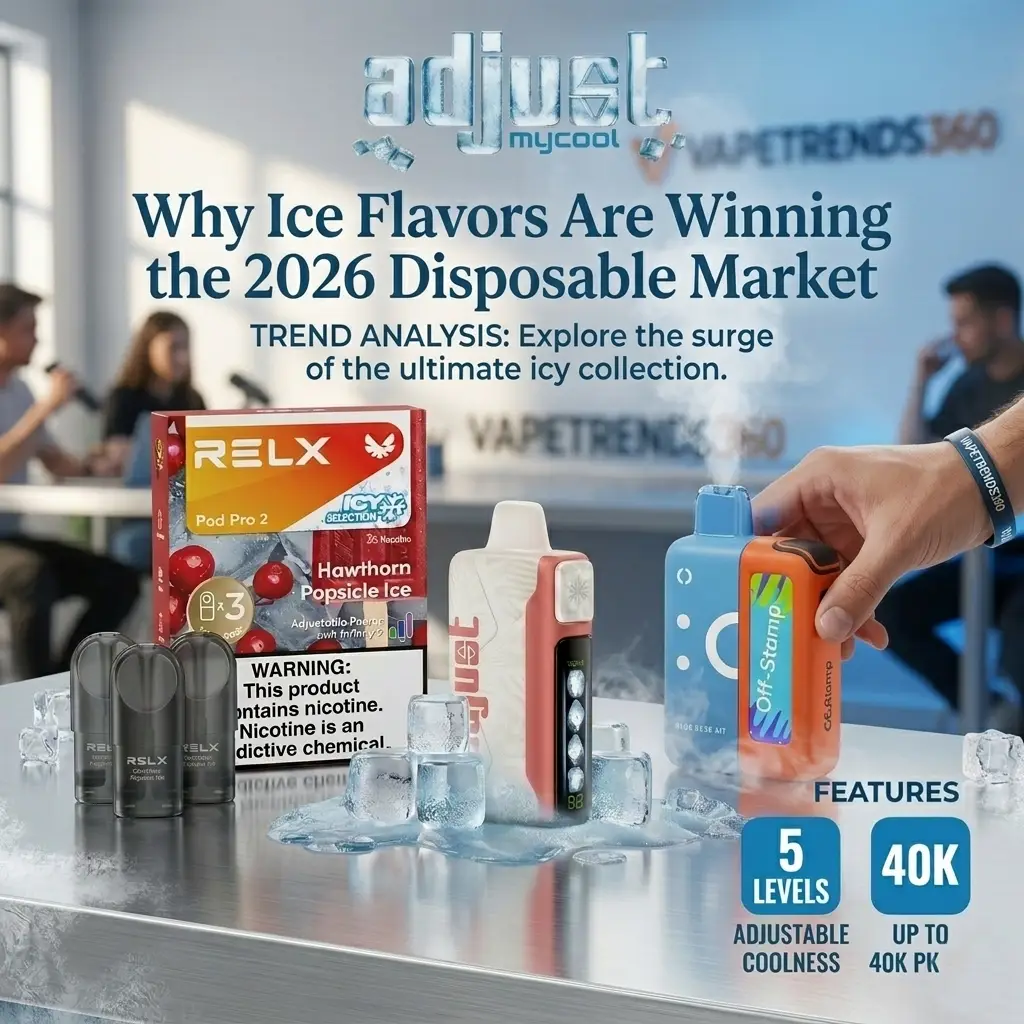
A newer sub-tier driven by devices that let the consumer adjust the menthol intensity. The Pillow Talk Ice Control IC40000 offers four cooling levels. The VNM Ice Mode 30000 uses the same adjustable-chill concept. These products command premium pricing and appeal to flavor-forward users who find fixed-ice devices either too cold or not cold enough.
This tier is where product differentiation is actually happening in 2026. For distributors carrying wider inventory, Ice Control SKUs offer a legitimate conversation to have with retailers about margin-on-volume rather than volume-on-margin.
Tier 3 — Pure mint / menthol
The Myle Meta 25000 Iced Mint, Geek Bar Ice Prince 50K, and Miami Mint variants across most major brands. This is the regulatory-safest tier and the consumer-demand floor — always a top-five seller, rarely a top-one, but the most resilient inventory in a category shakeout. For category managers, this should be a protected allocation regardless of what fruit-ice sales look like month-to-month.
The emerging opportunity: mint evolution
The standout market development of Q1 2026 is what retailers are calling “mint evolution” — the shift from sharp, dental-chemical menthol profiles toward layered mint formulations that incorporate cucumber, eucalyptus, cooling tea notes, or warmer spearmint-forward blends.
This matters commercially because it extends the mint sub-tier’s addressable market beyond traditional menthol-cigarette converts. Devices leaning into this trend include premium SKUs from Foger, SnowPlus, and several domestic-fill operations we’ve previously covered in the “Built in USA” vape playbook. Retailers reporting on mint-evolution SKUs note higher repeat purchase rates and lower rates of flavor fatigue compared with traditional single-note ice products.
What this means for wholesale and retail strategy
For distributors: Prioritize menthol and mint SKUs from FDA-authorized portfolios for directory-state retailers. Keep fruit-ice inventory for discretion-zone states but flag them clearly in sales-order documentation so retailers understand the compliance profile they’re buying into. Expect directory attrition on fruit-ice products to accelerate in H2 2026.
For retailers: Treat ice as its own category, not a flavor sub-tag inside “fruit.” Allocate shelf space in rough proportion to the 55–70% unit-sales signal. Within ice, maintain a three-tier mix: at least one pure mint, at least one adjustable-cooling device, and a rotating fruit-ice bestseller selection.
For brand operators: If your product roadmap for 2026 doesn’t include a pure-menthol or mint-evolution SKU with PMTA-ready documentation, you are operating without the strongest lever the regulatory framework currently offers. The window to file menthol PMTAs under the clearer March 2026 framework is now.
Forecast: We expect at least three major disposable brands to announce domestic-fill menthol lineups with accompanying PMTA filings before the end of 2026. The Glas G2 precedent — where the manufacturer has publicly said its scientific evidence package “aligns with the standards outlined in the FDA’s recent draft guidance” — suggests the agency may begin issuing its first non-tobacco, non-menthol MGOs to mint and mature-flavor applications within 12 to 18 months.
Frequently Asked Questions
Q: Are menthol vapes FDA-authorized?
A: Yes, partially. As of April 2026, roughly 41 ENDS products have received Marketing Granted Orders, all either tobacco- or menthol-flavored, and all from four or five large manufacturers (primarily subsidiaries of major tobacco companies). Menthol pods from NJOY, Logic, and Vuse have specific authorized SKUs. Most menthol disposables from independent brands do not yet have MGOs, though several PMTA applications are pending.
Q: Is “Blue Razz Ice” treated differently from “Watermelon Ice” under the FDA framework?
A: Not meaningfully. Both are classified as fruit-flavored ENDS under the draft guidance’s youth-appeal framework, which puts them in the highest evidentiary tier regardless of their menthol component. The “Ice” suffix adds menthol character but does not reclassify the product into the lower-burden menthol tier for PMTA purposes. This is a common point of confusion in the retail channel.
Q: Which state directories most restrict fruit-ice products?
A: California’s UTL and Mississippi’s HB 916 registry are the most restrictive in practice — both effectively require FDA authorization for inclusion, and no fruit-ice products are authorized. Wisconsin, Florida, Tennessee, North Carolina, and Pennsylvania operate directory systems that are somewhat more permissive, but fruit-ice products are still the most commonly removed category during registry updates.
Q: What’s driving the “mint evolution” trend versus classic menthol?
A: Two factors. First, consumer fatigue with sharp single-note menthol — retailers report that adjustable-cool and complex-mint SKUs have materially better repeat-purchase rates. Second, brand positioning: as menthol becomes the dominant regulatory-safe flavor, brands are differentiating within the category through formulation complexity rather than competing head-to-head on pure menthol.
Q: Should wholesalers stock adjustable-cooling devices like the Ice Control IC40000 or VNM Ice Mode 30000?
A: For retailers serving ice-forward demographics, yes. These devices carry premium wholesale pricing but command higher retail margins and appeal to consumers who have moved past price-driven purchase behavior. They are also a useful category differentiator for retailers competing with online pricing on mainline fruit-ice SKUs.
Q: Is the 55–70% ice category share sustainable?
A: Based on 18 months of consistent data, yes. The share is supported by a structural preference pattern (consumer preference for cooling sensations) rather than a passing trend. Watch for shifts if the FDA authorizes a material number of fruit or dessert SKUs (which we do not expect in 2026) or if a major state passes a menthol-specific ban (Massachusetts is the state to watch).
Sources and further reading
- FDA Center for Tobacco Products Newsroom — March 9, 2026 draft guidance on flavored ENDS
- Buchanan Ingersoll & Rooney — FDA Flavored Vape Draft Guidance Analysis
- National Law Review — FDA Formalizes Flavor-Specific PMTA Framework
- THR101 — FDA Flavored Vape Guidance retail data analysis
- Tobacco Insider — US FDA PMTA coverage
VapeTrends360 publishes industry analysis for adult professionals working in the regulated tobacco and nicotine supply chain. This article is informational and is not legal advice. Consult a licensed compliance attorney for decisions that implicate specific SKUs or jurisdictions.