Regulation · FDA
FDA Cracks Open the Flavored Vape Door — Just Not for Fruit, Candy, or Dessert
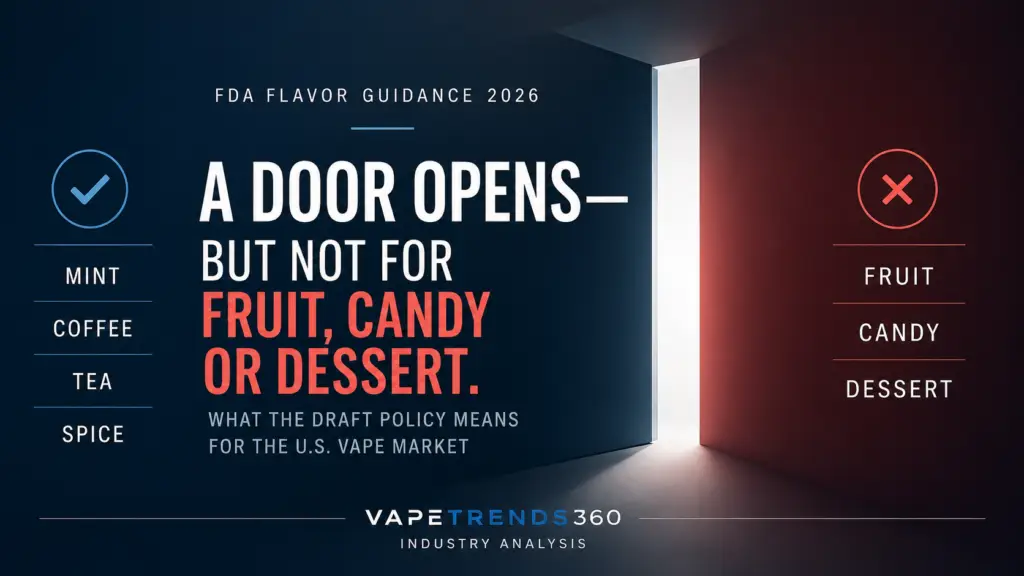
A draft guidance released March 9 and now in public comment through May 11 lays out the agency’s clearest framework yet for evaluating non-tobacco e-cigarette flavors. Mint and spice get a path. Sweet flavors face a wall.
For the first time since the youth vaping panic of 2017–2019 reset the U.S. regulatory conversation, the Food and Drug Administration has put in writing a framework for how a non-tobacco flavored e-cigarette could actually win marketing authorization — and which categories of flavor will keep getting denied.
The document, titled “Flavored Electronic Nicotine Delivery Systems (ENDS) Premarket Applications — Considerations Related to Youth Risk; Draft Guidance for Industry,” was published in the Federal Register on March 11 under Docket No. FDA-2026-D-1817. The agency formally opened the public comment window on April 17. It closes May 11, 2026.
The draft is non-binding. It does not authorize anything. It does not, on its own, change which products are legally sold today. What it does is signal — with more granularity than any prior FDA communication on the subject — how the Center for Tobacco Products intends to weigh youth-appeal evidence against adult-benefit evidence when reviewing Premarket Tobacco Product Applications (PMTAs) for flavored ENDS going forward.
For an industry where only 39 to 41 e-cigarette products have been federally authorized to date, all of them tobacco or menthol, that signal carries weight.
The graduated framework
The core of the guidance is what the FDA calls a “graduated risk-proportionate evaluation.” In practice, the agency is sorting non-tobacco flavors into tiers based on perceived youth-initiation risk relative to potential adult-switching benefit.
- Lower-risk tier: mint, menthol, and “novel” flavors including spice, coffee, tea, and clove. The FDA states these “may present a lower risk of youth initiation and use” relative to sweet categories. Manufacturers still must produce evidence of adult benefit, but the evidentiary bar is described as more achievable.
- Higher-risk tier: fruit, candy, dessert, and other sweet flavors. The agency cites National Youth Tobacco Survey data showing flavored ENDS “played a major role” in the 2017–2019 youth surge and continue to drive both initiation and persistence among young users. Authorization would require “robust and reliable evidence” that the flavored product helps adults completely switch from combusted cigarettes at a rate meaningfully better than tobacco-flavored alternatives.
The asymmetry is deliberate. The FDA’s position is that any added youth-appeal risk introduced by a sweet flavor must be offset by demonstrably greater adult-switching benefit — benefit that goes beyond what tobacco-flavored ENDS already provide.
By the Numbers
39–41 FDA-authorized e-cigarette products as of April 2026. Zero are fruit, candy, or dessert flavored. Four NJOY menthol pods are the only flavored authorizations beyond tobacco.
The DAR shortcut closes
One of the more consequential technical shifts in the draft concerns Device Access Restriction (DAR) technology — the umbrella term for fingerprint locks, age-verification chips, and Bluetooth-paired phone authentication that some manufacturers have positioned as a youth-mitigation tool.
In earlier reviews, including the June 2024 Technical Project Lead review for NJOY, the FDA had suggested DAR could be a viable mitigation pathway for flavored ENDS. The new draft narrows that opening considerably. The agency now states explicitly that DAR technology applied to candy, dessert, and other sweet-flavored ENDS, “without adequate and substantial evidence demonstrating sufficient mitigation of youth risk,” is “insufficient to overcome the heightened concerns associated with these flavor categories.”
For the disposable vape segment — where most high-volume SKUs are sweet, fruit-forward profiles — that language matters. A locked screen on a watermelon disposable will not be enough on its own.
If the FDA imposes a high bar for evidence, that could be a difficult needle to thread.
The reaction split
Public health organizations called the guidance a step in the wrong direction. The Campaign for Tobacco-Free Kids labeled it “troubling” given the FDA’s own summary of evidence that flavors drive youth use. Researchers also flagged that some of the “lower-risk” novel flavors, particularly cinnamon and clove, contain flavor chemicals that are themselves among the more concerning compounds identified in e-cigarette aerosol — a flavor can be lower in youth appeal yet still carry adult health concerns.
Independent manufacturers and trade groups read the document differently. The American Vapor Manufacturers warned that small companies will need to fund longitudinal switching studies costing millions of dollars before a single flavored PMTA is realistic — effectively concentrating the flavored category among large tobacco players (Altria, R.J. Reynolds, Japan Tobacco) who can absorb the regulatory science cost. The Vapor Technology Association continues its dialogue with the agency but has cautioned that the practical pathway for fruit and sweet flavors remains closed.
An FDA spokesperson described the draft as further affirming “the FDA’s ironclad commitment to protecting public health from the harms associated with tobacco use,” while authorizing products that prove they can help adults who smoke.
Why May 11 matters — for everyone, not just lawyers
The public comment period is the only formal opportunity for retailers, manufacturers, public health voices, and adult consumers to influence the document before it is finalized. After May 11, the FDA reviews submissions and at some point — typically six months to two years out for a guidance of this complexity — issues a final version. That final document then becomes the operating reference every PMTA reviewer leans on.
Comments can be submitted through Regulations.gov, citing Docket No. FDA-2026-D-1817. The full draft text is available on the FDA’s website.
The wider 2026 regulatory landscape
The flavored ENDS guidance does not arrive in isolation. It lands in a month that has already seen the FDA renew Modified Risk Tobacco Product authorization for five Philip Morris IQOS products (April 22), Virginia’s product-directory enforcement go live (April 1), and the Government Accountability Office issue a sharply critical report on FDA and DOJ enforcement against unauthorized e-cigarettes. The May 11 comment deadline arrives roughly three weeks before North Carolina’s PMTA registry takes effect, with Virginia’s and Wisconsin’s parallel registry laws operational by July 1.
The composite picture: the federal government is simultaneously narrowing what is legal at retail, expanding enforcement against unauthorized imports, and — cautiously — opening one regulatory door for non-tobacco flavors that can prove adult-benefit case. Whether that door is wide enough for anyone outside Big Tobacco to walk through remains the open question of the year.
Frequently Asked Questions
Does the draft guidance ban any flavors?
No. The document is non-binding and does not prohibit anything on its own. It clarifies how the FDA will evaluate PMTAs for flavored e-cigarettes going forward. Flavors that are currently unauthorized at the federal level remain unauthorized until and unless their manufacturer files a successful PMTA.
Will mint and menthol vapes become more widely available?
Possibly. The FDA already authorized menthol JUUL pods in 2025 and four NJOY menthol products previously. The new guidance signals mint and “novel” flavors like spice, coffee, and tea may face a lower evidentiary burden, suggesting more authorized SKUs in those categories over the next 12 to 24 months.
What happens to fruit, candy, and dessert disposables?
Federally, those products were never authorized in the first place. The new guidance does not change that status, but it confirms the FDA is unlikely to approve them through PMTA in the near term without large-scale switching studies. State-level registry laws (now active in 11 states with more pending) are the more immediate pressure on retail availability.
Can a regular consumer submit a comment?
Yes. Anyone can submit a comment via Regulations.gov under Docket No. FDA-2026-D-1817 before the May 11, 2026 deadline. The most useful comments include personal context, specific evidence or experience, and a clear statement of position.
How does this affect disposable vapes specifically?
Most disposable SKUs sold in the U.S. are sweet, fruit, or dessert profiles — the category facing the highest evidentiary bar. The guidance also explicitly states that adding age-locked device technology to sweet-flavored disposables is not, on its own, sufficient to overcome youth-risk concerns. Federal pressure on this segment is expected to continue.
When will the guidance be finalized?
There is no fixed deadline. After the May 11 comment close, the FDA will review submissions and issue a final guidance — typically anywhere from 6 months to 2 years for documents of this complexity. PMTA reviews triggered by the new framework will likely begin in earnest only after finalization.
· Full Draft Guidance Document (FDA.gov)
· FDA Center for Tobacco Products Newsroom
· Submit Public Comment (Regulations.gov)
· STAT News: FDA move on flavored vapes sparks concern (March 13, 2026)
· CSP Daily News: FDA releases new draft guidance regarding flavored e-cigarettes
· Troutman Pepper Locke: FDA Issues Draft Guidance on Flavored ENDS PMTAs
VapeTrends360 Weekly Brief
Stay Ahead of the Industry
Get the news before it becomes a problem.
- FDA enforcement updates
- New product launches
- Market trends
- Retailer insights
Join industry professionals who want the news before it becomes a problem. Free. Unsubscribe anytime.