FDA Opens Public Comment on Flavored E-Cigarette Draft Guidance: What the May 11 Deadline Means for the U.S. Industry
The agency’s new flavor-specific PMTA framework keeps fruit, candy and dessert SKUs on the highest evidentiary tier — while leaving a narrow opening for mint, coffee, tea and spice categories. Stakeholders have until May 11 to formally respond.

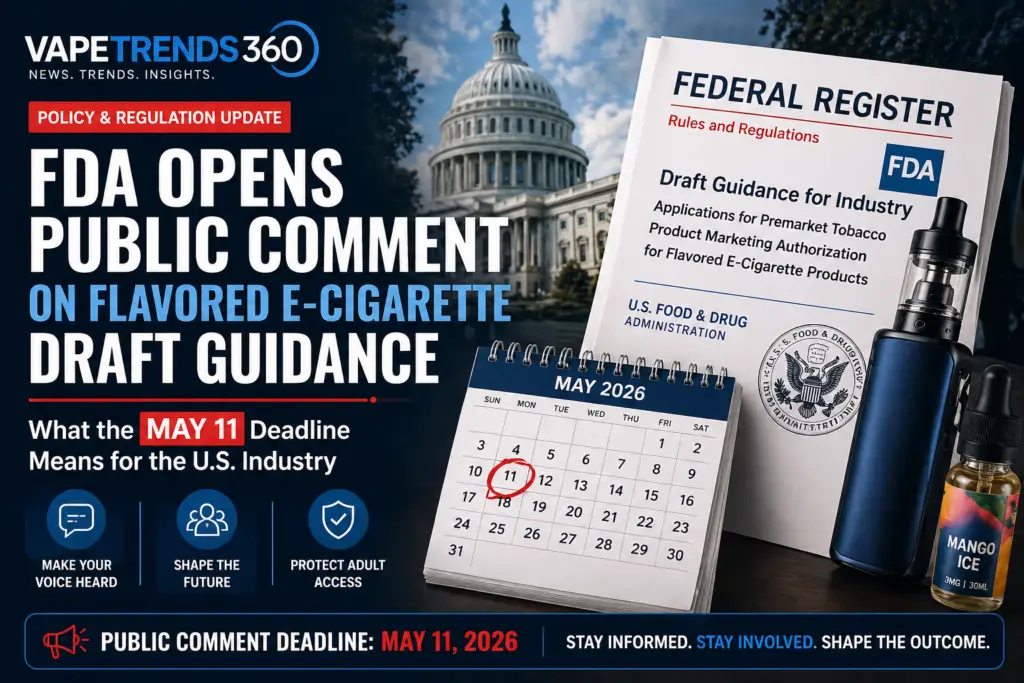
The U.S. Food and Drug Administration’s Center for Tobacco Products has formally opened the public comment window on its draft guidance covering flavored electronic nicotine delivery systems (ENDS), giving manufacturers, distributors, retailers, and public-health stakeholders a 24-day window to respond before the docket closes on May 11, 2026.
The notice — published by the FDA Center for Tobacco Products on April 17, 2026 — invites public input on a draft document originally released March 9, 2026, titled Flavored Electronic Nicotine Delivery Systems (ENDS) Premarket Applications – Considerations Related to Youth Risk. The guidance lays out, in greater detail than any prior FDA communication, what evidentiary burden manufacturers must meet to bring non-tobacco-flavored vapor products through the Premarket Tobacco Product Application (PMTA) pathway.
The 60-Second Read
- Comment deadline: May 11, 2026 (Federal Register Docket open via FDA CTP Newsroom).
- Framework: Risk-tiered, flavor-specific PMTA review — evidentiary burden scales with assessed youth appeal.
- Higher bar: Fruit, candy, dessert and other sweet flavors face the most stringent scientific requirements.
- Lower bar (relatively): Mint, coffee, tea and spice categories may have a more achievable pathway.
- Status quo: 41 FDA-authorized ENDS products remain — all tobacco or menthol — across just five companies.
- What hasn’t changed: The underlying APPH (“appropriate for the protection of public health”) standard is unchanged.
What the Draft Guidance Actually Says
The 17-page non-binding document does not represent a sweeping policy reversal. Instead, it formalizes — and partially clarifies — the agency’s existing posture toward flavored vapor products. Under the 2009 Family Smoking Prevention and Tobacco Control Act, applicants must demonstrate that marketing a tobacco product is “appropriate for the protection of the public health” (APPH). The new guidance reaffirms that this analysis weighs benefits to adult smokers against risks of youth initiation.
What is new is the structure. The FDA explicitly frames its approach as a tiered, flavor-specific evidentiary model. Tobacco-flavored applications are reviewed under the standard burden. Menthol may require slightly more robust evidence. Mint, coffee, tea and spice categories sit in an intermediate tier where authorization is plausible if applicants present strong adult-benefit data. Fruit, candy, dessert and other sweet flavors remain in the highest-risk category, requiring particularly compelling scientific evidence to justify authorization.
The agency cites federal data showing that in 2024, 87.6% of youth who reported current e-cigarette use chose flavored products, with fruit being the leading category. At the same time, the guidance acknowledges that the National Youth Tobacco Survey shows youth vaping prevalence has dropped to 5.9% — a 74% decline from 2019 peak levels — a fact that policy analysts argue should reshape the agency’s risk weighting going forward.
The Risk-Tier Framework at a Glance
| Flavor Category | FDA Evidentiary Burden | Indicative Pathway Outlook |
|---|---|---|
| Tobacco | Standard PMTA review | Established — 41 SKUs already authorized |
| Menthol | Slightly elevated; some authorizations exist | Achievable for well-resourced applicants |
| Mint, coffee, tea, spice | Intermediate — strong adult-benefit data required | Most plausible new authorization category in 2026–27 |
| Fruit, candy, dessert, sweets | Highest evidentiary tier; “substantial public health risk” language | Authorization unlikely without novel youth-mitigation evidence |
Device Access Restrictions: Acknowledged, Not Endorsed
One of the more technically significant elements of the guidance is its treatment of Device Access Restrictions (DARs) — biometric unlock, geofencing, and similar age-gating technologies built into the hardware itself. Prior FDA marketing denial orders had positioned “novel” access restrictions as one of the few mitigation approaches with meaningful potential.
The April 2026 draft preserves that interest but qualifies it: the agency will consider DARs as part of the holistic APPH analysis, while making clear that device-level age gating alone is unlikely to be sufficient to authorize highly youth-appealing flavors. For hardware engineers and PMTA strategists, that signals DARs are a supporting argument, not a standalone solution.
“The draft does not ease the agency’s underlying skepticism toward flavored ENDS, but it does make the rules of engagement clearer.”
Industry and Public-Health Reactions
Reactions to the draft have split along familiar lines. Harm-reduction advocates and trade groups have welcomed the procedural clarity but criticized the substance, arguing that maintaining a near-categorical bar against fruit and dessert flavors ignores both adult smoker preferences and the documented 74% decline in youth use since 2019.
Public-health advocates raised the opposite concern. Groups including the Truth Initiative warned that even acknowledging mint and coffee as potentially authorizable could trigger renewed youth uptake, particularly given that mint was the third-most popular youth flavor choice in the 2024 NYTS.
Legal analysts have also flagged a more technical issue: whether the FDA’s “comparative efficacy” requirement — the expectation that a flavored ENDS show added benefit over a tobacco-flavored alternative — is actually supported by Section 910 of the Tobacco Control Act. The same APPH standard applied to flavored nicotine pouches and IQOS menthol products has not been framed as a comparator requirement, raising arguments that the comparative-efficacy framework is an FDA policy choice, not a statutory mandate. The disparity is especially visible in the oral nicotine category, where the agency has continued authorizing flavored ZYN and on! PLUS pouches even as flavored vape applications stall — a dynamic explored in our prior briefing on why some vapers are switching to nicotine pouches in 2026.
What It Means for the Distribution Chain
For the U.S. distribution chain, the practical near-term implications are limited. The list of FDA-authorized vape products remains at 41 SKUs as of late April 2026, all tobacco- or menthol-flavored, manufactured by Logic, NJOY, Vuse and JUUL. Operators tracking the current FDA-authorized vape brand list will note that no flavored authorization has been issued under the new framework yet.
What is changing is the planning horizon. For multi-state distributors and category buyers, the guidance is most useful as a forward-looking signal:
- Mint, coffee, tea and spice SKUs may be the first non-menthol authorizations to clear in 2026–2027 — worth monitoring for category-management planning.
- Fruit, candy and dessert SKUs remain federally unauthorized and continue to face the dual pressure of state PMTA registries and federal enforcement.
- State registry laws — including Virginia’s directory enforcement, Mississippi’s HB 916, and similar models advancing in 20+ states — will continue to shape SKU availability faster than federal authorization decisions. California’s Unauthorized Tobacco List enforcement is the most aggressive in the country; see our California UTL Q1 2026 compliance report for the full SKU breakdown.
For background on how state registry enforcement is reshaping SKU availability, see our prior coverage of the U.S. Vape Policy Update Spring 2026. For hardware-side analysis of how the framework intersects with smart-device technology, our Smart Vape Hardware 2026 benchmark report covers the device-access-restriction (DAR) technologies the agency referenced in this guidance.
How to Submit a Public Comment Before May 11
Comments are filed electronically through the federal regulations portal referenced in the FDA notice. Submissions can be filed by individuals, retailers, distributors, manufacturers, trade associations, public-health organizations, or academic researchers. Effective comments tend to share three characteristics:
- Specificity. Reference the section of the draft being addressed and explain how it would affect the commenter’s operations or research.
- Evidence. Cite peer-reviewed studies, internal compliance data, or sales data where applicable. The agency emphasized that decisions rely on a “totality of scientific evidence,” not single studies.
- Constructive alternatives. Where commenters disagree with a proposed standard, suggest a workable alternative anchored in the APPH framework.
The full draft guidance, comment portal, and docket details are available through the FDA Center for Tobacco Products newsroom.
The Bottom Line
The April 17 comment opening does not authorize a single new flavored vape. What it does is convert FDA’s informal posture into a published, structured framework — one that the industry can now formally critique on the record. With youth vaping at a 50-year low and the authorized product list still capped at 41 SKUs, the May 11 deadline represents one of the most consequential opportunities in 2026 for the U.S. vapor industry to shape the federal flavor pathway it will operate under for the remainder of the decade. For a parallel look at how unauthorized brands are responding to the same regulatory pressure through “Made in USA” rebranding, see our Built-in-USA Vape Playbook.
FAQs
When does the FDA flavored e-cigarette comment period close?
May 11, 2026. Comments submitted after this date will not be guaranteed consideration in the final guidance.
Does this draft guidance authorize any new flavored vapes?
No. It is a non-binding draft guidance describing how the FDA evaluates PMTA submissions. It does not, on its own, authorize any product. The current authorized list remains 41 tobacco- and menthol-flavored ENDS products.
Which flavor categories have the best chance of authorization under this framework?
Mint, coffee, tea and spice categories sit in an intermediate evidentiary tier. They are the most plausible candidates for new non-menthol authorizations in 2026–2027, provided applicants can present strong adult-benefit data.
Are fruit and dessert flavors going to be banned outright?
The draft does not propose a ban. It places fruit, candy, dessert and other sweet flavors in the highest evidentiary tier, meaning authorization remains theoretically possible but requires substantially stronger scientific evidence to offset documented youth-appeal concerns.
How is this different from state PMTA registry laws?
State registries (Virginia, Mississippi, Alabama, Louisiana, and others) generally allow only SKUs that hold federal FDA authorization or have a pending PMTA. The April 17 federal guidance addresses how the FDA evaluates those federal applications. The two systems are linked but distinct.
Who can submit a public comment?
Anyone — including individual consumers, retailers, distributors, manufacturers, trade associations, public-health organizations, and academic researchers. Comments become part of the public docket.
Sources & Further Reading
- U.S. FDA Center for Tobacco Products — CTP Newsroom (April 17, 2026 notice)
- FDA Draft Guidance — Flavored Electronic Nicotine Delivery Systems (ENDS) Premarket Applications – Considerations Related to Youth Risk, March 9, 2026
- RxVape — FDA-Authorized Vape Brands 2026
- VapeTrends360 — U.S. Vape Policy Update Spring 2026
- VapeTrends360 — California UTL Q1 2026 Compliance Report
- VapeTrends360 — Nicotine Pouches vs Vapes: Why Some Vapers Are Switching in 2026
- VapeTrends360 — Smart Vape Hardware: 2026 Feature Benchmarks & Retail Margin Impact
- VapeTrends360 — The Built-in-USA Vape Playbook
- VapeTrends360 — U.S. Federal & National Vape Policy archive
- National Youth Tobacco Survey 2024 — Centers for Disease Control and Prevention
VapeTrends360 is an independent informational platform serving adult industry professionals. We do not sell vapor products, accept manufacturer sponsorship, or make cessation claims. This article is editorial analysis of publicly available federal regulatory documents and is not legal or compliance advice. Manufacturers and distributors should consult qualified regulatory counsel before filing PMTA submissions or public comments.