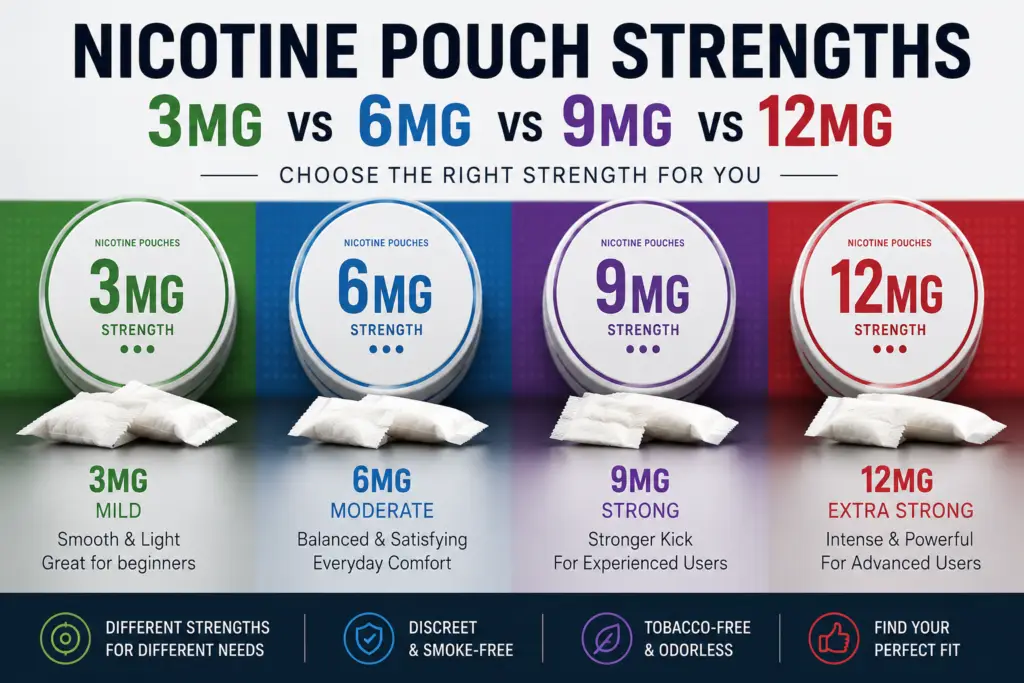
Quick answer on nicotine pouch strengths: The mg number on a nicotine pouch can mean nicotine content per pouch or per gram, depending on the brand, so identical numbers do not always deliver identical doses. As a general pattern, 3mg sits at entry level, 6mg is the common regular/medium tier, 9mg is strong, and 12mg and above is high strength meant for people with significant, established tolerance. Strength alone never guarantees quality, and anyone new to nicotine should start at the lowest available tier.
In this guide:
Editorial disclosure: This article is intended for adults 21 and older who use or are researching nicotine products. Nicotine is an addictive chemical. Nothing in this article is medical advice, and no strength level is recommended as the “best” choice — the right product, if any, depends on an individual’s existing tolerance and circumstances.
Understanding nicotine pouch strengths starts with a single number. Walk into any convenience store display or scroll through an online nicotine pouch retailer, and you will see the same number stamped across nearly every can: milligrams, or “mg.” A can might say 3mg, 6mg, 9mg, or 12mg, and shoppers often assume these numbers work like a simple ruler, where the higher the number, the stronger the experience. In practice, strength labeling is more complicated than it looks, and two pouches with an identical number on the label can feel noticeably different once they are actually in use. This guide breaks down what the mg number is actually measuring, how the major strength tiers compare, and why the label alone does not tell the whole story.
What Does “mg” Mean on a Nicotine Pouch?
The mg figure on a nicotine pouch can refer to two different things depending on the brand, and that inconsistency is a major source of confusion. Most mainstream brands list nicotine content per pouch, meaning a “6mg” pouch contains approximately 6 milligrams of nicotine in that single pouch. Some brands, however, list nicotine content per gram of pouch material, so a “6mg/g” product needs to be multiplied by the actual weight of the pouch to know the real nicotine dose. A larger, heavier pouch labeled at the same mg/g rating can therefore deliver considerably more total nicotine than a smaller pouch with an identical number. Reading the fine print on a can, not just the large number on the front, is the most reliable way to know which measurement system a brand is using. For context on how regulators evaluate specific strength claims, see our coverage of ZYN’s historic FDA “lower risk” status.
Nicotine Pouch Strengths Explained by Tier
These nicotine pouch strengths each tend to carry their own market positioning and their own risk profile. The color key below mirrors the comparison chart further down the page, making it easier to scan for the tier you are researching.
3mg Nicotine Pouches — Entry Level
Three-milligram pouches sit at the lower end of the strength spectrum offered by most mainstream brands. They are often positioned as an entry-level or lighter option, sometimes marketed toward people stepping down from another nicotine product. Even so, “lower strength” is relative. A 3mg pouch can still feel noticeable to someone who has never used nicotine before, since individual sensitivity varies widely based on body weight, metabolism, and prior nicotine exposure. A “low strength” label is a marketing category, not a guarantee of a mild experience for every user.
6mg Nicotine Pouches — Regular / Medium
Six milligrams is one of the most common strength tiers on the market and is often described as a “regular” or medium-strength option. It tends to be the tier most associated with people who already use nicotine regularly, such as cigarette smokers or existing pouch users who have moved past the lowest strength tier. Because 6mg spans such a wide share of the market — including mainstream brands like ZYN — the actual sensation of a 6mg pouch varies more than shoppers might expect, a fact that owes as much to formulation as it does to the number on the can.
9mg Nicotine Pouches — Strong
Nine milligrams moves into stronger territory, and brands generally market it toward established users rather than newcomers. At this tier, people with lower nicotine tolerance are more likely to notice unwanted effects such as nausea, lightheadedness, a racing heartbeat, or general discomfort, sensations sometimes described informally as feeling “nic-sick.” These effects are the body’s response to a nicotine dose that exceeds what it is adapted to handle, and they are a signal to stop use and let the effects pass rather than push through them. Our ZIMO Nicotine Pouches review looks at how an independent brand’s strength lineup compares at this level.
12mg Nicotine Pouches — High Strength
Twelve milligrams and above represents the high-strength end of the category and is intended for people with significant, established nicotine tolerance, generally heavy cigarette smokers or long-term users of strong nicotine products. This tier should not be treated as a normal or default starting point by anyone new to nicotine pouches. The gap in physical effect between a 6mg and a 12mg pouch is substantial, and moving straight to a high-strength product without tolerance built up over time meaningfully raises the risk of adverse effects.
Why the Same Nicotine Strength Can Feel Different
Formulation Factors That Change the Experience
If mg numbers were the whole story, two 6mg pouches from different brands would feel identical. In practice, users often report they do not, and several formulation factors explain why. Pouch size and fill weight matter because a smaller, tightly packed pouch can release its nicotine faster than a larger, looser one carrying the same total mg. Moisture level affects how quickly nicotine transfers from the pouch — wetter pouches tend to release nicotine faster, producing a sharper initial sensation, while drier pouches release more slowly over a longer period. The pH, or “freebase” level, of the nicotine formulation changes how readily nicotine is absorbed; a more alkaline formulation generally increases the rate and efficiency of absorption, independent of the labeled mg amount. Flavoring and other additives can also subtly influence perceived intensity, since certain flavor compounds affect how a pouch feels physically, even without changing the nicotine dose itself. Taken together, these variables mean the mg label is best understood as one input among several, not a complete measurement of the experience a pouch will deliver.
VapeTrends360 Weekly Brief
Stay Ahead of the Industry
Get the news before it becomes a problem.
- FDA enforcement updates
- New product launches
- Market trends
- Retailer insights
Join industry professionals who want the news before it becomes a problem. Free. Unsubscribe anytime.
Strength Does Not Equal Quality
It is also worth stating plainly that a higher strength number does not automatically signal a better-made or higher-quality product. Strength and quality are separate attributes — a well-formulated 6mg pouch from a reputable manufacturer can be a more consistent, better-tested product than a poorly made 12mg pouch. Shoppers who equate “stronger” with “better” risk overlooking more meaningful quality indicators, such as manufacturing standards, ingredient sourcing, and consistency between batches. For this same reason, harm-reduction guidance generally steers anyone new to nicotine, or new to pouches specifically, toward starting at the lowest available strength tier rather than assuming a middle or high strength is a safe default. Tolerance builds gradually, and starting low allows a new user to gauge their own reaction before considering whether a stronger product is appropriate at all.
Common Labeling Mistakes Retailers and Customers Make
Where the Confusion Comes From
Confusion over strength labeling is not limited to first-time buyers, it shows up at the retail level too. A frequent error is treating “mg per pouch” and “mg per gram” as interchangeable when comparing products, which can lead a customer to unknowingly select a much stronger or weaker product than intended. Retailers sometimes shelve or display products by brand rather than by actual nicotine content, making a visual side-by-side comparison misleading. Customers also commonly assume that flavor or packaging color coding is standardized across brands, when in reality each brand sets its own color and flavor-naming conventions with no industry-wide standard. Finally, both retailers and customers sometimes assume a product marketed as “extra strong” always exceeds one labeled at a specific mg number, when in fact descriptors like “regular,” “strong,” and “extra strong” are not formally regulated terms and can vary from brand to brand. For a broader look at how pouches stack up against other nicotine formats, see Nicotine Pouches vs Vapes: Why Some Vapers Are Switching in 2026.
Nicotine Pouch Strengths Comparison Chart
| Strength | Typical Positioning | Important Consideration |
|---|---|---|
| 3mg | Lower strength | May still be strong for nicotine-naive users |
| 6mg | Medium strength | Common among established nicotine users |
| 9mg | Strong | Greater risk of nausea, dizziness or discomfort |
| 12mg | High strength | Intended for people with significant nicotine tolerance |
Where to Buy Nicotine Pouches (Wholesale & Retail)
Shoppers and licensed retailers who want to compare nicotine pouch strengths side by side can review current listings from a working distributor catalog rather than relying on marketing copy alone.
Shop Nicotine Pouches at B&J Wholesale
Licensed retailers sourcing nicotine pouches in bulk can browse strength-labeled options through B&J Wholesale’s Nicotine Pouch Collection. Listings include ZYN Nicotine Pouches (wholesale) and ZIMO Nicotine Pouches, available in 3mg, 6mg, and 8mg (wholesale). B&J Wholesale requires a verified business account for wholesale pricing; individual adult (21+) shoppers should check the retailer’s site directly for retail purchase options.
Related Reading on VapeTrends360
Frequently Asked Questions About Nicotine Pouch Strengths
Is 6mg nicotine strong?
Six milligrams is generally marketed as a medium or “regular” strength and sits in the middle of the common strength range. Whether it feels strong to a particular person depends heavily on their existing nicotine tolerance, so a 6mg pouch that feels mild to a regular user may feel quite noticeable to someone new to nicotine.
Is 12mg nicotine per pouch?
On most mainstream brands, yes — a 12mg label typically indicates roughly 12 milligrams of nicotine contained in that individual pouch. However, some manufacturers list strength per gram of product rather than per pouch, so it is worth checking a can’s fine print to confirm which measurement system is being used before assuming the total dose.
Why does one 6mg pouch feel stronger than another?
Two pouches with the same labeled strength can deliver a different felt experience because of differences in moisture content, pouch size and fill weight, the pH or freebase level of the nicotine formulation, and how quickly the product releases nicotine. These formulation choices affect absorption speed and intensity independent of the mg number on the label.
Can nicotine pouches make you dizzy?
Yes, particularly at higher strengths or for users with lower nicotine tolerance. Dizziness, nausea, and a racing heartbeat are common signs of taking in more nicotine than the body is accustomed to, and they typically resolve once use is stopped and the nicotine wears off.
What is the difference between mg per pouch and mg per gram?
“Mg per pouch” states the total nicotine content contained in a single pouch, while “mg per gram” (often written mg/g) states nicotine concentration relative to the weight of the pouch material, meaning the actual nicotine dose depends on how much the individual pouch weighs. Two products with the same mg/g rating can therefore contain different total amounts of nicotine if their pouch sizes differ.
What strength nicotine pouch should a beginner start with?
Harm-reduction guidance generally points first-time users toward the lowest available strength tier, typically 3mg, rather than a medium or high tier. Starting low lets a new user gauge their own reaction before deciding whether a stronger product is appropriate at all.
Nicotine is an addictive chemical. Nicotine pouches are intended for use by adults 21 and older who already use nicotine or tobacco products. This article is for general educational and informational purposes only, does not constitute medical advice, and should not replace guidance from a qualified healthcare provider.