Shopify Just Declared War on the Vape Industry — What Happens Next?
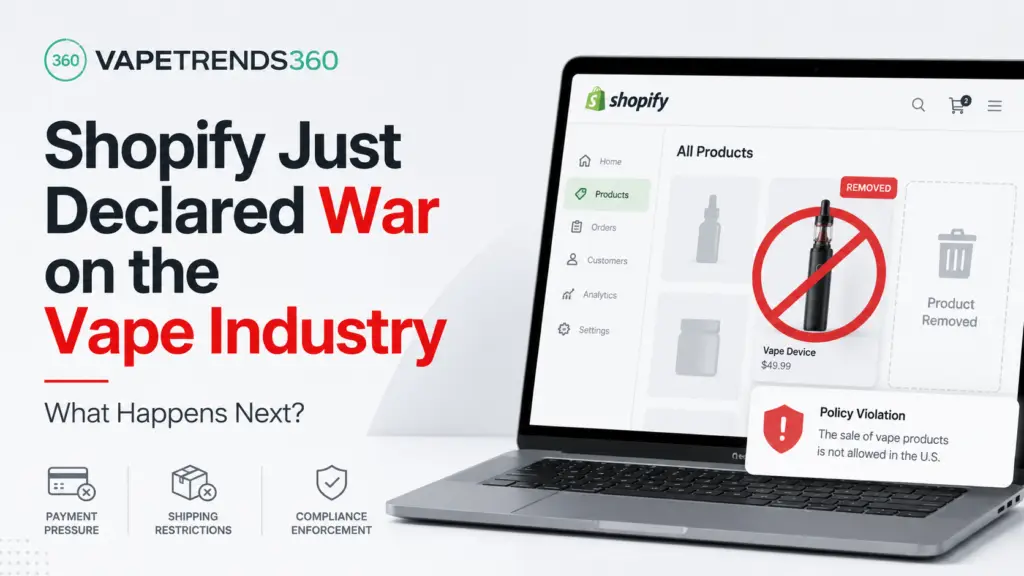
Reuters reports the e-commerce giant is poised to pull every vape from its U.S. platform within days — including the handful of products the FDA has actually authorized. If it holds, the fight over America's illegal vapes shifts from the shop counter to the servers and payment rails that quietly keep it running.

- What: Shopify is reportedly preparing to ban all vape sales on its U.S. platform "as soon as this week," per Reuters, citing two people familiar with the plan.
- The catch: The policy is described as applying to all vapes — including FDA-authorized products — not just unlicensed disposables.
- Why now: A bipartisan coalition of 25 state attorneys general has pressed Shopify for roughly a year to cut off illegal e-cigarette sellers.
- Not confirmed: Shopify has not publicly announced the policy and stopped short of confirming it. Treat this as a reported, expected move — not a finalized rule.
- The bigger signal: Enforcement is moving up the supply chain — to platforms, card networks, and logistics — rather than chasing individual brands.
The Report
What's actually being reported
On June 23, Reuters reported that Shopify intends to prohibit vape sales across its U.S. platform, potentially within the week, after months of talks with state enforcers. Trade and financial outlets quickly amplified the story, and the detail that has the industry's attention is the scope: as described by sources, the ban would not distinguish between illegal disposables and the small set of products carrying federal marketing authorization. In other words, a compliant, FDA-authorized SKU and a gray-market Chinese disposable could be swept off the platform by the same policy.
It's worth being precise here, because precision is the difference between a headline and a fact. Shopify has not issued a public announcement, and the company stopped short of confirming the policy when asked. Its statement was narrow: it has always prohibited illegal activity and acts when it learns a merchant is breaking its rules. Shopify also noted that enforcement choices weigh broader legal frameworks and are not driven by any single group. So the accurate framing is "reported and expected," not "officially declared." For brands building a contingency plan, that nuance buys a little time — but not much.
The Backstory
A year-long campaign that finally found its lever
This did not come out of nowhere. In November 2025, California Attorney General Rob Bonta and the City of New York co-led a coalition of 25 attorneys general in a letter urging Shopify to cut off merchants selling illegal tobacco products. The coalition flagged 29 illegal e-cigarette storefronts then running on the platform and pointed to an exhibit identifying more than 200 others. Shopify had already removed certain sellers California named back in April 2025, but the AGs wanted a structural fix rather than a game of whack-a-mole.
The strategic shift is the real story. For years, regulators chased manufacturers and retailers one at a time and watched the next shipment of disposables arrive from China anyway. By going after the infrastructure — the storefront software, the checkout, the payment processor — enforcers found a chokepoint that scales. One platform decision can do what thousands of individual enforcement actions could not.
The fight is moving from the shop counter to the servers and payment systems that quietly keep the market alive.
Follow The Money
The payment rails are the next front
Shopify is one pressure point; the money is another. In April 2026, the same coalition wrote to nine major card networks and processors — Visa, Mastercard, Stripe, and PayPal among them — demanding tighter controls on illegal vape transactions. Mastercard followed with a notice to acquiring banks warning that unlicensed vape sales breach its network standards, paired with language about zero tolerance for unlawful activity and the prospect of investigations and penalties for non-compliant merchants and their banks.
For any operator, that combination is the part to internalize. A storefront ban you can route around by switching platforms. But if the platforms and the card networks and the shipping providers all tighten at once, the cost and friction of selling unauthorized product online climbs sharply. For licensed, compliant distribution the math is different — and that gap is about to widen. Operators sourcing through a licensed wholesale distributor like B&J Wholesale are positioned to absorb a compliance-driven shakeout far better than anyone leaning on direct-import gray-market supply.
The Contradiction
The contradiction nobody at the federal level is resolving
Here's what makes this moment genuinely strange. While states tighten the screws, Washington has been loosening them. The FDA has authorized just 45 e-cigarette products to date — overwhelmingly tobacco-flavored — an approach manufacturers argue has starved the legal market and handed demand to the illegal one. Then, on May 5, 2026, the agency cleared its first fruit-flavored vapes: four Glas pods using digital age-gating, reversing a long de facto tobacco-and-menthol-only posture. Days later, the FDA signaled it would deprioritize enforcement against unauthorized vapes and nicotine pouches — a stance several attorneys general criticized publicly.
So a Shopify ban that captures FDA-authorized products would put the platform out ahead of the federal regulator that authorized them. State enforcers are effectively writing a stricter rule than the FDA is willing to enforce. That tension — softer federal posture, harder state-and-infrastructure posture — is the defining dynamic of the back half of 2026, and it's why "just get authorized" is no longer a complete compliance strategy on its own.
Impact
Who actually gets hurt
The blunt answer: not the names you'd expect. Industry sources note the hit to authorized manufacturers such as BAT or Juul should be limited, because very little authorized vape volume moves online — most of it sells through convenience stores, gas stations, and specialty vape shops. The brands genuinely exposed are the unauthorized disposable lines that built their entire distribution around e-commerce and direct-to-consumer funnels. For those operators, Shopify isn't a channel; it's the channel.
That's the dividing line worth circling. If your business depends on a Shopify storefront moving unauthorized product to consumers, this is an existential signal, not a speed bump. If you operate a licensed, compliant retail footprint — the model behind a brick-and-click operator like VapeOwls, which sells to verified adults 21+ — the immediate platform risk is lower, but the regulatory temperature is the same, and the age-gating and compliance bar is only rising.
The Playbook
What to do before the policy lands
If you sell on Shopify
Audit your catalog against FDA authorization and your state registry now, stand up an alternative compliant channel before you're forced to, and export your customer and order data while you still have access.
If you distribute or wholesale
Expect a scramble for compliant, registry-listed supply. Licensing and documentation just became a competitive advantage — make your authorization paperwork and lab data easy for buyers to verify.
If you watch the category
Track whether other platforms and card networks follow Shopify. If they do, the center of gravity shifts permanently from product approval to infrastructure access.
Frequently asked questions
Has Shopify officially confirmed it's banning vapes?
No. The plan was reported by Reuters on June 23, 2026, citing two people familiar with it, and described as taking effect "as soon as this week." Shopify acknowledged it prohibits illegal activity and enforces its policies, but stopped short of publicly confirming a blanket vape ban. Until the company publishes the policy, treat it as reported and expected rather than final.
Does the ban include FDA-authorized vape products?
As reported, yes — the policy is described as applying to all vapes regardless of FDA authorization status. In practice, the impact on authorized brands is expected to be limited because most authorized product sells through physical retail, not online. The unauthorized disposable segment, which relies heavily on e-commerce, is far more exposed.
Is this a U.S.-only policy or global?
The reporting describes a U.S. platform ban. Whether Shopify extends the prohibition to other markets was not clear at the time of reporting.
Why would FDA-authorized products get caught in a crackdown on illegal vapes?
A platform-wide policy is far easier to enforce than product-by-product review, so a blanket rule sweeps in compliant SKUs alongside illegal ones. It also reflects a tension between state enforcers pushing harder and a federal regulator that has recently signaled a softer enforcement posture.
Are payment processors part of this too?
Yes. In April 2026 a coalition of attorneys general pressed major card networks and processors — including Visa, Mastercard, Stripe, and PayPal — to block illegal vape transactions. Mastercard subsequently warned acquiring banks that unlicensed vape sales violate its network standards. The squeeze on payment rails runs parallel to the platform pressure.
What should a brand or retailer selling on Shopify do right now?
Audit your catalog against FDA authorization and state registry requirements, export your customer and order data, and stand up at least one alternative compliant sales channel before any policy takes effect. Operators with licensed wholesale relationships and verifiable compliance documentation are best positioned to weather the change.
Does this affect nicotine pouches?
The reported Shopify action centers on vapes. However, the broader infrastructure strategy — including the payment-network warnings — extends to unauthorized nicotine products generally, so pouch sellers should watch the same trend lines even if they're not in the first wave.
Sources & further reading: Reuters (via BNN Bloomberg); Nicotine Insider; International Business Times; California Attorney General's Office, November 2025 coalition letter.
VapeTrends360 provides B2B industry analysis for licensed professionals and does not sell or promote nicotine products to consumers. Reporting reflects information available as of June 23, 2026; details may change as Shopify formalizes any policy. This article is for informational purposes and is not legal advice.