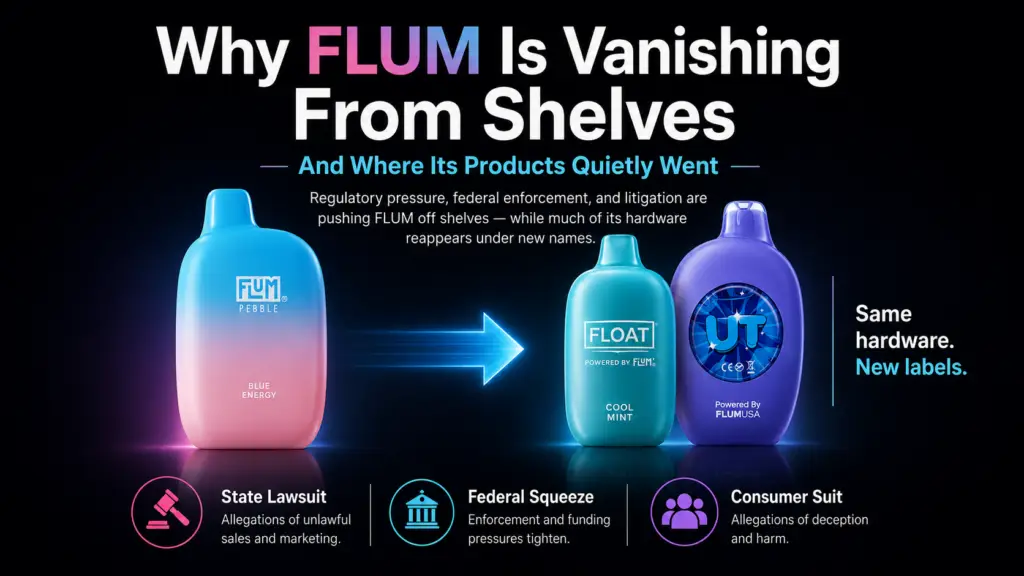
Why FLUM Is Vanishing From Shelves — And Where Its Products Quietly Went
One of the disposable category’s biggest names is being squeezed out of the U.S. market on three fronts at once. The hardware didn’t go anywhere — it just got new names.
If you stock disposables, you’ve probably noticed it already: FLUM is getting harder to source, harder to keep on the shelf, and increasingly absent from distributor menus. That’s not a supply hiccup or a freight delay. It’s the visible result of regulatory and legal pressure that has been building on the brand for more than a year — and a deliberate rebranding strategy that has moved most of FLUM’s catalog under new labels.
Here’s what the public record actually says, why it matters for the trade, and where those familiar devices ended up.
Quick answer
FLUM’s disappearance is not a supply problem — it is regulatory and legal pressure combined with a deliberate rebrand. In January 2025 California’s Attorney General sued the company behind the brand (Case No. 25PSCV00155) as part of a coordinated ten-jurisdiction action against illicit flavored disposables, with federal pressure and a separate consumer lawsuit running in parallel. The hardware did not go away: most of the catalog migrated to FLOAT — described in retailer and wholesale communications as the successor brand, same manufacturer lineage and flavor formulas, led by the Float X 10K — and to UT.
01The state lawsuit that put FLUM in the crosshairs
In January 2025, California’s Attorney General filed a civil complaint in Los Angeles County Superior Court (Case No. 25PSCV00155) against the company behind the FLUM brand, an affiliated California import/distribution entity, and the brand’s founder. The filing was announced as part of a coordinated, ten-jurisdiction push by attorneys general targeting illicit flavored disposable e-cigarettes.
According to the publicly filed complaint, the state alleges that the defendants:
- Imported, distributed, marketed, and sold flavored disposable e-cigarettes into California after the state’s retail flavored-tobacco ban (SB 793) took effect in December 2022;
- Sold products that lacked the FDA marketing authorization required to be sold legally in the U.S.;
- Marketed certain “Clear” variants in a way the state contends misled buyers into thinking they were flavorless, when the complaint asserts they carried a mint/menthol cooling profile; and
- Operated with licensing deficiencies on the import and distribution side.
The state’s claims run under California’s False Advertising Law (Bus. & Prof. Code § 17500) and Unfair Competition Law (§ 17200), and it seeks injunctions, restitution, investigation costs, and civil penalties of $2,500 per violation. That “per violation” structure is the part the whole industry should read twice: when penalties can attach to individual sales, shipments, or ads, exposure scales fast.
These are allegations in a pending case, not findings. But the complaint’s framing — importer → California wholesaler/distributor → retailer → consumer — is exactly how state enforcers map a supply chain. Every level of that chain is now reading the same playbook.
02The federal squeeze running in parallel
The state case isn’t happening in a vacuum. At the federal level, the math has turned sharply against the entire flavored-disposable category. By early 2026, the FDA had authorized only a few dozen e-cigarette products for legal U.S. sale — all of them tobacco- or menthol-flavored. No flavored disposable, fruit, candy, or dessert product had cleared the agency’s premarket review.
At the same time, enforcement shifted from warning letters toward harder tools. Federal appropriators directed roughly $200 million for fiscal-year 2026 enforcement against illegal vapes, with multi-agency “seize-and-destroy” authority aimed at unauthorized shipments before they reach shelves. Independent estimates have put the unauthorized share of single-use/disposable sales near 70%. For a brand whose entire identity is built on flavored disposables, that’s an existential math problem — not a FLUM-specific one, but one FLUM sits squarely inside.
Layer on the state-level registry and flavor-ban laws spreading across the country, plus California’s tightened penalty schedule under AB 3218 in 2026, and the legal shelf space for a flavored disposable keeps shrinking regardless of brand.
03A separate consumer suit over “forever chemicals”
On top of the state enforcement action, the brand’s parent has also faced a private proposed class action in federal court (Northern District of California) alleging that a FLUM disposable contained PFAS — so-called “forever chemicals” — that the complaint says were not disclosed to consumers. Reporting on the matter indicates the company moved to dismiss on jurisdictional grounds.
As with the state case, treat this as an allegation in active litigation. The procedural and merits status should be verified through the federal docket. But it adds a second, independent legal front — this one driven by plaintiffs’ attorneys rather than a regulator — to the pressure on the brand.
VapeTrends360 Weekly Brief
Stay Ahead of the Industry
Get the news before it becomes a problem.
- FDA enforcement updates
- New product launches
- Market trends
- Retailer insights
Join industry professionals who want the news before it becomes a problem. Free. Unsubscribe anytime.
04Where the products actually went: FLOAT and UT
Here’s the part most retailers ask about. FLUM didn’t simply die — the catalog migrated. Over 2025 and into 2026, the brand publicly rebranded much of its lineup, and the hardware many shops knew as FLUM now reaches the market under two banners:
FLOAT
Public retailer and wholesale communications describe FLOAT as the successor name to FLUM — same manufacturer lineage, same flavor formulas, refreshed packaging. The transition was led by the Float x 10K, with legacy models following: the old Flum Pebble re-emerged as the Float Pebble, and the Flum Mello line moved to the FLOAT name as well. (Worth flagging for customers: “FLOAT” as a brand is not the same thing as the old “Flum Float” device — a naming overlap that creates real confusion at the counter.) During the changeover, some packaging shipped labeled “clear” as artwork caught up with the rebrand.
UT
The second track is the UT line — positioned around “Ultimate Taste” performance devices such as the UT Bar series. Public brand explainers tie FLOAT’s current manufacturing to UT, the same maker behind the UT Bar disposables, so the FLOAT and UT names increasingly trace back to a shared production source. In practice, the FLUM identity has effectively been split and re-housed across these newer labels rather than retired outright.
| Legacy FLUM | Where it moved | Notes |
|---|---|---|
| Flum Pebble | Float Pebble | Same form factor, new label |
| Flum Mello | Float Mello / Mello series | Carried into FLOAT branding |
| New flagship | Float x 10K | First device to debut the FLOAT name |
| Performance line | UT Bar / UT series | “Ultimate Taste” positioning; shared manufacturing |
Always confirm current product names, packaging, and compliance status against your own supplier documentation — brand naming in this category is moving quarter to quarter.
05The takeaway for distributors and retailers
Strip away the brand drama and the pattern is clean. A flavored disposable with no FDA authorization is exposed on three independent tracks: state consumer-protection and flavor-ban enforcement, federal premarket-authorization enforcement, and private litigation. FLUM happened to draw attention on all three. The rebrand to FLOAT and UT changes the label on the shelf — it does not, by itself, change the underlying federal authorization question that drives most of the enforcement risk.
- Track the names, not just the brand. “FLUM,” “FLOAT,” and “UT” can all point back to related products. Know what you’re actually carrying.
- Keep clean records. Invoices, supplier identity, and proof of where products came from are the documents that matter most if questions ever arise.
- Watch your state. Registry laws, flavor bans, and penalty schedules now vary widely and change fast — what’s sellable in one state isn’t in the next.
- Authorization status is the through-line. A new name on the box doesn’t resolve the premarket question that’s removing flavored disposables from the legal market.
FLUM isn’t disappearing because of one lawsuit. It’s disappearing because the entire legal lane for flavored disposables is narrowing — and the brand chose to keep moving by changing what’s printed on the wrapper.
Public Sources
- California Department of Justice, Office of the Attorney General — press release on the multistate flavored-disposable enforcement and FLUM-related lawsuit (Jan. 15, 2025): oag.ca.gov
- People of the State of California v. Flumgio Technology Inc. et al. — publicly posted complaint (Case No. 25PSCV00155): complaint PDF
VapeTrends360 Weekly Brief
Stay Ahead of the Industry
Get the news before it becomes a problem.
- FDA enforcement updates
- New product launches
- Market trends
- Retailer insights
Join industry professionals who want the news before it becomes a problem. Free. Unsubscribe anytime.
Continue Reading