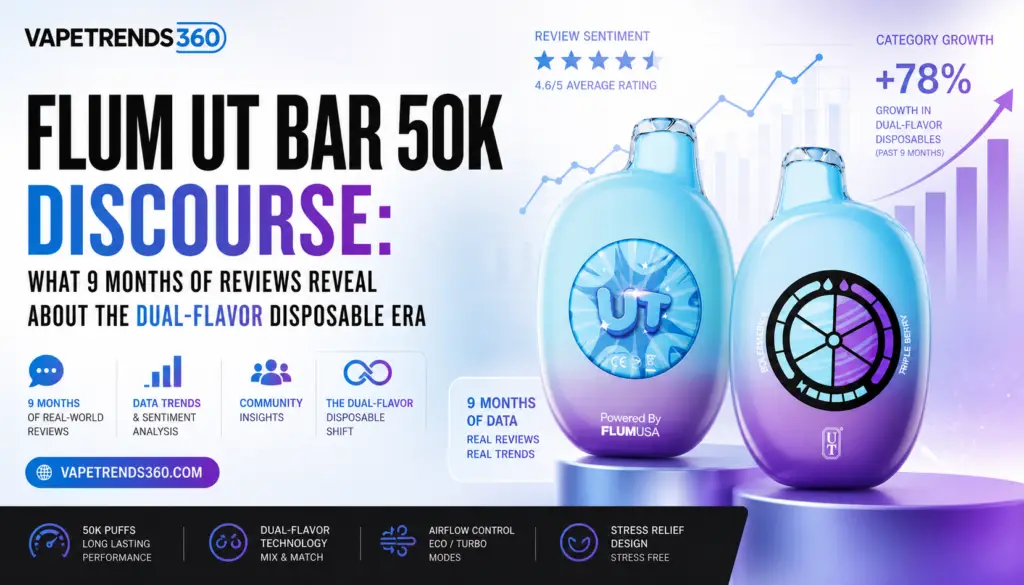
Flum UT Bar 50K Discourse: What 9 Months of Reviews Reveal About the Dual-Flavor Disposable Era
The UT Bar 50K isn’t just another high-puff device — it’s the most-debated disposable of the past three quarters, and the conversation around it tells us where the entire category is going. Five themes dominate the discourse, and three of them have direct implications for retailers, distributors, and brand strategists.

Since launching in mid-2025, Flum’s UT Bar 50K has generated more sustained discussion across Reddit’s r/electronic_cigarette, the E-Cigarette Forum, Vaping Underground, Planet of the Vapes, and the major reviewer YouTube channels than any other single SKU in the high-puff disposable segment. The conversation hasn’t been uniformly positive — and that’s precisely what makes it useful. After three quarters of accumulated user feedback, the discourse has settled into five distinct threads, each pointing toward a structural shift in how adult consumers evaluate 50K-class disposables in 2026.
This isn’t a product review. It’s an analysis of what nine months of organic conversation about a single device reveals about category-wide consumer expectations — and the gap between marketing claims and verified performance that retailers and distributors increasingly need to navigate.
1. The Dual-Flavor Toggle: Innovation or Marketing Theater?
The UT Bar 50K’s headline feature — two pre-filled tanks with a toggle that lets users switch flavors mid-device — has produced the most polarized discussion in the category. The pro-innovation camp frames it as a genuine solution to flavor fatigue, the well-documented phenomenon where heavy users tire of a single flavor profile after extended use of a 30K+ disposable. The skeptical camp argues it’s a marketing complication that adds engineering complexity without delivering meaningfully different vaping experiences.
What’s emerging from the discourse is a more nuanced consensus: the dual-flavor architecture works when manufacturers deliberately pair contrasting flavors (icy Blue Razz with warm Triple Berry, sweet Green Apple with tart Fuji Apple), and falls flat when the two profiles are too adjacent. This has direct sourcing implications. Distributors stocking dual-flavor SKUs should weight inventory toward the high-contrast pairings — the fruit-plus-mint and sweet-plus-sour combinations consistently outperform single-fruit-family pairings in user retention discussions.
For category strategists, the bigger signal is this: flavor customization is becoming a primary purchase driver in the 50K segment, alongside puff count and battery life. Competitors without some form of flavor agency — whether dual-tank, ice-control toggles, or sweetness sliders — increasingly read as last-generation. We covered the broader move toward flavor control devices in our Spring 2026 policy and product update.
2. Puff Count Skepticism Has Become a Category-Wide Reckoning
The most repeated complaint in UT Bar 50K reviews — and across the entire 50K class — is that advertised puff counts don’t survive contact with real-world use. Vapebeat’s testing found realistic delivery of approximately 40,000 puffs in Eco Mode and 20,000 in Turbo Mode for the UT Bar 50K specifically — meaningfully below the cover number, but well within the range users now consider acceptable.
What’s striking is how the conversation has matured. Two years ago, this kind of variance would have triggered widespread “scam” accusations. In 2026, the dominant tone across user reviews is closer to resigned acceptance: yes, the actual count is 70–80% of advertised, yes, that’s still strong value, and yes, the brand should just disclose it honestly. Vapesourcing’s product page reviews capture this resignation perfectly: users acknowledge the gap, then continue purchasing.
This points to a category-wide opportunity. Brands willing to publish honest dual-mode puff specs (“up to 50K Eco / up to 25K Turbo, real-world testing 35–40K Eco”) will increasingly differentiate themselves from competitors still racing the cover-number arms race. The 2026 high-puff industry forecast from Airis explicitly identifies honest labeling as a 2026 competitive advantage. Regulators are also paying attention: the FDA’s spring 2026 enforcement posture has explicitly flagged misleading product claims as a compliance risk separate from PMTA status.
3. The Squishy Back Panel: A Compliance Flag Hiding in Plain Sight
The UT Bar 50K’s most distinctive design element — a squeezable, stress-ball-like back panel — has produced the discourse’s most consequential B2B conversation. Consumer reception is split between users who find it genuinely calming (anxiety and stress relief are mentioned repeatedly in product page reviews) and reviewers who flag it as out-of-place on an adult product.
The industry-side critique cuts deeper. Mi-Pod’s review explicitly described the squeeze panel as “poor optics for an otherwise adult-friendly disposable vape” — and that framing matters. With the FDA’s April 2026 draft guidance on flavored e-cigarettes centered on youth-appeal risk factors, any design element that adds tactile play value invites scrutiny. The squeeze feature isn’t illegal, isn’t flavor-related, and isn’t packaging — but it’s the kind of design choice that gets cited in the appendices of regulatory filings.
B2B takeaway: Youth-appeal scrutiny is expanding from packaging and flavor names to industrial design. Distributors evaluating new SKUs in 2026 should add a “regulatory optics” line to product intake checklists — separate from PMTA status, separate from state directory listing — covering form factor, color palette, tactile features, and visual references that could read as youth-targeted. We expect this to become a formal due-diligence step within 18 months.
4. The “Empty Tank Burn” Problem and What It Says About Dual-Tank Engineering
The single most-discussed troubleshooting issue across UT Bar 50K threads is the empty-tank burn problem: when one of the two tanks runs dry, users report the empty side won’t fully shut off and produces burnt-tasting vapor that contaminates the still-full tank. The official workaround — pressing the corresponding flavor button until the empty side’s indicator drops to zero — is documented but widely described as finicky.
This is more than a customer service issue. It’s the first widely-discussed engineering challenge specific to dual-tank disposable architecture, and it likely won’t be the last. The dual-tank approach inherently creates failure modes that single-tank devices don’t have: asymmetric e-liquid depletion, coil aging mismatch between the two heating elements, and the user-experience problem of having “half a vape” that still has battery and one full tank but tastes burnt overall.
Expect 2026 product updates across the dual-tank category to focus on automatic shutoff for empty tanks, balanced-depletion firmware that draws proportionally from both tanks, and better visual indicators of remaining juice in each tank. Brands that solve the empty-tank UX problem cleanly will have a defensible engineering moat.
5. Cross-Shopping Patterns: What the UT Bar 50K Is Actually Competing With
The fastest-growing thread in UT Bar 50K discourse is comparison with Lost Mary MT35000 Turbo, RAZ RX 50K, Geek Bar Pulse X, Off Stamp X-Cube, and Foger Switch Pro. The cross-shopping consensus is informative:
- UT Bar 50K wins on: flavor variety per device (the dual-tank advantage), information display quality (the full-color screen with battery, juice levels, and flavor ratio is consistently praised), and flavor formulation (Flum’s flavor design has been a category strength since the original Pebble).
- UT Bar 50K loses on: form factor (multiple users describe it as too bulky/round to grip comfortably), single-use waste vs. modular alternatives like the Off Stamp X-Cube (which uses a reusable battery with disposable flavor cubes), and price-per-puff at the upper end of the 50K segment.
The Off Stamp X-Cube comparison is the most strategically interesting. As single-use disposable bans expand at the state level — most recently in Hawaii’s pending SB 2175 and California’s stalled-but-likely-to-return AB 762 — modular and refillable architectures gain a regulatory tailwind that pure disposables don’t. The UT Bar 50K’s cross-shopping disadvantage against modular competitors today becomes an existential disadvantage in disposable-ban states.
What This Discourse Tells Us About 2026 Category Direction
Pulling these five threads together, three category-level signals emerge:
- Flavor agency is the new puff count. The 30K-to-50K-to-70K cover-number race has effectively ended. The next axis of competition is how much control users have over flavor profile, intensity, and ratio mid-device.
- Honest specs are becoming a brand asset. The cover-number-vs-real-world gap is now openly discussed in user reviews. Brands that lean into transparency will accumulate trust capital that opaque competitors can’t easily match.
- Industrial design is the next regulatory front. Form factor, tactile features, and visual identity are entering the youth-appeal conversation. Distributors should treat this as an active sourcing variable.
The UT Bar 50K itself will likely be remembered as a transitional device — the product that proved dual-tank architecture is viable, surfaced its engineering challenges, and forced the rest of the category to take flavor agency seriously. Whether Flum holds the category lead through 2026 depends less on the UT Bar 50K and more on what the brand does with the engineering lessons it’s accumulated.

FAQ
Is the Flum UT Bar 50K compliant in California’s Unflavored Tobacco List (UTL) framework?
No. The vast majority of UT Bar 50K SKUs are flavored products and are not eligible for inclusion on California’s UTL. Only the “Naked” or “Clear” variants — which are functionally unflavored — would have any pathway to UTL eligibility, and only if Flum certifies and pays the associated fees. As of publication, no UT Bar 50K SKU appears on the California UTL.
Is the UT Bar 50K listed on Virginia’s Liquid Nicotine and Nicotine Vapor Product Directory?
Retailers and distributors must verify product-by-product on the Virginia Office of the Attorney General’s directory. With Virginia’s directory enforcement having begun April 1, 2026, any unlisted UT Bar 50K SKUs sold in the Commonwealth carry a $1,000-per-day, per-product civil penalty exposure for both retailers and manufacturers.
What is the realistic puff count for the Flum UT Bar 50K based on third-party testing?
Independent testing — most notably from Vapebeat — found approximately 35,000 to 40,000 puffs in Eco Mode and 20,000 to 25,000 puffs in Turbo Mode under typical use patterns. Heavy users with longer draws will see lower numbers. The 50,000 advertised count reflects best-case Eco Mode performance with shorter draws.
Why does the UT Bar 50K have a squishy back panel, and is it a regulatory risk?
Flum has marketed the squeeze panel as a stress-relief and fidget feature. Industry reviewers have flagged it as potentially problematic from a youth-appeal optics standpoint, particularly given the FDA’s April 2026 draft guidance on assessing youth risk factors for non-tobacco-flavored e-cigarettes. It is not currently the subject of any specific FDA enforcement action, but it represents the kind of design element that may attract scrutiny going forward.
How does the UT Bar 50K compare to modular systems like the Off Stamp X-Cube?
The UT Bar 50K offers a more sophisticated information display and a more refined dual-flavor experience. The Off Stamp X-Cube offers a reusable battery with replaceable flavor cubes, producing significantly less e-waste and likely better positioning under expanding state-level disposable bans. The choice depends on whether the priority is feature richness (UT Bar 50K) or sustainability and regulatory durability (X-Cube).
What’s next for Flum after the UT Bar 50K?
Flum has not publicly announced a UT Bar 50K successor as of publication. Industry watchers expect the brand’s next major release to address the empty-tank burn issue with improved firmware, refine the form factor based on cross-shopping feedback, and potentially explore lower-nicotine variants in line with the broader market shift toward 20mg and 30mg nicotine strength options.
Related VapeTrends360 Coverage
- U.S. Vape Policy Update Spring 2026: VTA–FDA Talks, State Registry Laws & What Retailers Must Know
- FDA Signals Possible Return of Adult-Oriented Vape Flavors in 2026 (forthcoming)
- Which States Allow Flavored Vapes in 2026? Full Legal Guide (forthcoming)
- FDA-Authorized Vape Products in 2026: What Retailers and Consumers Need to Know (forthcoming)
External References