Industry Analysis
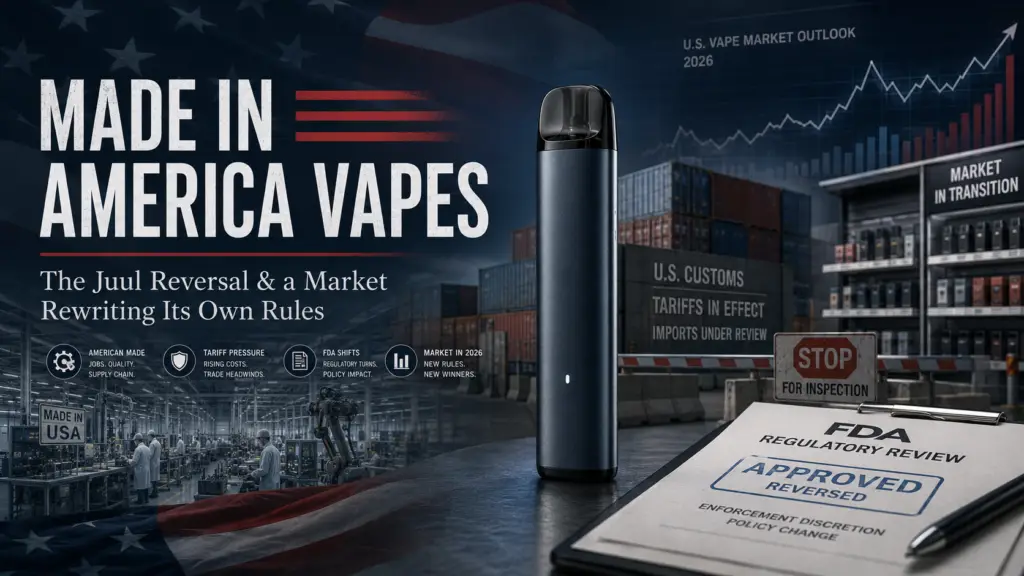
"Made in America" Vapes, the Juul Reversal, and a Market Rewriting Its Own Rules
Tariffs, import seizures, and a newly permissive FDA posture are reshaping the U.S. vape industry from three directions at once. Here is what the data actually shows — and what it means for retailers and distributors heading into the second half of 2026.
For most of the past decade, the structure of the U.S. vape market was simple to describe, if difficult to police: devices designed and manufactured in Shenzhen, imported in bulk, and sold through a retail layer that operated largely outside the FDA's premarket authorization framework. That structure is now under more simultaneous pressure than at any point in the industry's history — from trade policy, from federal enforcement, and from a regulatory agency that has begun, selectively, to open the front door it spent years holding shut.
Three developments define the current moment: a wave of new brands wrapping themselves in American manufacturing claims, the FDA's reversal on Juul Labs, and a product landscape splintering toward smart hardware on one side and hemp-derived cannabinoids on the other. Each deserves a closer look, because the surface narrative and the underlying facts diverge in ways that matter for anyone operating in this space.
The "Made in America" Pivot — and What's Behind the Flag
Since October 2025, at least eight new vape brands emphasizing American manufacturing credentials have appeared on U.S. retail shelves, according to a Reuters analysis published this spring. None of the eight holds FDA marketing authorization. And while trademark documents and business filings show some are controlled by U.S. firms, at least two trace back to Chinese or Hong Kong ownership — including a brand whose Hong Kong parent also holds Chinese trademarks for sub-brands of an established Shenzhen manufacturer, and another controlled by a representative of a Shenzhen technology company despite the American flag stamped on its packaging.
The strategic logic is not hard to read. The Trump administration's tariff regime and its enforcement posture have made Chinese-labeled disposables a priority target for Customs and Border Protection at ports of entry — pressure that has been amplified by congressional scrutiny of illicit Chinese vape imports. A Barclays analyst quoted in the Reuters reporting suggested these brands are betting that American branding makes their products less likely to draw a customs officer's attention. Notably, Chinese trade data shows no decline in vape exports to the U.S., which exceeded $4 billion in 2025 — suggesting the supply chain has not moved so much as the labeling has.
There are genuine domestic moves within the trend. One small U.S. company opened its first American factory in December to fill disposables with e-liquid stateside, citing both import disruptions and consumer preference for American-made products — though its devices are still produced by a Chinese manufacturing partner. That hybrid model, domestic filling on imported hardware, may be the most realistic version of "Made in America" the category can support in the near term.
The FDA, for its part, has been unambiguous on the legal question: selling an unauthorized vape is illegal regardless of where it is manufactured. A flag on the box changes the optics, not the compliance status.
The Market by the Numbers
41
Total vape products with FDA marketing authorization since regulation began in 2016
~70%
Share of U.S. vape sales attributed to unlicensed products, per BAT estimates
$4B+
Value of Chinese vape exports to the U.S. in 2025, per Chinese trade data
8
New "American" vape brands identified on U.S. shelves since October 2025, none authorized
Sponsored · B&J Wholesale

Licensed wholesale distribution for nicotine pouches and vapor products — ZYN, Lucy Breakers, ZIMO, and more, with B2B volume pricing for licensed retailers. Explore the B&J Wholesale catalog →
The Juul Reversal: A Narrow Door Opens
The single most consequential regulatory action of the past year remains the FDA's July 2025 decision to grant marketing authorization to five Juul Labs products — the JUUL device and tobacco- and menthol-flavored JUULpods at 3% and 5% nicotine concentrations. The decision reversed the agency's 2022 marketing denial, which had been stayed on appeal and formally rescinded in 2024, and pulled a company that once flirted with bankruptcy back into the legal market with a clean regulatory slate.
The authorization rested on longitudinal data showing meaningful rates of adult smokers switching completely from combustible cigarettes — the "appropriate for the protection of public health" standard the statute requires. It also drew immediate fire: Senate Democrats publicly objected and sent a letter of alarm to the FDA Commissioner within weeks, and public health groups urged close monitoring of youth uptake of the menthol products.
For the industry, the signal matters more than the single company. The Juul authorization, following the NJOY menthol approvals before it, suggests the agency under the current administration is willing to authorize closed-system products with robust switching data — a posture reinforced by its recent first-ever authorization of non-tobacco GLAS ENDS under a new age-gating standard — while continuing to deny the overwhelming majority of flavored applications. The pathway is real, but it remains extraordinarily narrow: 41 authorized products against millions of applications is not a market opening so much as a guarded checkpoint.
The pathway is real, but it remains extraordinarily narrow — 41 authorized products is not a market opening so much as a guarded checkpoint.
Retail Caught in the Middle
The group bearing the most practical risk in all of this is brick-and-mortar retail. Trade organizations representing convenience stores have lobbied the federal government for a more aggressive crackdown on the illicit market — not out of regulatory enthusiasm, but because the current environment puts compliant retailers at a structural disadvantage against competitors stocking unauthorized products, while exposing everyone to seizure and liability risk. Our enforcement tracker logs import alerts, warning letters, and retailer fines as they land. Their core demand is simple: a clear, current, authoritative list of what is legal to sell.
That demand is harder to satisfy than it sounds. With enforcement discretion shifting, state registries proliferating, and brands rebadging themselves faster than agencies can catalog them, the compliance picture a retailer faces in June 2026 can look different by September. Distributors and retailers alike should be verifying authorization status at the SKU level, not the brand level, and documenting that verification.
Where Product Innovation Went
With the conventional nicotine category constrained, innovation has flowed around the obstacle in two directions. The first is hardware sophistication: Bluetooth app integration, biometric locks, adjustable temperature curves, and modular pod architectures are migrating from niche mod culture into mainstream closed systems — partly as genuine feature competition — visible in the high-capacity disposable segment we have tracked all year — and partly because age-gating technology is becoming a regulatory selling point. A parallel detection economy has emerged alongside it, with AI-driven vapor sensors marketed to schools and facilities.
Sponsored · VapeOwls

Closed-system innovation in action: the RELX Infinity 2 with Pod Pro 2 adjustable-power pods, available now for Southern California adults 21+ at VapeOwls →
The second direction is the hemp-derived cannabinoid crossover. Wellness-positioned brands have expanded aggressively into Delta-9 and other hemp-derived vape lines, which operate under the federal farm bill framework rather than the Tobacco Control Act — a distinction that has allowed flavor and format experimentation the nicotine side can no longer attempt. Whether that legal asymmetry survives the next round of federal and state attention is one of the open questions of 2026, and operators building on it should treat the framework as contested rather than settled. Consumer-side trends in both categories are something we track regularly, as do adult retail observers like our partners at VapeOwls.
Market Size: Read the Estimates Carefully
Headline market-size figures for this industry vary enormously depending on who is counting and what they include. British American Tobacco pegged the U.S. vape market at roughly $12 billion in 2024 — a figure that notably includes the unlicensed majority of sales. Market-research firms publishing forecasts for the broader e-cigarette and vaporizer category, some of which fold in cannabis hardware and global segments, have projected annual growth rates north of 20% and end-of-decade valuations many multiples higher. Both can be true within their own definitions, but operators making inventory and investment decisions should anchor on the conservative, U.S.-specific figures and treat the expansive projections as directional at best.
What is not in dispute is demand. Consumer appetite for vapor products has proven resilient through every enforcement cycle to date, and adjacent categories like modern oral nicotine pouches are growing alongside it. The contested question — the one tariffs, seizures, registries, and PMTAs are all really fighting over — is which businesses get to serve that demand legally, and on whose terms.
The Bottom Line
The U.S. vape industry in mid-2026 is a high-stakes game of adaptation. Manufacturers are re-flagging supply chains faster than regulators can map them. The FDA is simultaneously the industry's strictest gatekeeper and, for a select few, its newest legitimizer. And the retailers in between are demanding the one thing the system has never managed to provide: clarity. Until it arrives — and we will keep covering every development in our federal policy section and daily industry news — the operators who survive will be the ones who treat compliance verification as a daily discipline rather than a one-time checkbox — because in this market, the rules are being rewritten in real time.
Frequently Asked Questions
How many vape products are FDA-authorized in 2026?
As of mid-2026, the FDA has granted marketing authorization to roughly 41 vape products since it began regulating e-cigarettes in 2016. Everything else on the U.S. market — an estimated 70% of sales, per industry figures — is unauthorized.
Are "Made in America" vapes legal to sell?
Only if the specific product holds FDA marketing authorization. Manufacturing location has no bearing on legality — the FDA has stated explicitly that selling an unauthorized vape is illegal whether it is made in Shenzhen or in the United States. None of the eight new American-branded labels identified by Reuters holds authorization.
What exactly did the FDA authorize for Juul?
In July 2025 the FDA authorized five Juul Labs products: the JUUL device plus tobacco- and menthol-flavored JUULpods in 3% and 5% nicotine concentrations. No fruit, candy, or other flavored Juul products were authorized.
Why are hemp-derived THC vapes regulated differently from nicotine vapes?
Hemp-derived cannabinoid products operate under the federal farm bill framework rather than the Tobacco Control Act, so they are not subject to the FDA's premarket tobacco application process. That legal asymmetry has enabled rapid flavor and product expansion — but it is contested, and both federal and state lawmakers are actively revisiting it.
How can a retailer verify a vape product is legal to sell?
Check the specific product — at the SKU level, not the brand level — against the FDA's published list of authorized tobacco products, confirm compliance with any state vapor registry in your jurisdiction, and document the verification. Brand-level assumptions are the most common compliance failure we see.
VapeTrends360 covers regulatory, market, and product developments across the U.S. vapor industry. This article reflects publicly reported information current as of June 2026 and does not constitute legal or compliance advice. Vapor products are intended for adults 21+.