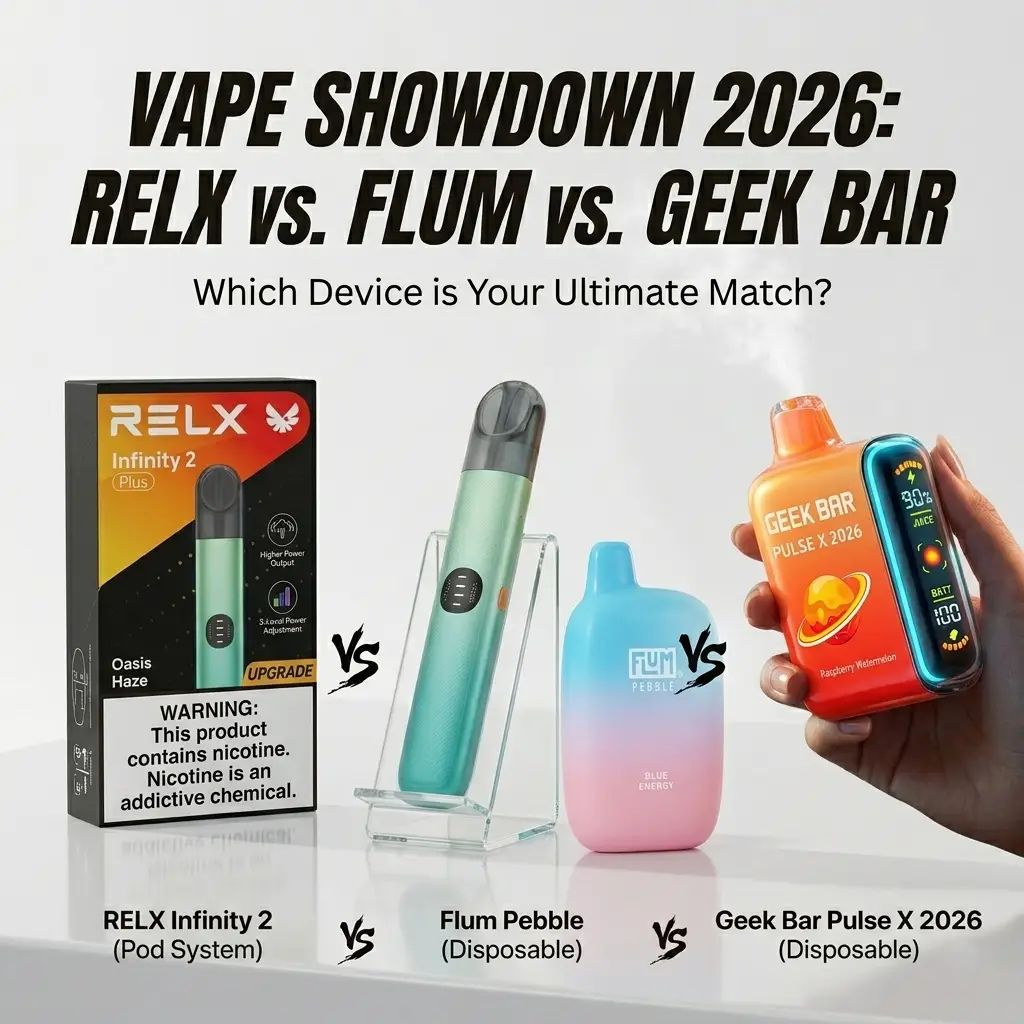
The disposable vape market has quietly turned into a spec race. A few years ago, 5,000 puffs was considered a lot. Now the shelf is stacked with 18K, 40K, and 50K devices, and in our own CROSIN 40K vs. IceBomb 18K vs. Flum Float Mello Pro 50K comparison, we broke down how those three devices stack up on paper. What we didn’t dig into there is the actual engineering behind the number on the box: two components, a mesh coil and a battery cell, doing almost all of the work. Here’s how they actually get a disposable from a few thousand puffs to 50,000 or more.
What Makes a Coil “Mesh,” and Why Does It Matter at 50,000 Puffs?
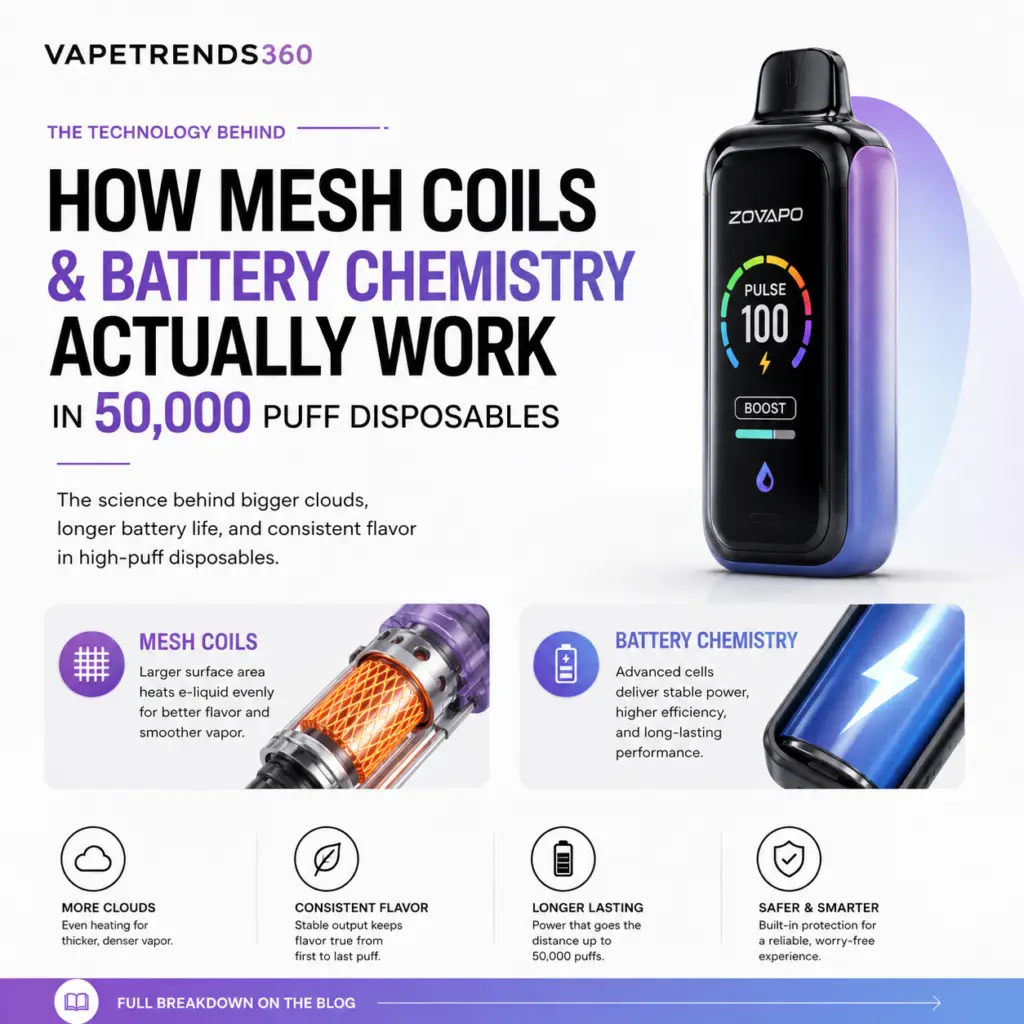
A traditional single-coil wick uses one thin strand of resistance wire wrapped around a wicking material. It heats a small, concentrated area, which is fine for a few hundred puffs but leads to uneven heating and dry spots as the wick saturates unevenly over time. A mesh coil replaces that wire with a flat, perforated sheet of resistance metal, dramatically increasing the surface area in contact with the e-liquid.
That larger surface area means heat spreads evenly across the whole coil instead of concentrating in one spot. Practically, this translates into three things that matter specifically for high-puff disposables: more consistent flavor from the first puff to the last, a much lower chance of the burnt “dry hit” taste that used to plague long-life disposables, and slower overall degradation of the coil material, since the heat load is spread thin instead of concentrated.
Some higher-end 40K–50K devices, including the CROSIN 40K and Flum Float Mello Pro 50K we compared previously, use dual mesh coils rather than a single mesh sheet — effectively doubling the heated surface area again and allowing for the adjustable airflow and multi-mode power output found on those devices.
Battery Chemistry 101: What’s Actually Powering These Devices
Almost every disposable in the high-puff class runs on a small lithium-ion or lithium-polymer (LiPo) cell, typically somewhere between 500mAh and 1,000mAh. mAh (milliamp-hours) is a measure of how much charge the battery can store — roughly, a bigger number means more total energy available before the cell needs recharging.
Two things matter more than the raw mAh number, though. First is the discharge curve: lithium cells don’t deliver power in a straight line, they taper off as they empty, which is why some devices feel weaker in the final stretch even though there’s technically still charge left. Second is recharging. A single charge on a 1,000mAh cell simply cannot deliver enough energy to vaporize 50,000 puffs’ worth of e-liquid — which is exactly why nearly every device in this class ships with USB-C fast charging built in. The battery isn’t sized to last the whole device lifespan on one charge; it’s sized to be topped up repeatedly as the tank empties.
VapeTrends360 Weekly Brief
Stay Ahead of the Industry
Get the news before it becomes a problem.
- FDA enforcement updates
- New product launches
- Market trends
- Retailer insights
Join industry professionals who want the news before it becomes a problem. Free. Unsubscribe anytime.
How Coil + Battery Combine to Reach the 50K Puff Class
| Component | Role | Why It Matters for High Puff Counts |
|---|---|---|
| Mesh coil | Vaporizes e-liquid evenly across a wide surface | Slower degradation, fewer dry hits over thousands of puffs |
| Dual mesh coil | Doubles heated surface area | Supports multi-mode power output and adjustable airflow |
| Li-ion / LiPo cell (500–1,000mAh) | Stores and delivers electrical energy to the coil | Bigger, well-managed cells sustain output over a larger e-liquid reservoir |
| USB-C fast charging | Recharges the cell between sessions | Lets the battery be recharged dozens of times so it can outlast the e-liquid, not just one charge cycle |
| Power/output modes | Adjusts wattage delivered to the coil | Trades vapor density for battery life on demand |
For a real-world look at how this plays out across actual devices, see the battery and coil specs in our CROSIN 40K vs. IceBomb 18K vs. Flum Float Mello Pro 50K comparison, our Geek Bar Pulse 2 & Pulse X 2 Review, and our ICE BOMB Pod Vape Kit Review.
Why Puff Counts Are Lab Numbers, Not Guarantees
Manufacturer puff ratings come from standardized test draws of a fixed length and power setting. Real-world puff counts vary because people take longer or shorter draws, switch power modes, and use devices in different temperatures that affect both battery performance and e-liquid viscosity. A “50,000 puff” rating is best read as a lab ceiling under ideal conditions rather than a number every user will hit — the coil and battery combination determines the ceiling, but your draw habits determine how close you get to it.
FAQs
How do mesh coils increase puff count compared to standard coils?
Mesh coils spread heat across a much larger surface area than a single wire coil, which means more even vaporization and slower material degradation over thousands of puffs. That translates into a longer usable life before flavor quality drops off.
Is a bigger battery mAh rating always better?
Not on its own. A larger mAh rating means more stored energy, but how that energy is delivered — the discharge curve, the power modes, and how well the device manages the cell as it drains — matters just as much as the raw capacity number.
Can I recharge a disposable vape indefinitely?
No. USB-C charging on a disposable is meant to get you through the e-liquid in the tank, not to extend the device’s life indefinitely. Once the e-liquid runs out or the coil degrades, recharging the battery further won’t restore performance.
Why does vapor production get weaker near the end of a disposable’s life?
This is usually a combination of coil residue buildup and the battery’s discharge curve tapering off as the cell empties — both are normal end-of-life behavior rather than a sign of a defective unit.
Do all 50,000+ puff devices use dual mesh coils?
No. Some higher-end devices use dual mesh coils to support multiple power modes and adjustable airflow, while simpler, often less expensive devices use a single mesh coil with draw-activated firing only.
Related Coverage
Want to see this hardware in action? Read our CROSIN 40K vs. IceBomb 18K vs. Flum Float Mello Pro 50K comparison, our Geek Bar Pulse 2 & Pulse X 2 Review, or our ICE BOMB Pod Vape Kit Review. For more explainers like this one, browse our Technology section or the full Vape Guides archive.
Curious how these specs compare across devices actually in stock? Zovapo’s 50,000+ Puff Disposable Vapes Compared guide lines up several current 50K-class devices side by side, and their disposable vape collection is a useful reference for current retail specs.
Disclosure: This article contains links to Zovapo, a retail partner. Editorial assessments are made independently by the VapeTrends360 team. VapeTrends360 does not sell nicotine products and does not make health or cessation claims. These products contain nicotine. Nicotine is an addictive chemical. For adult use only (21+). Specifications reflect manufacturer ratings; real-world performance varies.