100,000-puff disposables have landed on US shelves, and the marketing is all about that number. It shouldn’t be. The number that changes how these devices are sold, stocked and scrutinized is 40mL — the volume of nicotine e-liquid sealed inside a single unit.
The 100K tier is real, and it is thin
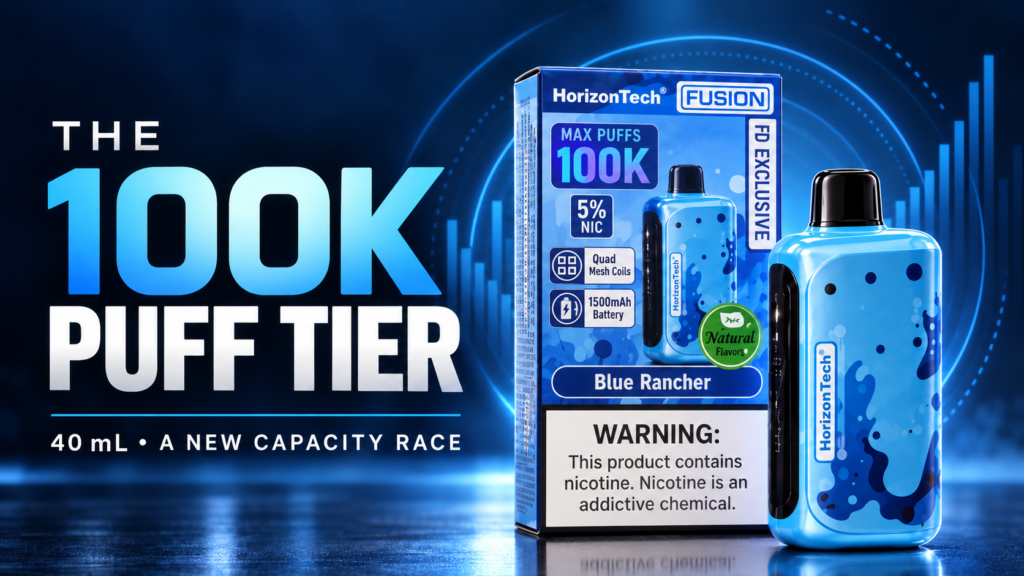
For most of 2026 the top of the disposable shelf was 50,000 puffs. It now has a floor above it. The device carrying the tier in the US is the HorizonTech 100K: 40mL of prefilled e-liquid, a 0.8Ω quad mesh coil, a 1500mAh rechargeable cell, and a rating of 100,000 puffs in Regular mode. It is listed at $17.99 on Element Vape, $17.85 on VaporDNA and $17.98 on Vape Juice Depot — a tight band that tells you the MSRP is holding.
What is not happening is a rush. Searching the US retail shelf for genuine 100,000-puff disposables turns up the HorizonTech, an iJoy XP100K sold as a pod system rather than a one-piece unit, and a handful of grey-market names like the WASPE Double Flavor 100K Pro that are hard to verify and harder to buy legitimately. Compare that with the 50K tier, where Geek Bar, Lost Mary, NEXA, Flum, Foger and American Standard all shipped competing devices inside a year. The 100K tier today is one device with a category to itself.
That gap is the story. If 100K were simply the next rung, the same six brands would already be on it.
Why 40mL is the number, not 100,000
Puff ratings are produced on a machine taking short, standardized draws. They are not comparable between brands, they are not reproducible by a human, and every serious retailer already knows it. Millilitres are comparable, because a milliliter is a milliliter.
Here is what the jump actually looks like, using only figures the manufacturers themselves publish:
| Device | Rated puffs | Published e-liquid | Battery |
| HorizonTech 100K | 100,000 / 60,000 Boost | 40mL | 1500mAh |
| Geek Bar Pulse X 2 50K | 50,000 | 28mL | 850mAh |
| American Standard 50K Kit | 50,000 | 23mL | 850mAh |
| Geek Bar Mate 60K | 60,000 | Not published | Not published |
Two things fall out of that table. The first is that 40mL is a real step — not the 2× the puff count implies, but roughly 1.4 to 1.7× the 50K class, which is a lot of liquid to put in one sealed shell. The second is that half the class still does not publish capacity at all, which is why a puff number nobody can verify remains the industry’s favourite unit of measurement. We made the same point looking at the 50K shelf in American Standard 50K Kit vs This Bar, where one device discloses and the other doesn’t.
The rating halves in Boost, and that is printed on the box
HorizonTech does something most of this class avoids: it publishes both modes. Regular runs around 30W and carries the 100,000 rating. Boost runs around 40W and is rated at roughly 60,000 from the same 40mL.
Read plainly, the device is a 60K you can stretch to 100K by leaving it alone. That is a defensible claim and an unusually honest one — but it also means the number on the front of the box describes the gentlest possible use of the product. Retailers fielding “it didn’t last” complaints will be explaining power modes, not defending a lie.
What it does to cost per puff
The economics are the reason this tier exists at all.
| Device | Typical US price | Cost per 1,000 rated puffs |
| HorizonTech 100K (Regular) | $17.99 | $0.18 |
| HorizonTech 100K (Boost) | $17.99 | $0.30 |
| NEXA Ultra 2 50K | $15.75 | $0.32 |
| American Standard 50K Kit | $18.99 | $0.38 |
| Geek Bar Pulse X 2 50K | $22.99 | $0.46 |
Eighteen cents per thousand is roughly half the best 50K number and a third of the worst. For a shopper who does the arithmetic, there is no argument. Our running cost-per-1,000-puffs ranking across 20 devices puts this in context: nothing in the 20K–60K range gets under $0.28.
The catch, and it is the whole reason the tier is thin, is that this arithmetic is the manufacturer’s to lose. A device rated at 100,000 puffs that people abandon at 40,000 because they got bored of the flavor has an effective cost per puff of $0.45, and the brand has no way to stop that happening.
“Disposable” stopped being accurate several tiers ago
A 1500mAh cell cannot vaporize 40mL of liquid on one charge. Not within an order of magnitude. Every 100K device is a sealed rechargeable that gets thrown away when the liquid runs out, which is a different product category from the cig-a-like the word “disposable” was coined for, and a different one again from the 600-puff bars regulators wrote their first rules about.
We traced this drift when screens, USB-C and adjustable airflow arrived in smart disposable vapes in 2026. The 100K tier completes it: at 40mL, the on-device liquid gauge stops being a feature and becomes a necessity, because there is no way to judge that much liquid by eye.
Shelf economics: fewer units, deeper commitment
For a retailer, doubling capacity per unit does not double anything good. It halves reorder frequency, which is the metric small vape shops actually live on.
A customer on 50K devices comes back roughly twice as often as the same customer on a 100K. Basket value per visit goes up a little; visits go down a lot; and every visit is an opportunity to sell a second item. Shops that have already moved to $/mL rather than $/unit as their planning number will see this coming. Shops thinking in units will notice it as a quiet decline in footfall three months from now.
The flavor side is sharper still. Forty milliliters is two to six months on one flavor, depending on the user. That means a 100K SKU needs fewer facings but far better ones, because a shopper choosing a flavor here is making a decision they cannot walk back. Brands respond by widening the line — HorizonTech lists past thirty flavors — which is how 100,000-puff disposables push inventory risk straight back onto the retailer, who cannot stock thirty facings of a device that sells every six months.
The sensible pattern, and the one we are seeing, is a narrow trial run: a handful of flavors, a few units each, and a decision to restock made on evidence rather than on the brand’s flavor chart.
The compliance surface of a 40mL sealed device
None of the high-puff disposable shelf carries FDA marketing authorization. That is not specific to the 100K tier — the authorized ENDS list remains short and contains almost no disposables — but capacity changes how the category looks to anyone writing rules.
Forty milliliters at 5% is a large quantity of nicotine in one consumer unit, and volume is the kind of number that ends up in legislation precisely because it is unambiguous in a way puff counts never are. The EU already caps tank capacity at 2mL under TPD; several US state product-directory regimes ask for capacity on the registration form. A tier built on volume is a tier whose defining specification is also the easiest one for a regulator to write a limit against.
The practical exposure for US retailers is nearer term and more boring: state product directories, flavor restrictions that apply regardless of capacity, and import screening that has tightened through 2026. 100,000-puff disposables are not more illegal than a 50K device. They are simply more conspicuous.
What the tier still needs to disclose
Three things would make the 100K tier assessable rather than merely impressive, and HorizonTech already does two of them:
- E-liquid capacity on the front of the box. Published by HorizonTech and by American Standard; absent on much of the 50K and 60K shelf, including the Geek Bar Mate 60K.
- Both power modes’ ratings, side by side. HorizonTech prints 100,000 / 60,000. Most brands print only the higher number and let you discover the other one.
- The draw standard behind the puff count. Nobody publishes this, which is why no two brands’ puff numbers can be compared. Until it changes, cost per milliliter is the only honest cross-brand metric.
Where this goes next
If 100K works commercially, the 50K brands will follow within two quarters — they have the supply chains and the coil technology, and quad mesh is not exotic. If it doesn’t, the reason will be flavor fatigue rather than engineering: a device people stop using at 40% of its rated life is a bad product no matter how cheap the arithmetic looks on the shelf edge.
Either way, the useful takeaway for anyone buying or stocking 100,000-puff disposables is to stop reading the number on the front. Read the milliliters, read both power modes, and divide.
The device driving the tier is on sale in the US now — HorizonTech 100K at $17.99 — and our retail desk put it through a full consumer review, flavor by flavor, at HorizonTech 100K review: 40mL, 100,000 puffs and all nine flavors.
Frequently asked questions
What is a 100K puff vape?
A sealed rechargeable vape rated for around 100,000 puffs by the manufacturer, achieved by holding far more e-liquid than a standard disposable. The HorizonTech 100K, the device defining the tier in the US, holds 40mL and runs a 0.8Ω quad mesh coil off a 1500mAh USB-C rechargeable battery.
How much e-liquid is in a 100,000-puff vape?
40mL in the HorizonTech 100K. For comparison, the Geek Bar Pulse X 2 50K publishes 28mL and the American Standard 50K Kit publishes 23mL. Capacity, not puff count, is the only figure that can be compared across brands.
Are the puff claims on 100,000-puff disposables accurate?
They are laboratory ratings taken with short machine draws, so they describe a ceiling rather than an average. HorizonTech’s own figures make the point: the same 40mL is rated 100,000 puffs in Regular mode and about 60,000 in Boost. Real use lands between the two depending on draw length and mode.
How many 100K devices are actually on sale in the US?
Very few. The HorizonTech 100K is the one widely stocked by mainstream US online retailers. An iJoy XP100K exists as a pod system rather than a one-piece unit, and other 100K-labelled names are hard to verify through legitimate distribution.
Is a 100K vape cheaper per puff than a 50K?
Substantially. At $17.99 the HorizonTech 100K works out to about $0.18 per 1,000 rated puffs in Regular mode, against $0.32 to $0.46 for the 50K devices in the same price band. In Boost mode it rises to about $0.30, which puts it level with the better 50Ks.
Are 100K disposables FDA authorized?
No. The FDA’s authorized ENDS list contains almost no disposable products of any capacity, so this is a category-wide position rather than something particular to the 100K tier.
Why would a retailer avoid stocking 100K devices?
Because they halve reorder frequency and multiply flavor risk. A 40mL device is two to six months of use on a single flavor, so each SKU sells rarely and a wrong flavor choice sits on the shelf for a long time. Narrow trial runs rather than full flavor walls are the rational response.
Is a 100K vape still a disposable?
Only by convention. A 1500mAh battery cannot vaporize 40mL of liquid on one charge, so the device is recharged many times and then discarded when the liquid is gone. It is a sealed rechargeable with a fixed lifespan, which is a different product from the disposables the category’s rules were written around.
Specifications are the manufacturers’ published figures. US pricing checked against Element Vape, VaporDNA and Vape Juice Depot listings on 28 September 2026. VapeTrends360 covers the trade; commercial links are marked. Adults 21+ only. Nicotine is an addictive chemical.
VapeTrends360 Weekly Brief
Stay Ahead of the Industry
Get the news before it becomes a problem.
- FDA enforcement updates
- New product launches
- Market trends
- Retailer insights
Join industry professionals who want the news before it becomes a problem. Free. Unsubscribe anytime.