FDA Authorizes First-Ever Non-Tobacco Vapes: Glas ENDS Get Green Light Under New Age-Gating Standard
After five years of denied applications and a Supreme Court ruling, the FDA has cracked the flavor ceiling — but only for products that solve youth access at the device level.
What you need to know in 30 seconds
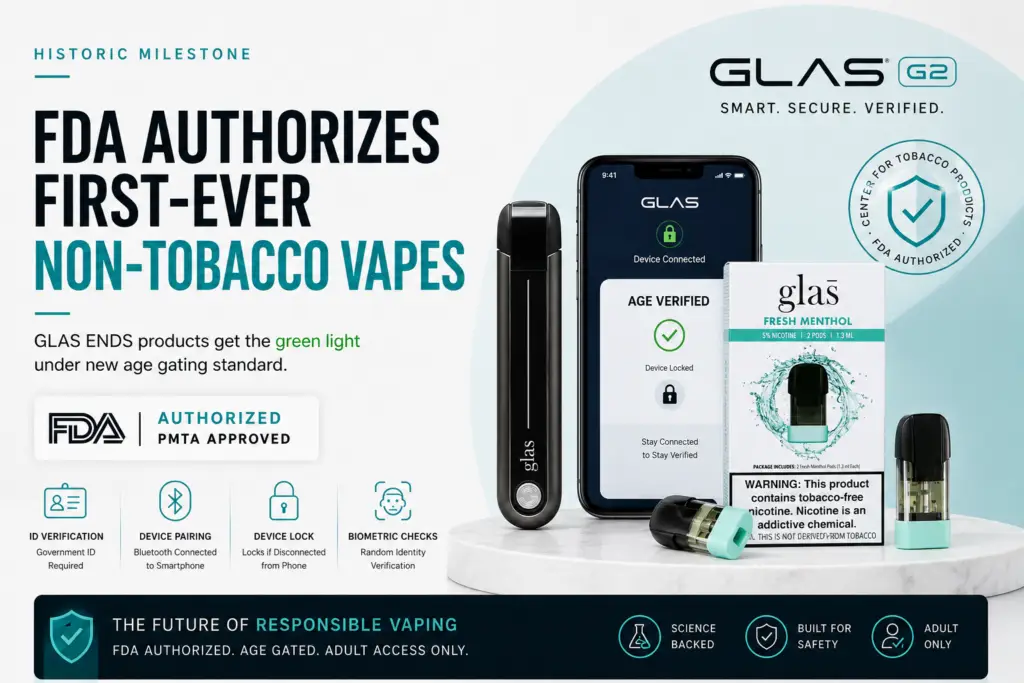
- First non-tobacco, non-menthol authorization ever. Four Glas pods cleared PMTA on May 5, 2026 — Classic Menthol, Fresh Menthol, Gold (mango), and Sapphire (blueberry) at 50 mg/mL nicotine.
- Total authorized ENDS now stands at 45. Glas joins JUUL, Vuse, NJOY, and Logic on the FDA’s official legal list — see our complete FDA-authorized product database.
- Approval hinges on device-level age verification. Government ID + Bluetooth phone pairing + biometric check-ins set the new template.
- Strict marketing conditions apply. All advertising must target adults 21+, with mandatory FDA reporting on audience demographics.
- Retailers should update SKU lists immediately. All other unauthorized fruit and dessert disposables remain illegal.
A Watershed Moment for U.S. Vape Regulation
After more than five years of denied applications, federal lawsuits, and a Supreme Court ruling that upheld the FDA’s hard line on flavors, the agency has finally crossed a threshold the entire industry has been watching for. On May 5, 2026, the U.S. Food and Drug Administration authorized the marketing of four Glas ENDS products through the Premarket Tobacco Product Application (PMTA) pathway — including, for the first time ever, non-tobacco and non-menthol flavors: Gold (mango) and Sapphire (blueberry).
This is not a small administrative update. As VapeTrends360 has reported in our prior coverage of the FDA Vape Enforcement Plan 2026, the draft flavor-specific PMTA framework, and the May 11 FDA public-comment deadline, the legal U.S. ENDS market has been frozen at tobacco and menthol for years. Today’s marketing granted orders crack that ceiling — but only narrowly, and only for products that solve the youth-access problem at the device level.
What the FDA Actually Authorized
Each authorized product is an e-liquid pod containing 50 mg/mL (5%) tobacco-derived nicotine, paired with the Glas G2 device:
With these orders, the FDA’s authorized ENDS list now contains 45 products — the only e-cigarettes that may be lawfully sold in the United States. The full list is maintained at fda.gov/authorizedecigs.
Why This Decision Is a Major Policy Shift
To understand why the Glas authorizations are a watershed moment, it helps to remember where the FDA started. Of the more than six million ENDS products submitted under the September 2020 PMTA deadline, the agency has historically authorized only tobacco- and menthol-flavored products. Tens of thousands of fruit, candy, and dessert SKUs received marketing denial orders — the legacy this decision is now beginning to unwind. Our enforcement actions and warning letters tracker documents how aggressively the FDA has pursued unauthorized products since then.
In 2025, the U.S. Supreme Court upheld the FDA’s denials in FDA v. Wages and White Lion Investments, confirming the agency could lawfully reject flavored ENDS applications. That ruling effectively closed the door on most flavored PMTAs filed under the old framework — until March 2026, when the FDA published draft guidance outlining a graduated, risk-proportionate framework for flavored ENDS.
The new logic: solve the youth problem at the hardware level
In its press release, the FDA was explicit about the logic that allowed Gold and Sapphire to clear the bar:
By helping to prevent youth use, device access restrictions are a potential game changer. This technology is also an indication of the role innovation may serve in the effort to protect young people from threats posed by nicotine use and addiction while helping to enable availability of an expanded array of flavored options for adults who smoke.
— Bret Koplow, Acting Director, FDA Center for Tobacco Products
In other words: the FDA didn’t soften its view that fruit flavors carry youth-appeal risk. Instead, it accepted that a sufficiently robust hardware-and-software gate can mitigate that risk enough to let an adult-quitting benefit win the cost-benefit calculation.
How Glas’s Device-Level Age Verification Works
The technical specification described in the FDA’s order is the most stringent age-gating system ever attached to a U.S. ENDS authorization. It has four layered components:
Government ID Verification
User uploads valid government-issued ID through the companion app. A selfie is matched to the ID photo.
Bluetooth Pairing
The Glas G2 device only operates while in Bluetooth proximity to the verified user’s paired phone.
Biometric Check-Ins
The app periodically prompts the registered user to confirm identity, blocking shared or transferred use.
Targeted Advertising
Marketing must reach 21+ verifiable channels only, with full demographic reporting to the FDA.
The FDA’s review found that most adults aged 21+ successfully completed verification while youth and young adults could not. That usability gap — adults pass, minors fail — is the empirical basis for the agency’s confidence that the system materially reduces youth-access risk.
If you’re a wholesale buyer, this is the critical signal: future flavored authorizations will likely require comparable hardware/software gating. Disposable formats with no app, no Bluetooth, and no biometric layer are unlikely to clear the bar in the near term. Compliance-focused wholesalers like B&J Wholesale already publish regulatory intelligence on FDA enforcement and SKU-level compliance for licensed retailers preparing for this transition.
The Political Context Behind the Decision
The FDA’s announcement did not arrive in a vacuum. Major news outlets reported that on the same day the marketing orders were issued, President Donald Trump publicly rebuked FDA Commissioner Marty Makary, MD, MPH, for not moving quickly enough to authorize flavored vapes — a campaign promise Trump had repeatedly described as his pledge to “save” vaping. Earlier reporting indicated that Makary had been holding back on the Glas products even after FDA scientific reviewers had cleared them.
By the evening of May 5, the agency moved. Industry observers reading the public record see a decision that combines genuine scientific findings about the Glas age-gating system with clear political pressure to act. Both can be true simultaneously, and both matter for forecasting what’s next.
Health advocacy groups — including the Truth Initiative and the Campaign for Tobacco-Free Kids — have framed this as a “key test case,” warning that the agency must monitor youth-uptake data closely and pull authorization if it rises.
What This Means for You
Adult Consumers (21+)
- The four Glas pods are now legally available alongside other FDA-authorized closed-system vapes.
- Use requires a smartphone, Bluetooth pairing, and identity verification — closed-loop, single-user.
- FDA stresses authorization is not endorsement. Non-users should not start.
Vape Retailers
- Update your point-of-sale and online catalogs immediately — only the four Glas SKUs are eligible.
- Maintain robust 21+ ID verification, especially in directory-enforcement states.
- Document chain-of-custody and source only from licensed, compliant distributors.
Wholesalers & Distributors
- Reassess inventory mix. Compliance-led catalogs are the lowest-risk lane.
- Watch the warning-letter trail — wholesale platforms have been flagged as recently as 2025.
- Use compliance-aware partners like B&J Wholesale and VapeOwls.
Manufacturers with Pending PMTAs
- The Glas template is now the de facto benchmark for flavored authorizations.
- Tobacco/menthol applications without device-level gating remain reviewable on traditional grounds.
- Sweeter flavors will require even stronger adult-benefit evidence and gating.
By the Numbers: The U.S. ENDS Landscape in May 2026
The youth-vaping decline is central to the FDA’s evolving posture. With teen use at a decade low while ~25 million adults still smoke combustibles, the agency faces growing pressure to expand rather than restrict the legal alternatives available to adults trying to switch — provided youth-protection guardrails hold.
What Happens Next
Active FDA monitoring
The agency will track underage use, marketing-audience demographics, and Glas’s compliance with all post-market reporting. Authorization can be suspended or withdrawn.
More flavored applications, but slowly
Other manufacturers with similar device-level age-gating — and pending PMTAs that include menthol or tobacco-adjacent mature flavors — are now in a stronger position.
Continued enforcement against unauthorized disposables
The FDA, CBP, and state partners continue seizures, warning letters, and import refusals. Track the latest in our enforcement actions hub.
State-level patchwork persists
Even FDA-authorized products can face state-directory exclusions or flavor restrictions. See our ongoing state vape regulations coverage.
Frequently Asked Questions
What did the FDA actually approve on May 5, 2026?
Is this the first time the FDA has authorized fruit-flavored vapes?
Does this mean other fruit-flavored disposables are now legal?
What is the Glas age-verification system?
How many e-cigarettes are now FDA-authorized in the U.S.?
Can I buy Glas Gold or Sapphire pods at any vape shop?
Will more flavored vapes get authorized soon?
Can the FDA take the authorization back?
What does this mean for unauthorized disposables already on shelves?
Where can I read the FDA’s official announcement?
The Bottom Line
The Glas authorizations are not a flavor-ban reversal. They are a technology-conditional unlock — a signal that the FDA is willing to approve non-tobacco flavors when, and only when, manufacturers build a youth-access barrier directly into the product. For adult smokers seeking alternatives, the legal flavor catalog just expanded for the first time. For the broader industry, the message is clear: the next wave of authorizations will reward hardware-and-software innovation, not flavor variety alone.
Related on VapeTrends360
Continue reading our independent coverage of the U.S. vape market.
Stay ahead of every PMTA decision.
VapeTrends360 tracks every FDA marketing order, denial, and state-level regulatory development as it happens.
Get weekly updatesSources & References
- U.S. FDA Press Release — FDA Expands Market Access, Authorizes New ENDS Products (May 5, 2026)
- FDA Authorized E-Cigarettes List
- FDA Searchable Tobacco Products Database
- VapeTrends360 — U.S. Vape Policy Update Spring 2026
- VapeTrends360 — US Federal & National Policy Hub
- VapeTrends360 — State Vape Regulations Hub
- B&J Wholesale — Industry Compliance News
- VapeOwls — Online Vape Store
VapeTrends360 Weekly Brief
Stay Ahead of the Industry
Get the news before it becomes a problem.
- FDA enforcement updates
- New product launches
- Market trends
- Retailer insights
Join industry professionals who want the news before it becomes a problem. Free. Unsubscribe anytime.