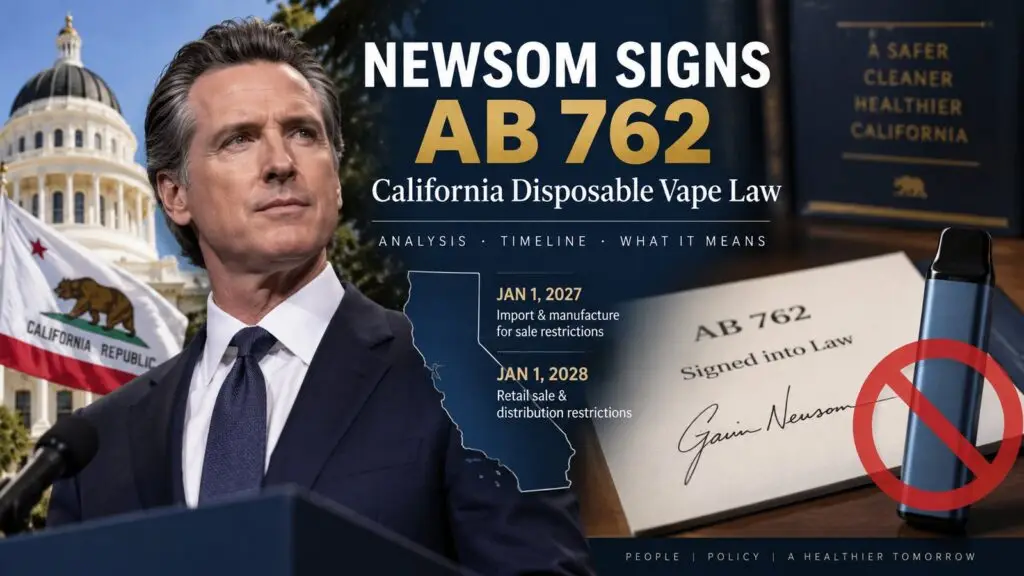
- SignedSeptember 28, 2026, by Governor Gavin Newsom. Now Chapter 717, Statutes of 2026.
- What is bannedNicotine vaping devices not designed for reuse that are either non-refillable or non-rechargeable.
- January 1, 2027No importing or manufacturing these devices for sale in California.
- January 1, 2028No selling, distributing, or offering them for sale.
- Penalties$500, $1,000, then $2,000 per violation, or an infraction of up to $500; tobacco license can be suspended or revoked.
- ExemptCannabis vaping devices and FDA-regulated medical devices.
What the California disposable vape law actually says
The headlines say “single-use, battery-powered vapes.” The statute is broader than that phrase suggests, and the difference matters for anyone who has to comply with the California disposable vape law. AB 762 defines a “disposable, battery-embedded vapor inhalation device” as a nicotine vaporizer that is not designed to be reused and that is either non-refillable or non-rechargeable. The word is “or.” A 50,000-puff device with a USB-C port is still banned, because it cannot be refilled. That covers essentially the entire high-puff disposable category as it exists on shelves today.
- January 1, 2027: no person may import or manufacture these devices for sale in California.
- January 1, 2028: no person may sell, distribute, or offer them for sale.
- Penalties: civil fines of $500 for a first violation, $1,000 for a second, $2,000 for each after that, or an infraction of up to $500. Cities, counties, or the state may enforce, and the Department of Tax and Fee Administration may suspend or revoke a tobacco license.
- Exempt: cannabis vaping devices, and FDA-regulated medical devices.
- Still legal: rechargeable devices that take replaceable pods or refillable tanks, and open-system hardware.
For the full timeline and retailer checklist, see our explainer, California Disposable Vape Ban: AB 762 Timeline, Penalties and What’s Next. This piece is about whether the law will do what its authors say it will.
The part the industry should concede
The waste problem is not invented. CalPIRG’s estimate, cited in the Associated Press coverage of the signing, is that nearly 500,000 disposable vapes are thrown away every day in the United States. Each one carries a lithium-ion cell that cannot legally go in household trash, almost never gets recycled, and is a known ignition source in collection trucks and sorting facilities. Assemblymember Jacqui Irwin, the bill’s author, framed the measure as keeping battery chemistry out of land and waterways. That is a legitimate public interest, and an industry that has spent years asking to be treated as a serious consumer-products category cannot simultaneously argue that its packaging should be exempt from the rules that apply to every other battery-powered product.
Trade groups made the wrong argument against this bill. The Neighborhood Market Association’s Arkan Somo asked where the environmental rationale would stop; the California Grocers Association warned of smuggling and the burden on family-owned stores. Those are real costs, but they are arguments about who pays, not about whether the problem exists. The stronger objection to the California disposable vape law is not that the goal is wrong. It is that this particular tool has already been tested, and it did not work.
The United Kingdom already ran this experiment
The UK banned disposable vapes on June 1, 2025, using a definition very close to California’s: a legal device has to be both rechargeable and refillable. Fifteen months later the trade data tells a clear story.
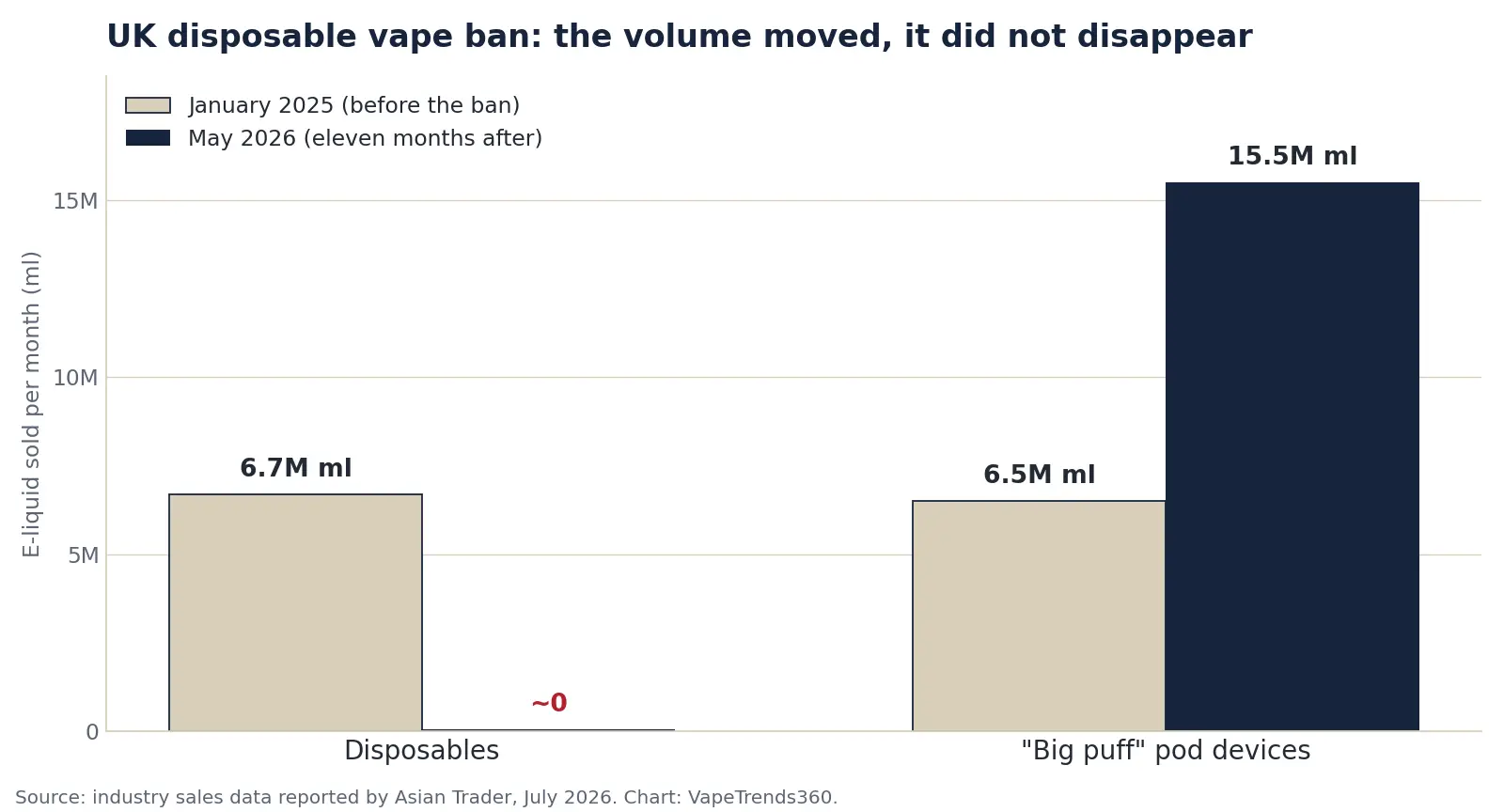
Industry figures reported by Asian Trader in July 2026 show that e-liquid sold in disposables fell from 6.7 million milliliters in January 2025 to almost nothing by May 2026, while e-liquid sold in “big puff” pod devices rose from 6.5 million to 15.5 million milliliters over the same period. Sales of the new format were up roughly 70 percent. Total consumption did not move.
The waste did not fall either
The environmental outcome is the part California should study most carefully. Material Focus, the UK’s electrical-waste body, still counts about 6.3 million vapes discarded every week. Suez, one of the country’s largest waste operators, logged 670 fires across its UK sites in 2025, 368 of them confirmed as battery or vape related and another 176 suspected. Material Focus executive director Scott Butler summed it up in one phrase: the “vapocalypse” continues. The devices that replaced disposables have the same batteries, the same form factor, and, judging by the fire data, the same afterlife in the waste stream.
The only thing that changed is that the pod now clicks out of the body.
There is no reason to expect California to be different. The manufacturers who supplied the UK’s transition draw on the same Shenzhen manufacturing base that supplies the U.S. market, and the pod-kit versions of the most popular American devices already exist. Geek Bar’s Mate 60K and Foger’s Switch Pro 30K are rechargeable devices with swappable pods that are, under AB 762’s definition, perfectly legal. Any brand that has not already filed the California-compliant variant of its best seller will have done so long before January 2027.
Why a third law changes less than the first two did
Here is the uncomfortable context that the signing coverage left out. Most of the disposable devices AB 762 bans are already illegal to sell in California, twice over.
Already prohibited, twice over
First, federally. Every e-cigarette on the U.S. market needs a marketing order from the FDA. As of this writing, the only disposable e-cigarettes that hold one are NJOY’s Daily models. Not one of the 20,000- to 100,000-puff devices that dominate convenience-store shelves has authorization, which means every one of them is, in the FDA’s own language, an unauthorized tobacco product subject to seizure. Second, at the state level. California has prohibited flavored tobacco sales since December 2022, and the Attorney General now maintains an Unflavored Tobacco List; anything not on it is subject to seizure and penalties. The overwhelming majority of disposables are flavored.
So the products AB 762 targets are already prohibited by federal law and, in most cases, already prohibited by California’s own flavor law. They remain on shelves anyway. That is the whole point. The binding constraint on disposable vapes in California has never been the number of statutes on the books; it has been the capacity and will to enforce them at the port, the distributor, and the counter. A third prohibition stacked on two unenforced ones does not obviously change the calculus of a retailer who has already decided the first two are not worth worrying about. The realistic effect of the sales ban in 2028 is to push volume from stores that follow the rules toward stores that do not, and toward out-of-state shippers who were never going to comply.
The cannabis exemption undercuts the battery logic
The cannabis exemption makes the environmental logic harder to defend. A disposable cannabis vape carries the same embedded lithium cell as a disposable nicotine vape and ends up in the same trash can. If the harm is the battery, the exemption is inconsistent. If the exemption exists because California’s licensed cannabis industry has more effective representation in Sacramento than its tobacco retailers do, then the law is at least partly about something other than batteries, and it should be judged accordingly.
What would actually reduce the waste
None of this means the state should have done nothing. It means the state chose the intervention that is easiest to legislate and hardest to make work. Three approaches would do more for the stated goal.
1Enforce the laws that already exist, at the import layer
2Make the producer pay for the battery
3Measure the outcome, not the product count
What retailers and distributors should do now
Whatever one thinks of the policy, the compliance clock is running. For businesses that sell into California, the California disposable vape law sets a straightforward sequence.
| Date | What changes | What to do |
|---|---|---|
| Now through 2026 | Nothing yet in force | Audit every SKU against the definition: is it refillable, and is it rechargeable? If the answer to either is no, it goes on the exit list. |
| January 1, 2027 | Import and manufacture for California sale prohibited | Distributors: no new disposable inventory bound for California after this date. Plan sell-through of existing stock across the 12-month window. |
| January 1, 2028 | Retail sale and distribution prohibited | Shelves must be clear. Expect seizure authority and license action, not just fines, for anything left. |
The strategic move is to shift the assortment toward rechargeable pod systems now, while the transition is a choice rather than an emergency. Pod kits carry a lower cost per refill for the customer and, for the retailer, a repeat-purchase relationship that a sealed disposable never offered. The UK numbers suggest the customers did not leave the category when disposables disappeared; they went wherever the pod kits were already on the shelf.
Frequently asked questions
Does AB 762 ban rechargeable disposable vapes?
Yes. The law bans devices that are not designed to be reused and are either non-refillable or non-rechargeable. A rechargeable device that cannot be refilled is still banned. Only devices that are both rechargeable and accept replacement pods or refills remain legal.
When does the California disposable vape law take effect?
Importing and manufacturing disposables for sale in California is prohibited from January 1, 2027. Selling, distributing, or offering them for sale is prohibited from January 1, 2028.
Are cannabis disposable vapes included?
No. The definition applies only to devices containing nicotine and explicitly excludes cannabis and cannabis products. FDA-regulated medical devices are also exempt.
What are the penalties for selling a banned device?
Civil penalties of $500 for a first violation, $1,000 for a second, and $2,000 for each subsequent violation, or an infraction with a fine of up to $500. The California Department of Tax and Fee Administration may also suspend or revoke a retailer’s tobacco license.
Did the UK disposable vape ban reduce vaping or vape waste?
Not measurably. After the June 2025 ban, e-liquid sold in disposables fell to near zero while e-liquid sold in rechargeable pod devices more than doubled, and UK waste operators continued to report millions of vapes discarded weekly and hundreds of battery-related fires in 2025.
Sources
- Associated Press via ABC News, “Newsom signs California law banning sales of single-use, battery-powered vapes,” September 28, 2026: abcnews.com
- LAist, “Newsom signs California law banning single-use, battery-powered vapes,” September 28, 2026: laist.com
- California Legislature, AB 762 bill text as chaptered (Chapter 717, Statutes of 2026): legiscan.com
- Vaping360, “California Legislature Sends Disposable Vape Ban to Newsom,” August 31, 2026: vaping360.com
- Asian Trader, “Big Puff Vape Sales Spike After Disposable Vape Ban,” July 28, 2026: asiantrader.biz
- CSP Daily News, “California unveils unflavored tobacco list to enforce flavored tobacco ban”: cspdailynews.com
VapeTrends360 Weekly Brief
Stay Ahead of the Industry
Get the news before it becomes a problem.
- FDA enforcement updates
- New product launches
- Market trends
- Retailer insights
Join industry professionals who want the news before it becomes a problem. Free. Unsubscribe anytime.