The Federal Trade Commission has pulled the vaping industry into one of its most active consumer-protection priorities of the past two years — and this time the evidence regulators want is supply-chain paperwork, not toxicology data.
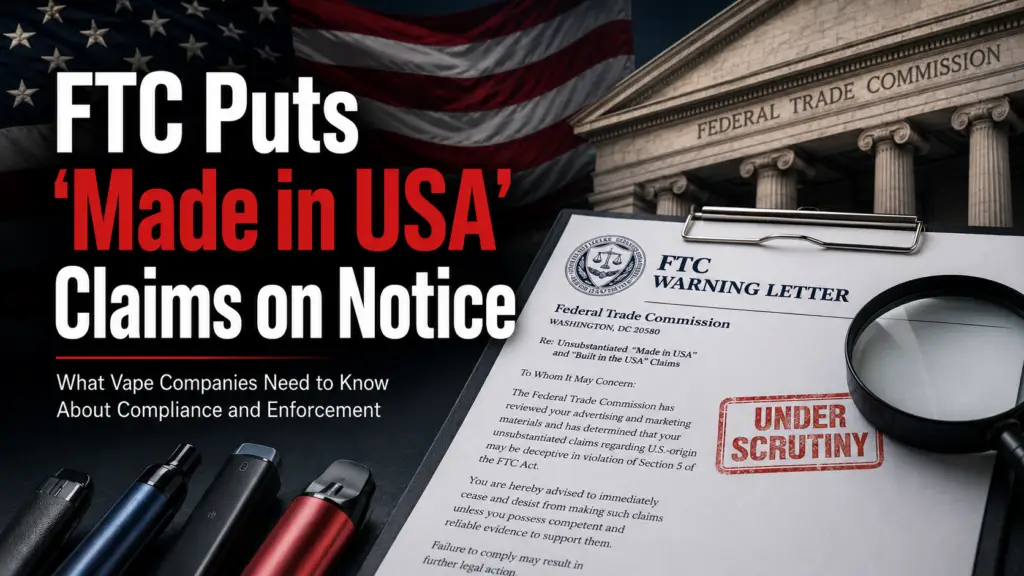
On July 6, 2026, the agency announced warning letters to seven companies over U.S.-origin advertising claims. Three of those letters went to businesses selling electronic cigarettes.
The named recipients on the vape side are NebTech Inc., which markets Reign Bar; Lucky Bar Holdings LLC, which markets Fifty Bar; and My Vape Order Inc., which markets Air Factory. In each case, FTC staff said available information suggested the products may have been imported in whole or in significant part despite unqualified American-origin messaging on websites, social media and product labeling.
Nothing in these letters is a finding of wrongdoing. The FTC states plainly in each letter that it does not reflect a formal determination that the company’s claims violate the law. But for an industry built on globally sourced batteries, chipsets, coils and housings, the message is hard to miss: if your packaging says America, you need documentation that says the same thing.
On July 6, 2026, the FTC sent warning letters to seven companies over questionable “Made in the USA” claims. Three involved vaping: NebTech (Reign Bar), Lucky Bar Holdings (Fifty Bar) and My Vape Order (Air Factory). FTC staff said available information suggested the products may have been imported in whole or in significant part. The letters are not findings of violation. Each company may be able to substantiate its claims or revise its advertising, and the FTC asked recipients to contact staff within five business days to discuss compliance. Under the Made in USA Labeling Rule, unlawful claims can lead to injunctions, consumer redress or civil penalties.
Claims cited: “Made in USA,” “#MadeinUSA,” “Built in the USA”
Claims cited: “BUILT IN THE USA,” “The Only Disposable Built in the USA,” “Proudly made in the USA”
Claims cited: “AMERICAN MADE,” “Made in America”
What the FTC Announced on July 6
The Commission said the letters went to companies selling products including drums, industrial laser machinery, coordinate measuring machines and e-cigarettes. The agency also noted that the action addressed a “Made in Texas” representation in addition to the U.S.-origin claims at issue.
Christopher Mufarrige, Director of the FTC’s Bureau of Consumer Protection, framed the initiative around consumer trust, saying the agency would hold accountable companies that undermine that trust with misleading origin claims. The press release ties the action to a broader push: an April 2026 sweep that produced three settlements involving flag products, footwear and electronic dartboards, and a March 2026 executive order directing the Commission to prioritize enforcement over unlawful “Made in USA” claims.
For VapeTrends360 readers, the significance is the category itself. Vaping products have not historically been a focus of FTC origin-claim work. Three letters in a single day suggests staff have been reviewing how disposables and pod systems are marketed to American consumers. We traced how origin marketing became a vape industry compliance question long before these letters landed.
The Three Vape Companies Named in the Warning Letters
NebTech Inc. and Reign Bar
The letter to NebTech states that available information obtained by Commission staff suggests NebTech promotes certain Reign Bar products, such as electronic cigarettes, as made in the United States. The letter identifies unqualified claims on the Reign Bar website, social media accounts and posts, and product labeling, including “Made in USA,” the hashtag “#MadeinUSA,” and “Built in the USA.”
Staff said it has reason to believe NebTech may be importing the product in whole or in significant part despite those claims, and that unless the company can adequately substantiate that “all or virtually all” of the product is made in the United States, the claims may violate the FTC Act, the Made in USA Labeling Rule and Section 45a.
Lucky Bar Holdings LLC and Fifty Bar
The Fifty Bar letter points to similar messaging across the brand’s website, social accounts and labeling. The FTC quotes claims that the product is “BUILT IN THE USA” and is “The Only Disposable Built in the USA,” along with “Proudly made in the USA.”
Notably, the letter also flags brand marketing that explains what “built in America” supposedly means — language describing manufacturing in U.S.-based facilities, sourcing through American suppliers and creation by American workers and engineers. That detail matters analytically: the agency treated the brand’s own explanatory copy as reinforcing, not softening, a broad U.S.-origin message.
My Vape Order Inc. and Air Factory
The My Vape Order letter identifies claims that Air Factory products are “AMERICAN MADE” and “Made in America.” As with the other two, the FTC said staff had reason to believe the products may be imported in whole or in significant part, and asked the company to substantiate or correct.
All three letters carry the same closing instructions: review origin representations, labeling and advertising immediately; cease conduct that could violate the law; and contact Bureau staff within five business days to discuss a compliance plan.
What “Made in USA” Actually Requires
The governing benchmark is the “all or virtually all” standard, codified for labels in the Made in USA Labeling Rule at 16 C.F.R. Part 323 and explained in the FTC’s business guidance.
Beyond that threshold, FTC guidance says the agency weighs how much of total manufacturing cost is attributable to U.S. parts and processing, how far removed any foreign content is from the finished product, and how important that foreign content is to the product’s form or function.
Cost percentages alone don’t settle it. A cheap imported part that makes the product work can defeat an unqualified claim — the FTC’s own example is a U.S.-built watch with an inexpensive imported movement. Companies also carry an ongoing duty to keep claims accurate when sourcing changes.
Why Vape Products Create a Complicated Origin Question
Consider how many discrete steps sit behind a single disposable:
Those stages routinely occur in different facilities, under different ownership, in different countries. A brand may legitimately perform meaningful work in the United States — laboratory formulation, filling, sealing, testing, batch documentation — while sourcing cells, chips and shells abroad. Absent verified documentation, no one should assume where any particular company’s components originate.
That is exactly the analytical gap the FTC’s framework probes. Filling and packaging a device domestically may be substantial commercial activity and still not equal “all or virtually all.” A battery and a control chip are not incidental to a vape; they are the product’s function. Recent disposable vape market developments show how quickly sourcing decisions change which devices reach U.S. shelves.
“Built in the USA” May Not Avoid the Same Problem
Swapping verbs is not a safe harbor. FTC guidance treats “Built in USA,” “American-made” and “Manufactured in USA” as express U.S.-origin claims, evaluated against the same standard as “Made in USA.”
Implied claims count too. The agency looks at the net impression an ad, label or post conveys — meaning flag graphics, U.S. map outlines, patriotic taglines and hashtags can communicate American origin on their own or in combination with other copy.
VapeTrends360 Weekly Brief
Stay Ahead of the Industry
Get the news before it becomes a problem.
- FDA enforcement updates
- New product launches
- Market trends
- Retailer insights
Join industry professionals who want the news before it becomes a problem. Free. Unsubscribe anytime.
Whether any particular wording is acceptable depends entirely on the underlying facts and the evidence behind the claim. This article is industry analysis, not legal advice.
What Vape Brands and Retailers Should Review Now
- Product packaging and labels
- Website product pages
- Homepage banners
- Social posts and pinned profile copy
- Influencer and affiliate content
- Distributor catalogs
- Retailer product descriptions
- Trade-show booths and signage
- Email campaigns
- Hashtags and flag imagery
- Claims inherited from manufacturers or suppliers
- Documentation supporting every origin statement
The last two items deserve emphasis. Distributors, wholesalers and online retailers frequently paste supplier copy into their own listings — and repeating an unsupported origin claim puts your own advertising at issue.
Ask for the substantiation rather than assuming it exists: component-level sourcing records, supplier certifications of U.S.-content percentages, bills of materials, cost breakdowns and assembly records. FTC guidance permits good-faith reliance on supplier information, but advises asking suppliers for specific U.S.-content percentages instead of assuming inputs are entirely domestic.
What This Signals for Enforcement Beyond the FDA
Vape compliance conversations usually revolve around PMTA authorization, youth-appeal marketing, nicotine warnings and state flavor restrictions. This action widens the frame.
Advertising and consumer protection generally — whether claims are truthful, non-misleading and substantiated.
Regulation of tobacco products under its own statutory authority, including premarket review and product standards.
Nothing in the July 6 materials indicates a joint FTC–FDA initiative, and it shouldn’t be characterized that way. What it does show is that origin marketing is now a second regulatory surface for vape brands — one where the relevant evidence is supply-chain paperwork rather than laboratory data. It sits alongside the pressures we track elsewhere: FDA enforcement actions, shifting state vape laws, and the payment processor crackdowns reshaping how brands get paid.
What Happens Next?
A warning letter is a compliance prompt. It puts a company on notice of staff concerns and invites correction; it is not an adjudication. A formal enforcement action, by contrast, is filed litigation or an administrative proceeding with formal allegations. Many matters resolve through a settlement or consent order in which a company agrees to stop specified claims and sometimes to pay money.
From here, watch for revised or removed origin claims on the three brands’ properties, public responses from the companies, any substantiation they present, and whether the Commission takes further steps. Each company may be able to support its claims or adjust its advertising, and quiet correction is a common outcome.
Frequently Asked Questions
Can a vape assembled in America be called “Made in USA”?
Only if final assembly, all significant processing and all or virtually all components are domestic. U.S. assembly of largely imported parts generally will not meet the standard.
Is “Built in USA” legally safer than “Made in USA”?
No. FTC guidance lists “Built in USA” among express U.S.-origin claims subject to the same standard.
Does a warning letter mean the company violated the law?
No. Each letter states that it does not reflect a formal determination of violation.
Can retailers be responsible for repeating a manufacturer’s origin claim?
Advertising claims a seller makes are the seller’s own. Copying unsupported supplier language creates real exposure, which is why substantiation should be requested first.
Can a company use “Designed in USA” if manufacturing occurs overseas?
Specific-process claims can be acceptable when truthful and clearly limited to that process — the FTC’s example is “Designed in USA — Made in Finland” — but they must not imply broader domestic manufacturing.
What evidence should support a U.S.-origin claim?
Competent and reliable documentation: bills of materials, supplier certifications with stated U.S.-content percentages, manufacturing cost allocations and assembly records, refreshed whenever sourcing changes.
The Bottom Line
American-origin marketing is a powerful differentiator in a category crowded with anonymous imports, which is precisely why regulators expect it to be backed by records rather than sentiment.
Three vape-related warning letters in one day do not establish that anyone broke the law — but they do establish that the FTC is reading vape packaging, product pages and social feeds. In an industry whose supply chains cross several borders before a device reaches a shelf, the safest claim is the one you can prove line by line.
- FTC press release: “FTC Warns Companies Making Questionable ‘Made in the USA’ Claims” (July 6, 2026)
- FTC warning letter — NebTech Inc. (Reign Bar)
- FTC warning letter — Lucky Bar Holdings LLC (Fifty Bar)
- FTC warning letter — My Vape Order Inc. (Air Factory)
- FTC: Complying with the Made in USA Standard
- Made in USA Labeling Rule, 16 C.F.R. Part 323
- FTC Enforcement Policy Statement on U.S. Origin Claims (1997)
- FTC Made in USA resource hub
Editorial note: VapeTrends360 is editorially independent and not affiliated with any brand named in this article. This report summarizes FTC warning letters and public agency guidance and is not legal advice. Companies with questions about their own origin claims should consult qualified counsel.