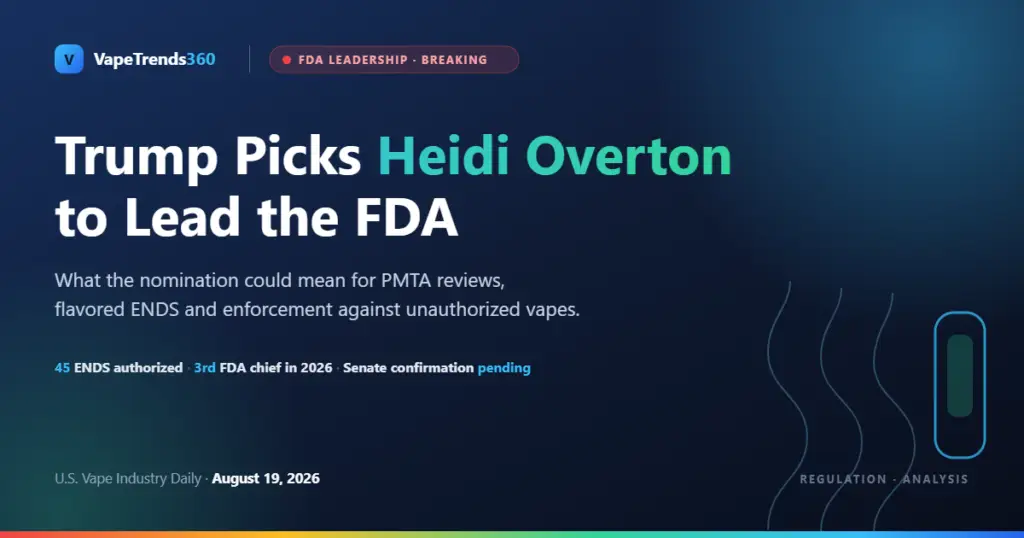
President Trump has selected White House health policy adviser Dr. Heidi Overton to lead the FDA, setting up another potential shift at an agency already undergoing major changes in tobacco regulation. For the U.S. vapor industry, the key question is whether Overton will continue — or reshape — the agency’s evolving approach to PMTA reviews, flavored products and enforcement against unauthorized e-cigarettes.
Heidi Overton is a board-certified physician and White House domestic-policy adviser whom President Trump nominated on August 19, 2026 to serve as FDA Commissioner. She replaces Marty Makary, who resigned in May 2026 after a dispute over flavored vape authorizations. Heidi Overton has stated no position on vaping, and the nomination changes nothing about which e-cigarettes are legal to sell today. Senate confirmation is still required.
Key takeaways
- What happened: Trump announced Dr. Heidi Overton, deputy assistant to the president for domestic policy, as his pick for FDA Commissioner on August 18–19, 2026. She still requires Senate confirmation.
- Why vape matters here: Her predecessor, Dr. Marty Makary, resigned May 12, 2026 amid a White House fight over how fast the FDA was moving on flavored vape authorizations.
- Who’s in charge now: Kyle Diamantas, the FDA’s food chief, has served as acting commissioner since May. CTP is led on an acting basis by Bret Koplow.
- No vape policy announced yet. Overton has made no public statement on ENDS, PMTA or flavors as of publication. Everything below is scenario analysis, not prediction.
- The five levers she inherits: PMTA review throughput, the flavored-ENDS pathway, enforcement discretion for unauthorized products, the new foreign-manufacturer registration rule, and CTP personnel.
- Bottom line for operators: nothing changes legally today. 45 ENDS products are authorized — see the complete FDA-authorized list; everything else on U.S. shelves remains unauthorized and enforceable against.
What’s in this report
- What actually happened
- Who is Heidi Overton?
- Why the vape industry cares
- FDA tobacco timeline: 2025–2026
- The 5 policy levers she inherits
- Comparison: three FDA eras
- Three scenarios for 2026–2027
- What it means for your business
- Confirmation: what happens next
- Signals to watch
- Trending searches
- Glossary of terms
- FAQs
1. What actually happened on August 18–19, 2026
President Donald Trump announced that he intends to nominate Dr. Heidi Overton — currently deputy assistant to the president for domestic policy and a deputy director of the White House Domestic Policy Council — as the next Commissioner of Food and Drugs. The announcement came via Truth Social on the evening of August 18 and was reported across Reuters, STAT, Axios and NBC News on August 19.
The nomination must clear the Senate Committee on Health, Education, Labor and Pensions (HELP) and then a full Senate floor vote. Until that happens, Kyle Diamantas — the FDA’s deputy commissioner for human foods, elevated to acting commissioner after Makary’s exit — continues to run the agency.
Overton has not announced any vape, nicotine or tobacco policy. Nothing in this report is a statement of her intentions. What follows is an analysis of the regulatory machinery she would inherit and the decision points that will reveal her direction. Treat anyone claiming to know her ENDS position today as speculation.
| Fast facts: the Heidi Overton FDA nomination | |
|---|---|
| Nominee | Dr. Heidi Overton, board-certified physician |
| Current role | Deputy assistant to the president for domestic policy; deputy director, White House Domestic Policy Council |
| Nominated for | Commissioner of Food and Drugs (FDA Commissioner) |
| Announced | August 18, 2026 (Truth Social); reported August 19, 2026 |
| Status | Senate confirmation pending — not yet in office |
| Predecessor | Dr. Marty Makary, resigned May 12, 2026 |
| Acting commissioner | Kyle Diamantas, FDA deputy commissioner for human foods |
| Acting CTP director | Bret Koplow |
| Stated vape policy | None as of August 19, 2026 |
| Authorized ENDS products | 45 (as of the May 5, 2026 Glas authorizations) |
2. Who is Heidi Overton?
Overton is a board-certified physician who joined the second Trump administration at the start of the term and has led health policy from the White House Domestic Policy Council ever since, working closely with the Department of Health and Human Services. Per STAT’s reporting, her portfolio has included the redesign of federal dietary guidance, changes to the childhood vaccine schedule, and pharmaceutical pricing negotiations. Endpoints News notes prior work with the America First Policy Institute.
What her profile suggests — and what it doesn’t
- She is a policy operator, not a career tobacco regulator. Nothing in her public record indicates deep experience with the Tobacco Control Act, the PMTA pathway, or the Center for Tobacco Products. That cuts both ways: fewer entrenched positions, but also more reliance on CTP career staff and White House direction.
- She is a White House insider. Makary’s exit was reported as a clash over agency pace versus White House expectations. A commissioner who came from inside the building is structurally less likely to end up in that same standoff.
- Her health-policy record is broad, not nicotine-specific. Food, vaccines and drug pricing have consumed her portfolio. Tobacco has not been a visible priority — which is itself a signal about where CTP might sit in her attention hierarchy.
3. Why the vape industry cares more than any other FDA-regulated sector
Because flavored vapes are the reason the last commissioner is gone.
Dr. Marty Makary resigned on May 12, 2026, roughly a year into the job. Trade and mainstream reporting converged on the same account: White House officials wanted faster movement on reduced-risk nicotine products for adult smokers, Makary’s FDA insisted on completing scientific review first, and the friction became unsustainable. MediaPost and Medical Xpress both framed the departure around fruit-flavored vape marketing decisions.
That makes the commissioner’s chair unusually consequential for this category. In most FDA sectors, the commissioner sets tone while center directors set policy. In tobacco, 2026 has demonstrated the opposite: the top of the building has been directly involved in individual ENDS marketing decisions, and it cost one commissioner his job.
Just days after Makary’s exit, Senator Jack Reed sent a May 15, 2026 letter to Acting Commissioner Diamantas demanding answers on fruit-flavored vape authorization. Congressional oversight on this file is active — which means Overton’s confirmation hearing is a near-certain venue for flavored-ENDS questioning.
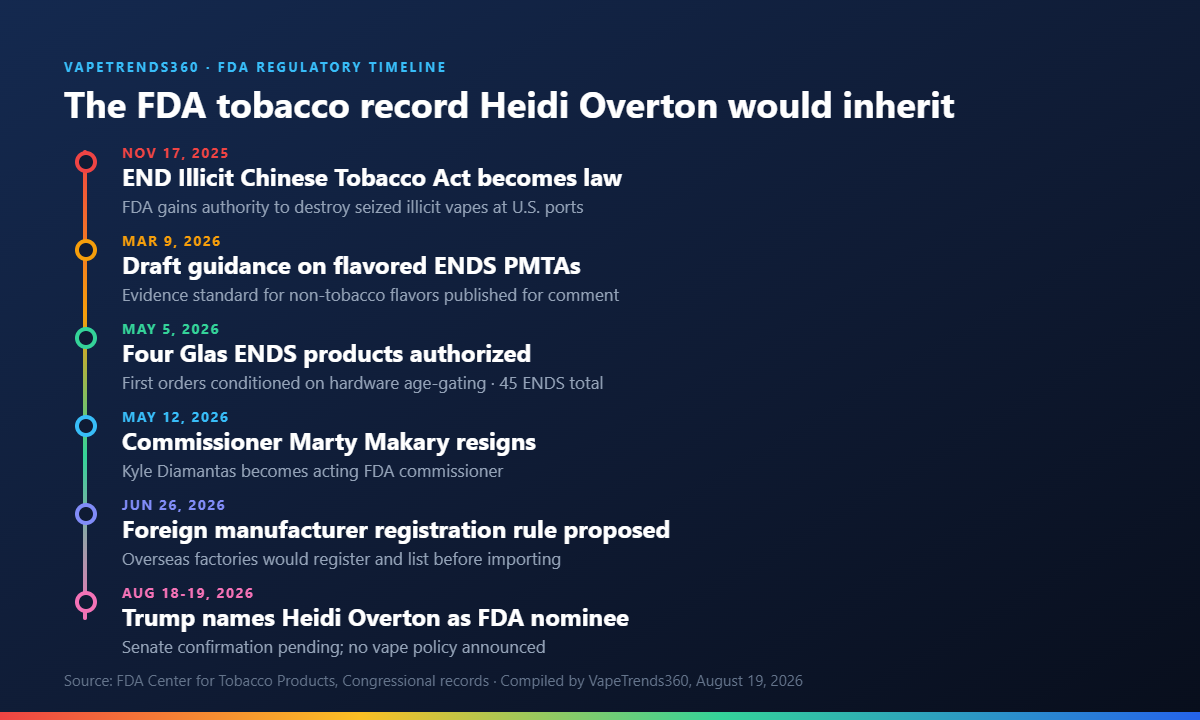
4. The FDA tobacco timeline she would inherit
To understand what a new commissioner can actually change, you need the 18-month record. This is where U.S. vape regulation stands as of August 19, 2026.
The END Illicit Chinese Tobacco Act becomes law inside the FY2026 appropriations package, giving FDA authority to destroy counterfeit, adulterated or misbranded tobacco products seized at U.S. ports — closing the loophole that let refused shipments re-enter global supply chains. (Senate release)
CTP issues draft guidance on flavored ENDS PMTAs, spelling out the evidence applicants need to show that a non-tobacco flavor doesn’t disproportionately appeal to minors. (Analysis)
FDA opens the public comment period on the flavored e-cigarette application guidance.
FDA authorizes four Glas ENDS products — the first marketing orders conditioned on hardware-level age-gating (government-ID verification, Bluetooth pairing, randomized biometric check-ins). Total authorized ENDS reaches 45. (FDA)
Commissioner Makary resigns. Kyle Diamantas becomes acting commissioner.
CTP publishes enforcement-priority guidance for unauthorized ENDS and nicotine pouch products — the document that governs which illegal products get pursued first.
FDA proposes a rule requiring foreign tobacco manufacturers to register establishments and list products before importing into the U.S. — squarely aimed at overseas disposable-vape supply. (CTP Newsroom)
FDA grants modified-risk orders for 20 ZYN products, extending the reduced-risk framework into oral nicotine.
FDA authorizes four additional nicotine pouches from Helix Innovations.
Trump names Heidi Overton as FDA Commissioner nominee.
That eight-word sentence is arguably the most important thing an FDA official said about vaping in 2026. It signals a working theory inside CTP: flavor risk can be managed through hardware and access control rather than prohibited outright. Whether the next commissioner adopts, expands or abandons that theory is the single biggest regulatory variable facing this industry. We covered the decision in depth in our report on the first-ever non-tobacco vape authorizations and the new age-gating standard.
5. The five levers a Commissioner Overton would actually control
Lever 1 — PMTA review throughput
The commissioner sets resourcing and pace expectations for CTP’s Office of Science. 2026 already saw a deliberate push on product-review efficiency, and the authorized-ENDS count moved for the first time in years. A new commissioner can accelerate this further, or let it drift while attention goes to drugs and food.
Watch: how many marketing granted orders issue in Q4 2026, and whether any come from applicants outside the big four manufacturers.
Lever 2 — The flavored-ENDS pathway
The March 2026 draft guidance is draft. Finalizing it, softening it, hardening it, or quietly shelving it are all live options. This is the lever that removed the last commissioner, and the one where a confirmation hearing answer will move the market. For state-level flavor context, see our 2026 state-by-state vape flavor ban tracker.
Watch: whether the final guidance keeps the Glas-style “access restriction as mitigation” concept.
Lever 3 — Enforcement discretion on unauthorized ENDS
Roughly everything sold in the U.S. disposable market lacks a marketing order. The May 2026 enforcement-priority guidance decides who gets hit first: importers, distributors, or retailers. With destruction authority now in statute and CBP coordination in place, this lever has real teeth. Retailers should read our guide on how to spot a fake disposable vape and our breakdown of vape payment processing after the crackdown.
Watch: whether enforcement stays import-focused or moves downstream to distribution and retail.
Lever 4 — The foreign manufacturer registration rule
The June 26, 2026 proposed rule is the structural change with the longest shadow. If finalized, overseas factories supplying the U.S. must register with FDA and list products before import. That converts an opaque supply chain into an addressable list — and gives enforcement a target set it never had. A new commissioner controls whether this rule is finalized quickly, weakened, or slow-walked.
Watch: the Unified Agenda entry and whether a final rule lands before the end of FY2027.
Lever 5 — CTP leadership and personnel
CTP has been running with an acting director. A permanent appointment is the clearest single signal of direction a commissioner can send — clearer than any speech. Watch who gets the job, and whether they come from FDA science staff, public-health advocacy, or industry-adjacent regulatory practice.
Don’t read this as vape-only. Nicotine pouches got modified-risk orders for 20 ZYN products in June and four more Helix authorizations in August — the fastest-moving authorized category in U.S. nicotine. See our full 2026 authorized pouch list and the retail margin and shelf-space data behind the pouch boom.
6. Comparison: three FDA eras, one category
The clearest way to read this nomination is against what came before it.
| Dimension | Makary FDA (2025 – May 2026) | Diamantas interim (May – Aug 2026) | Overton FDA (if confirmed) |
|---|---|---|---|
| Posture toward flavored ENDS | Science-first; authorizations gated on completed review Cautious | Continuity; existing guidance and orders carried forward Hold | Unknown — no public position stated TBD |
| Relationship with White House | Friction over pace; ended in resignation Strained | Caretaker, low political exposure Neutral | Came from inside the White House Aligned |
| PMTA throughput | Efficiency push began; ENDS count reached 45 Rising | Steady; pouch orders continued Rising | Depends on resourcing priorities TBD |
| Enforcement emphasis | Imports, seizures, destruction authority Active | Continued import-side enforcement Active | Likely continues — statutory, not discretionary Active |
| Structural reform | Foreign-manufacturer rule proposed Initiated | Comment period administration Process | Controls finalization timing Decisive |
| Tobacco as a personal priority | High — it defined the tenure High | Low — food background Low | Unproven; portfolio has been food, vaccines, drug pricing TBD |
7. Three scenarios for U.S. vape regulation, 2026–2027
Scenario framing — not forecasts. Each includes the tell that would confirm it.
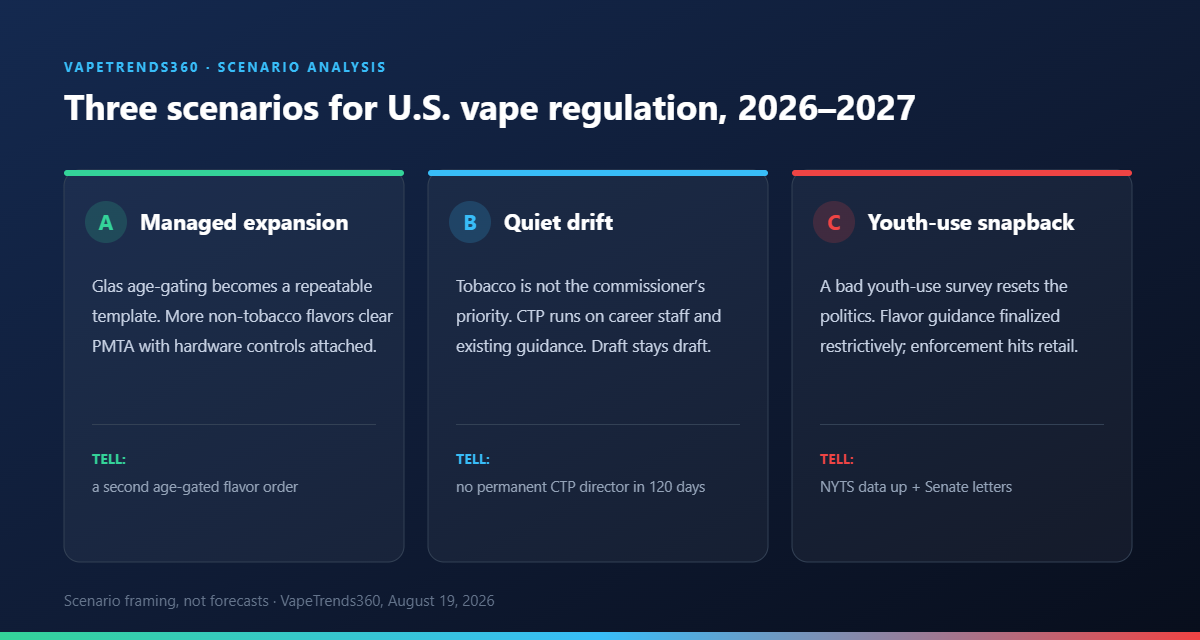
A. Managed expansion
Continuity+The Glas age-gating model is finalized as a repeatable template. More non-tobacco flavors clear PMTA with hardware controls attached. Authorized-product count climbs past 60. Enforcement hardens against everything outside that list.
Tell: a second age-gated flavor authorization from a different applicant.
B. Quiet drift
Base caseTobacco is not the new commissioner’s priority. CTP runs on career staff and existing guidance. Draft flavor guidance stays draft. The foreign-manufacturer rule advances on bureaucratic time. Nothing breaks, nothing accelerates.
Tell: no permanent CTP director named within 120 days of confirmation.
C. Youth-use snapback
Tail riskA bad youth-use survey or a high-profile incident resets the politics. FDA leans on its stated authority to suspend authorizations, the flavor guidance is finalized restrictively, and enforcement moves downstream to retail.
Tell: NYTS data trending up, plus renewed Senate letters.
8. What this actually means for your business
| You are a… | What changes today | What to do this quarter |
|---|---|---|
| Manufacturer / brand | Nothing legally. Application review continues under existing guidance. | Build the access-restriction evidence package now. The Glas precedent says hardware controls are a credible mitigation argument. Track the foreign-manufacturer rule if any production is offshore. |
| Importer / distributor | Nothing legally — but destruction authority and CBP coordination are already live. | Audit supplier registration readiness ahead of the proposed foreign-manufacturer rule. Map which SKUs have marketing orders and which don’t. |
| Retailer / c-store | Nothing legally. Enforcement priorities from May 2026 still govern. | Reconcile your planogram against the authorized list. Keep age-verification records defensible. Read the state flavor ban tracker — state law is moving faster than FDA. |
| Adult consumer (21+) | Nothing. No product became legal or illegal because of a nomination. | Buy from age-verified U.S. sellers with traceable supply. Learn to identify counterfeit disposables. |
Compliance pressure is pushing demand toward age-verified U.S. retailers with documented sourcing. Retail examples in this segment include Zovapo (disposables and pouches, with buyer guides such as its 2026 Geek Bar lineup guide and Flum lineup guide), VapeOwls (device and hardware focus — see its Off-Stamp SW9000 modular review), and B&J Wholesale for the oral-nicotine side, including its 2026 nicotine pouch buyer’s guide and wholesale accounts for licensed retailers. VapeTrends360 is editorially independent; listings are illustrative of the compliant-retail segment, not endorsements.
9. Confirmation: what happens next, and when
- Formal nomination transmitted to the Senate. The Truth Social announcement is intent; the paperwork follows.
- Referral to the Senate HELP Committee, plus financial disclosure and ethics review.
- Confirmation hearing. This is the industry’s first real information event. Expect flavored-ENDS questions from both directions — public-health senators pressing on youth use, harm-reduction-friendly members pressing on the PMTA backlog.
- Committee vote, then floor vote. Recent FDA confirmations have run roughly two to three months from announcement, though the Senate calendar governs.
- Meanwhile, the agency keeps operating. Acting Commissioner Diamantas retains authority. Marketing orders, warning letters and import alerts continue to issue.
Do not pause compliance work waiting for a confirmed commissioner. The enforcement instruments that matter most to importers and retailers — port destruction authority, import alerts, and the May 2026 enforcement priorities — are statutory or already final. They do not require a Senate-confirmed commissioner to operate.
10. Signals to watch over the next 90 days
- The confirmation hearing transcript — specifically any answer containing the words “flavor,” “youth,” or “harm reduction.”
- Whether a permanent CTP director is named, and that person’s background.
- Whether the March 2026 flavored-ENDS draft guidance moves toward final.
- The next ENDS marketing granted order — does it repeat the age-gating condition?
- The docket and Unified Agenda status of the foreign-manufacturer registration rule.
- Whether enforcement announcements shift from imports to domestic distribution.
- Youth-use survey data — the fastest way any of this reverses.
11. What people are searching right now
Search interest around this story is clustering in three buckets: the nominee herself, the practical “what’s legal now” question, and the PMTA list. If you publish or merchandise around this news, these are the phrases doing the work:
12. Glossary: the terms in this story, defined
These are the terms that decide what a change of FDA leadership can and cannot do to the vapor market.
- FDA Commissioner
- The Commissioner of Food and Drugs is the head of the U.S. Food and Drug Administration, nominated by the president and confirmed by the Senate. The commissioner sets agency priorities and resourcing, including for the Center for Tobacco Products. Heidi Overton is the current nominee for this position.
- PMTA (Premarket Tobacco Product Application)
- The application a manufacturer files to obtain FDA permission to market a new tobacco product, including e-cigarettes and nicotine pouches. FDA must find the product appropriate for the protection of public health before granting an order.
- ENDS (Electronic Nicotine Delivery Systems)
- FDA’s regulatory term for e-cigarettes, vape pens, pod systems and disposable vapes — any device that delivers nicotine as an aerosol without burning tobacco.
- Marketing granted order (MGO)
- The authorization FDA issues when a PMTA succeeds. It is the only thing that makes a vape legal to sell in the United States. Roughly 45 ENDS products hold one as of August 2026.
- CTP (Center for Tobacco Products)
- The FDA center that regulates tobacco products, reviews PMTAs and runs enforcement against unauthorized products. It reports to the FDA Commissioner and is currently led on an acting basis by Bret Koplow.
- Enforcement discretion
- FDA’s published priorities for which unauthorized products it pursues first. Because most of the U.S. disposable vape market lacks a marketing order, this document effectively decides who faces enforcement.
- MRTP (Modified Risk Tobacco Product)
- A separate FDA authorization allowing a manufacturer to make reduced-risk claims in marketing. FDA granted MRTP orders for 20 ZYN nicotine pouch products in June 2026.
13. Frequently asked questions
Who is Heidi Overton, and what is she being nominated for?
Dr. Heidi Overton is a board-certified physician and deputy assistant to the president for domestic policy at the White House. On August 18–19, 2026, President Trump announced her as his nominee for Commissioner of Food and Drugs, the top job at the FDA. The role requires Senate confirmation.
Has Overton said anything about vapes, flavors or PMTA?
No. As of August 19, 2026, she has made no public statement on electronic nicotine delivery systems, flavored vape authorizations, or the premarket tobacco application pathway. Her confirmation hearing is the first likely venue for a substantive answer.
Why did the last FDA commissioner resign over vapes?
Dr. Marty Makary resigned on May 12, 2026, after about a year in office. Reporting attributed the departure to friction with White House officials who wanted faster decisions on flavored and reduced-risk nicotine products, against an FDA insisting on completing scientific review first. It is the rare case where a specific product category directly preceded a commissioner’s exit.
Who is running the FDA right now?
Kyle Diamantas, the FDA’s deputy commissioner for human foods, has served as acting commissioner since May 2026 and continues in the role until a nominee is confirmed. The Center for Tobacco Products has been led on an acting basis by Bret Koplow.
Does this nomination change which vapes are legal to sell today?
No. Legality is determined by whether a product holds an FDA marketing granted order, not by who leads the agency. Approximately 45 ENDS products are authorized for U.S. sale. Everything else on the market is unauthorized and subject to enforcement, regardless of the leadership question.
Will flavored vapes get approved faster under a new commissioner?
Unknown, and anyone stating otherwise is speculating. The relevant fact is that FDA already authorized non-tobacco-flavored ENDS in May 2026 under a new theory: flavor risk mitigated by hardware-level age-gating. Whether that template is repeated and expanded is the real question — and it is one the next commissioner can influence heavily.
What is a PMTA, in plain terms?
A Premarket Tobacco Product Application is the submission a manufacturer files to get FDA permission to market a new tobacco product, including vapes and nicotine pouches. FDA must find the product “appropriate for the protection of public health” — weighing benefit to adult smokers against risk of youth initiation. Without a marketing granted order, the product cannot legally be sold in the U.S.
How does the foreign manufacturer registration rule affect imported disposables?
The rule FDA proposed on June 26, 2026 would require overseas tobacco-product manufacturers to register their establishments and list their products with FDA before importing. For the disposable vape category — overwhelmingly manufactured abroad — that would replace an opaque supply chain with a registry the agency can act against. It is proposed, not final; the next commissioner controls the timing.
Can FDA destroy illegal vapes at the border now?
Yes. The END Illicit Chinese Tobacco Act, enacted November 17, 2025 within the FY2026 appropriations package, extended FDA’s destruction authority to counterfeit, adulterated or misbranded tobacco products seized at U.S. ports. Previously, refused shipments could re-enter global commerce.
What should retailers do while confirmation plays out?
Treat the regulatory environment as unchanged. Reconcile inventory against the authorized-product list, maintain defensible age-verification records, track state-level flavor restrictions — which are moving faster than federal policy — and keep supplier documentation current in case the foreign-manufacturer rule is finalized.
When will Overton actually take office?
Only after Senate confirmation. The process runs through the Senate HELP Committee — paperwork, disclosures, a hearing, a committee vote, then a floor vote. Recent FDA commissioner confirmations have taken roughly two to three months from announcement, but the Senate calendar and any political opposition can extend that considerably.
21+ only. This article is journalism and general information, not legal, regulatory or medical advice. Nicotine is an addictive chemical. Products discussed are intended for adults 21 and over; nothing here is a recommendation to start or continue using nicotine. Regulatory status changes frequently — verify current authorization status against FDA’s official marketing granted orders list before making commercial decisions. Some outbound retail links are commercial third parties and are not endorsements.
VapeTrends360 Weekly Brief
Stay Ahead of the Industry
Get the news before it becomes a problem.
- FDA enforcement updates
- New product launches
- Market trends
- Retailer insights
Join industry professionals who want the news before it becomes a problem. Free. Unsubscribe anytime.