Federal Enforcement · Follow-Up Analysis
Operation Red Mist: What Came After the $175M Seizure
Two weeks on, the largest maritime vape seizure in U.S. history looks less like a one-off bust and more like the opening move of a sustained import blockade — and the enforcement is widening on every front at once.
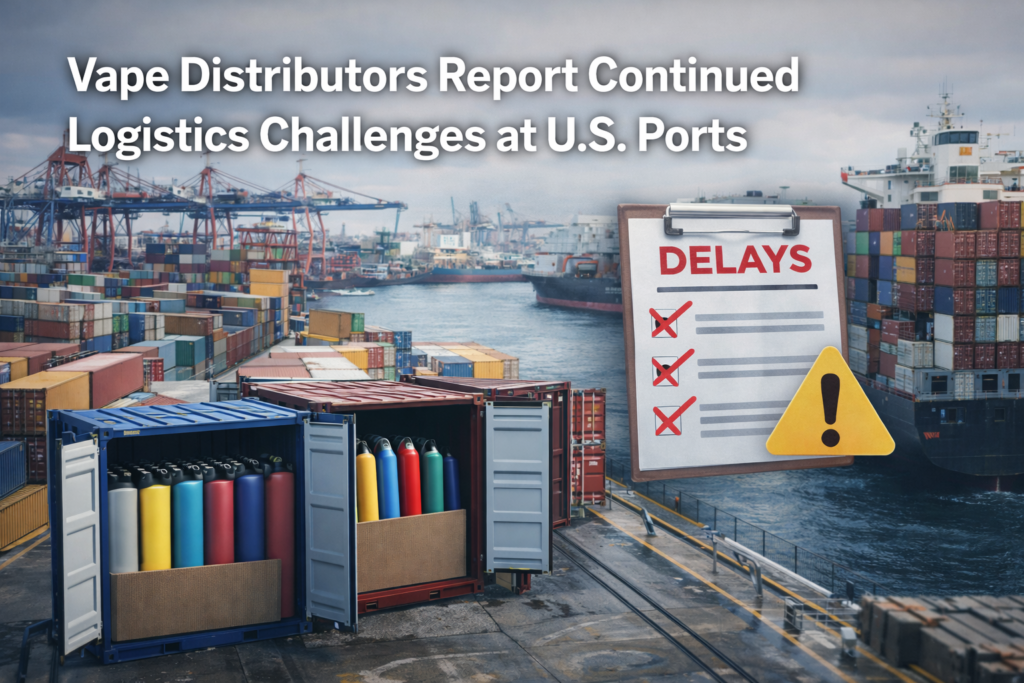
When U.S. Customs and Border Protection announced Operation Red Mist in mid-May, we called it an unmistakable signal: working alongside the U.S. Coast Guard and the FDA, federal agents seized more than 18 million unauthorized electronic nicotine delivery systems with an estimated retail value above $175 million, almost all of it routed through maritime cargo from China. That much is settled fact, confirmed in CBP's own national media release.
The more important story is what has happened since. In the two weeks following the announcement, the federal posture has shifted from a single headline seizure toward a coordinated, multi-front campaign — criminal exposure for distributors, a ground-level retail enforcement wave, a quietly widening "legal lane" of authorized products, and an explicit move to attack the supply chain upstream, at the dock and before it. Here is where things actually stand, what is confirmed, and what is still developing.
1. From seizure to prosecution: the criminal turn
The clearest directional shift is in the legal posture. For most of the past three years, federal action against illicit vapes has leaned administrative — warning letters, import alerts, and additions to public non-compliance lists. That framing is now changing.
The interagency e-cigarette task force that anchors this effort was established in June 2024 by the Department of Justice and the FDA. It is not new — but its reach is broad and built for prosecution. It draws in DOJ's Civil Division, the U.S. Marshals Service, and the ATF, plus CBP and Homeland Security Investigations, the U.S. Postal Inspection Service, and the Federal Trade Commission. The statutory toolkit spans the Federal Food, Drug, and Cosmetic Act and the PACT Act, and the violations on the table carry felony exposure and civil monetary penalties, not just paperwork.
The rhetoric has hardened to match. Attorney General Pamela Bondi has described unauthorized vapes as a "national security issue," tied the smuggling channels to products sold near schools and military bases, and signaled that recent raids were "just the beginning." A DOJ sweep in September 2025 had already pulled roughly 2.1 million products from distributors and retailers across seven states, paired with civil forfeiture actions. Red Mist extends that logic from the retail floor to the cargo container.
2. The retail enforcement wave
If the maritime seizure was the upstream blow, the FDA's parallel move is downstream — clearing the shelves. The agency's two long-standing instruments are warning letters and civil money penalty (CMP) complaints, and both are being pointed at the same brand families that dominated the Red Mist haul.
This is not theoretical. The FDA's public enforcement actions record shows hundreds of warning letters issued to online and physical retailers, repeatedly naming youth-appealing disposables such as Geek Bar and Lost Mary, alongside dozens of CMP complaints filed against manufacturers for marketing products without the required premarket authorization. None of the major disposable brands — Elf Bar, Geek Bar, Lost Mary, Breeze, Vozol — holds a marketing granted order. Every unit of them in a U.S. store is being sold outside federal authorization.
For retailers, the practical risk is no longer just a seized shipment at the port. It is a letter with the store's name on it, and a penalty calculation behind it. We track this thread in our enforcement actions & warning letters coverage.
3. The "legal lane" is widening — but it's fruit, not menthol
Running alongside the crackdown is a stabilizing move that drew far more attention: the FDA is expanding the small roster of products that can be sold legally. As of late May 2026, 45 ENDS products carry full FDA marketing authorization — up from 41 in mid-March — from a short list of manufacturers including Glas, Juul, NJOY, Logic, and R.J. Reynolds Vapor Company.
The pivot hinges on hardware, not flavor chemistry. The Glas G2 uses Bluetooth "device access restriction" age-gating: an adult verifies identity with a government ID through an app, and the device only fires when it is near that verified phone. The FDA cited this as the deciding factor — a technological answer to the youth-access problem that has blocked sweet flavors for years. As CNBC reported, the authorization also followed reported pressure from the Trump administration to "save" flavored vaping.
Read together, the message is coherent: crush the unauthorized side while opening a narrow, tightly controlled door for compliant products. We unpacked the device-level standard in FDA Authorizes First-Ever Non-Tobacco Vapes and the broader regulatory week in The Week the FDA Rewrote the Rules.
The enforcement-priorities guidance running underneath it
Days before Red Mist, the FDA also moved on enforcement priorities for unauthorized products, building on the flavored-ENDS draft guidance whose comment window we covered in our May 11 deadline analysis. The throughline for serious operators: a credible, filed PMTA is becoming the dividing line between "enforcement target" and "lower priority."
4. Market reaction: shortage, prices, and the cigarette question
A seizure of 18 million units does not vanish without a ripple. In regions where illicit disposables dominate, supply has visibly tightened as distributors struggle to move product past heightened CBP scrutiny at the ports.
Two downstream effects are worth watching — and worth labeling carefully:
- Price pressure. Trade and retail chatter points to rising street prices for illicit brands in the hardest-hit markets. Figures in the 25–40% range have circulated, but these are anecdotal regional observations, not verified national data. Treat them as a directional signal, not a statistic.
- The combustible-cigarette concern. Public-health researchers have long warned that aggressively restricting vape supply can push some adult dual-users back toward combustible cigarettes — a substitution effect documented around flavor bans and restrictions generally. It is a legitimate, evidence-grounded worry. It is not, however, a measured outcome of Red Mist specifically; no study has yet attributed a cigarette-sales bump to this operation.
For adult consumers feeling the squeeze on availability, our consumer sister-site VapeOwls maintains a plain-English explainer on what is actually happening to the big disposable brands and what is still shippable: Are Geek Bars Discontinued?
5. Upstream: the maritime blockade and the China link
The strategic core of Red Mist is that it targets the supply chain itself rather than the storefront. CBP has been explicit that enforcement is now coordinated at every stage — pre-shipment intelligence and targeting, port-of-entry inspection, and post-seizure investigation. The shipments in this haul were misclassified and mislabeled (commonly disguised to dodge taxes, duties, and detection), failed tobacco and electronics import requirements, and breached transport safety and environmental standards.
Two policy developments give that strategy teeth. First, the FY2026 agriculture appropriations package directed a dedicated $200 million FDA enforcement budget for fiscal 2026, expanding inspection and seizure-and-destruction capacity. Second, reporting indicates the Ensuring the Necessary Destruction (END) of Illicit Chinese Tobacco Act — enacted in late 2025 — gives the FDA explicit authority to destroy adulterated, misbranded, or counterfeit Chinese tobacco products rather than merely detain or return them, closing the loophole where seized goods re-enter through alternative channels.
The next phase points further up the chain: identifying the specific manufacturing and freight-forwarding operations coordinating the mislabeled containers. Notably, trade press observed that CBP's May 13 release coincided with a high-profile U.S.–China diplomatic moment — a reminder that vape enforcement now sits inside a much larger trade-and-sovereignty conversation.
What it means for retailers and distributors
The takeaways for the legal trade are straightforward, even if the environment is not:
- Origin is not a shield. "Made in USA" branding does not substitute for authorization — the FDA cares about a marketing order, not a flag. See our Made in USA compliance analysis and the "Built in USA" playbook.
- Audit your shelf against the authorized list. With 45 authorized SKUs against an estimated 6,000+ products in circulation, the overwhelming majority of inventory carries enforcement risk.
- Watch the state layer. Federal action stacks on top of state registries and flavor laws — see our California UTL Q1 2026 report.
- Lean toward compliance-friendly categories. Authorized ENDS and the fast-growing nicotine-pouch segment are where the regulatory wind is at your back.
For the wholesale view
Our B2B partner site has a distributor-focused breakdown of supply-chain exposure and the compliant-stock pivot following the seizure:
Operation Red Mist: $175M Seized — What Distributors Must Do Now (B&J Wholesale)
Timeline: how the campaign tightened
- June 2024DOJ & FDA establish the multi-agency e-cigarette task force (ATF, U.S. Marshals, USPIS, FTC, CBP/HSI).
- Sept 2025DOJ sweep seizes ~2.1M units across seven states; AG Bondi frames illicit vapes as a national-security issue.
- March 2026GAO report (GAO-26-107991) flags that DOJ criminal action still lags the market's scale; FDA-authorized count reaches 41.
- May 5, 2026FDA authorizes four Glas pods — first-ever fruit-flavored ENDS — bringing the authorized total to 45.
- May 13–14, 2026CBP announces Operation Red Mist: 18M+ units, $175M+, seized from China-origin maritime cargo.
- Late May 2026Retail enforcement intensifies; supply tightens in illicit-heavy regions; upstream factory-identification effort advances.
Frequently asked questions
What was Operation Red Mist?
A coordinated federal enforcement initiative led by CBP with the U.S. Coast Guard and the FDA. Announced in mid-May 2026, it resulted in the seizure of more than 18 million unauthorized vape units valued at over $175 million, primarily from maritime cargo shipments originating in China — the largest maritime vape seizure on record.
Are distributors now facing criminal charges, not just warnings?
The legal posture has shifted toward criminal liability. The interagency task force is empowered to pursue felony-level cases under the FD&C and PACT Acts, and DOJ leadership has publicly committed to prosecution. That said, a March 2026 GAO report found criminal actions still lagged the market's scale, so the volume of new indictments tied specifically to Red Mist is best treated as developing until charges are filed publicly.
How many vape products are FDA-authorized right now?
As of late May 2026, 45 ENDS products hold full FDA marketing authorization — up from 41 in mid-March, after four Glas pods were authorized on May 5. Against an estimated 6,000+ products in the market, that means the vast majority of disposables remain unauthorized.
Did the FDA just authorize menthol vapes?
No — menthol e-cigarettes were first authorized in 2024. The genuinely new step in May 2026 was the FDA's first-ever authorization of non-tobacco, non-menthol flavors: Glas's mango and blueberry fruit pods, made possible by the device's Bluetooth age-gating technology. The May 5 batch did also include two menthol varieties.
Why are Geek Bar and Lost Mary getting harder to find?
Neither brand has FDA authorization, both are repeatedly named in FDA warning letters and import alerts, and Red Mist removed millions of units from the supply chain. Heightened port scrutiny is restricting restocks, tightening availability in many regions.
Have illicit vape prices really jumped 25–40%?
That range reflects anecdotal, region-specific market observations rather than verified national data. Supply has clearly tightened where illicit disposables dominate, and upward price pressure is plausible — but treat any precise percentage as directional, not confirmed.
Could the crackdown push adults back to cigarettes?
It's a documented concern. Research around flavor bans and vape restrictions has long suggested that sharply limiting vape access can drive some adult dual-users back toward combustible cigarettes. No study has yet measured this effect for Red Mist specifically, but public-health researchers are watching for it.
What should compliant retailers and distributors do now?
Audit inventory against the FDA's authorized list, recognize that "Made in USA" branding is not a substitute for a marketing order, factor in state registry and flavor laws, and weight purchasing toward authorized ENDS and the nicotine-pouch category, where regulatory risk is lowest.
Sources & further reading
- U.S. Customs and Border Protection — Operation Red Mist national media release
- U.S. FDA — FDA Expands Market Access, Authorizes New ENDS Products (May 5, 2026)
- U.S. FDA — Advisory and Enforcement Actions Against Industry
- U.S. Senate Judiciary Committee — Federal multi-agency task force established
- CNBC — FDA's first approval of fruit-flavored e-cigarettes
- VapeTrends360 — Operation Red Mist: The original report
- B&J Wholesale — What distributors must do now
- VapeOwls — Are Geek Bars discontinued? (consumer guide)
VapeTrends360 provides neutral, data-forward industry analysis for retailers, distributors, and policy watchers. This article is for informational purposes only and does not constitute legal advice; compliance obligations vary by jurisdiction and change frequently — verify current requirements with the relevant agency or qualified counsel before acting. Nicotine products are intended for adults 21+. Figures described as anecdotal or developing have not been independently verified and may change as official records become available.
VapeTrends360 Weekly Brief
Stay Ahead of the Industry
Get the news before it becomes a problem.
- FDA enforcement updates
- New product launches
- Market trends
- Retailer insights
Join industry professionals who want the news before it becomes a problem. Free. Unsubscribe anytime.
Continue Reading